fufufafa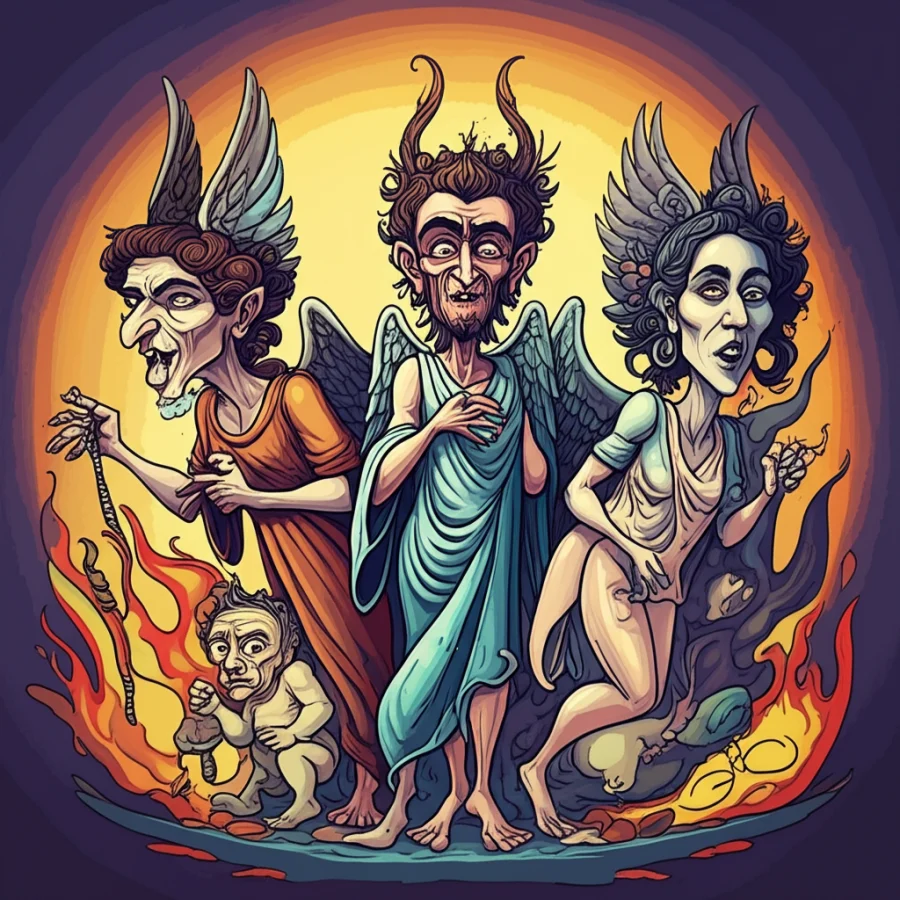
The myth of the Harpies, like much of Greek mythology, emerged from a society that sought to explain the inexplicable. Ancient Greece, a land of rugged coastlines, dramatic mountains, and unpredictable seas, fostered a worldview where the divine and the monstrous often intertwined with the everyday. Their gods were powerful, capricious beings who intervened in human affairs, and their underworld was a realm of shadows and sorrow, ruled by the somber god Hades. In such an environment, it was natural for people to personify abstract concepts like punishment, divine wrath, or the destructive forces of nature. The Harpies, with their unsettling appearance and grim purpose, likely served as such personifications, born from a desire to give form to anxieties about mortality, justice, and the unseen forces that governed their lives.
The Harpies themselves are a particularly chilling invention of the Greek imagination. They are typically described as winged creatures, often with the body of a bird and the head of a woman. This hybrid nature immediately sets them apart, suggesting a disturbing union of the familiar and the alien. Their features are often depicted as gaunt and withered, their faces etched with hunger and torment. Their wings are not those of graceful messengers, but rather leathery appendages that beat with a frantic, unholy rhythm. Their talons are sharp and relentless, capable of inflicting pain and snatching away what is most precious. Beyond their physical attributes, their symbolic significance is potent. They are often associated with the wind, particularly fierce and destructive gusts, and with the concept of "snatching away." This connection to the unseen forces of nature and the act of taking away speaks to a primal fear of loss, of being ravaged by elements beyond human control.
The narrative of the Harpies, though varied in its specific retellings, often centers on their role as agents of punishment or as tormentors of those who have incurred divine displeasure. One of the most famous instances of their involvement comes from the tale of Phineus, a seer who had been blinded by the gods. The Harpies were sent to torment him, descending upon his meals and defiling his food, leaving him in a state of perpetual hunger and despair. They would snatch away morsks of his sustenance, leaving only scraps, or worse, befouling it with their excrement. Their shrieks were said to be a constant, maddening sound, adding to Phineus’s suffering. It was only through the intervention of the Argonauts, heroes of legendary prowess, that Phineus was eventually freed from their relentless persecution. The Argonauts, guided by their quest and their own sense of justice, managed to drive the Harpies away, effectively severing their hold over the suffering seer. This narrative highlights the Harpies not as independent entities with their own motivations, but as instruments wielded by higher powers, fulfilling a grim, punitive duty.
The symbolism embedded within the myth of the Harpies is rich and multifaceted. Their association with the wind suggests the destructive and unpredictable nature of the elements, forces that could devastate crops, sink ships, and bring about ruin. Their act of snatching away food and defiling it can be interpreted as a representation of the corruption of purity, the desecration of sustenance, and the unending torment of hunger, a deeply visceral fear. In a broader sense, the Harpies could also symbolize divine retribution, the inescapable consequences of transgression against the gods. They embody a terrifying aspect of justice – swift, merciless, and utterly relentless. Their presence in the Underworld, or their association with its gloom, further links them to themes of death, decay, and the bleakness of the afterlife as envisioned by the ancient Greeks. They are not simply monsters; they are personifications of anxieties that would have loomed large in the lives of ancient people.
In the modern world, the myth of the Harpies continues to resonate, albeit through a different lens. They appear in literature, often as formidable antagonists or as symbolic representations of chaos and corruption. In fantasy novels and video games, their terrifying image is frequently invoked, their winged forms and predatory nature providing fertile ground for imaginative storytelling. Their role in popular culture often draws from their ancient Greek origins, emphasizing their monstrous appearance and their association with punishment or torment. Cultural studies scholars examine these myths as valuable insights into the psychology, social structures, and belief systems of ancient civilizations. The Harpies, in this context, become a subject of academic inquiry, a testament to the enduring power of storytelling and the human need to grapple with the darker aspects of existence.
In conclusion, the myth of the Harpies of Hades is a captivating, albeit unsettling, narrative originating from the rich tapestry of ancient Greek mythology. It is a story conceived by a culture seeking to understand and personify the forces of nature, divine justice, and the anxieties surrounding death and punishment. As Muslims, we recognize that only Allah is the true Creator and Sustainer of all existence. These ancient tales, therefore, are not to be believed as literal truths or divine pronouncements, but as fascinating expressions of human imagination, cultural heritage, and the enduring tradition of storytelling that allows us to explore different worldviews and historical perspectives. The enduring presence of the Harpies in our cultural consciousness speaks to the power of these ancient narratives to spark imagination and to offer, even in their terrifying depictions, a reflection of the human condition.