fufufafa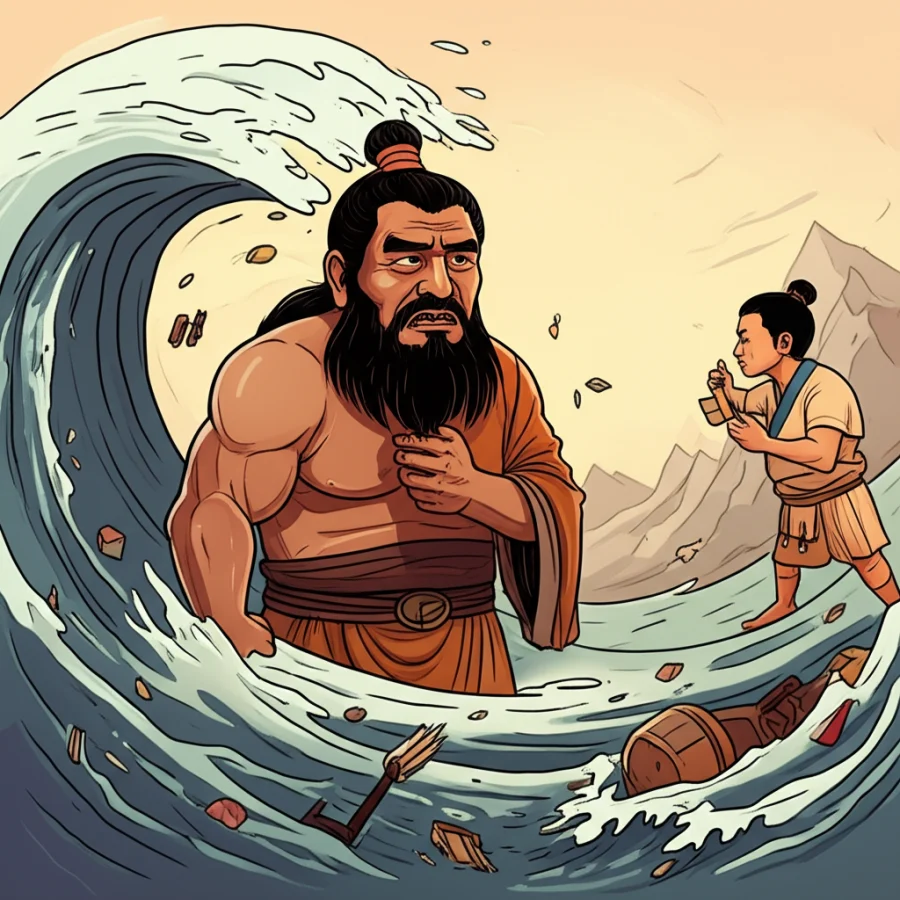
Across the vast tapestry of human history, woven with threads of observation, fear, and profound respect for the forces of nature, countless stories have emerged to explain the world. Among these, the ancient Chinese narratives surrounding the Great Flood, and the monumental efforts of figures like Gun and Yu, offer a glimpse into a world where the colossal power of the elements was a constant, formidable presence. This is not a tale of divine pronouncements or literal truths, but a traditional story, passed down through generations by ancient peoples seeking to comprehend the chaotic dance between humanity and the untamed earth.
The genesis of these flood myths can be traced to a China steeped in agrarian life, a society deeply dependent on the predictable rhythms of rivers and rain. Imagine a time when the Yellow River, the "Mother River" of China, was as much a source of life as it was a harbinger of destruction. Its annual floods, while vital for fertilizing the soil, could also devastate entire villages, sweeping away homes, crops, and lives. In such an environment, where the boundaries between the natural and the supernatural often blurred, it was natural for people to attribute these overwhelming forces to powerful entities or to the consequences of cosmic imbalances. The worldview of these ancient peoples was one of profound interconnectedness. They saw the heavens, the earth, and humanity as intrinsically linked, and the disruption of this harmony could manifest in cataclysmic events. Mountains, like the sacred Mount Tai, were often seen as conduits to the divine, places of immense spiritual significance, and their presence in the narrative underscores the profound respect and awe these ancient societies held for the natural world.
At the heart of the flood legends lies the figure of Gun. He is often depicted as a powerful, if ultimately flawed, hero. His defining characteristic, in the context of the flood, is his determination and his possession of a mystical earth-controlling soil, known as xirang. This soil, it is said, could expand when Gun needed it and shrink when he commanded it. However, Gun’s symbolic attribute was not necessarily his divine power, but rather his resourcefulness and his unwavering resolve in the face of an overwhelming challenge. He was a symbol of human ingenuity attempting to wrestle with nature’s might, a testament to the desire to control the uncontrollable.
The narrative of the Great Flood, as told through the legends of Gun and Yu, begins with an unprecedented deluge. The skies wept relentlessly, and the rivers, swollen beyond their banks, transformed the land into a vast, churning ocean. This was not a mere inconvenience; it was an existential threat. The ancient texts describe a world in disarray, where communities were submerged, and despair was rampant.
In this desperate hour, Gun emerged as the chosen one, tasked with the monumental undertaking of controlling the floodwaters. Armed with his mystical xirang, he set to work. He attempted to build dams, to channel the raging torrents, to erect barriers against the relentless onslaught. For nine years, the legends say, Gun toiled. He raised earthworks, fortified riverbanks, and fought an unceasing battle against the encroaching waters. Yet, his efforts, while valiant, proved to be ultimately futile. The sheer scale of the flood, perhaps a representation of nature’s unyielding power or the consequences of a cosmic imbalance, overwhelmed his strategies. The dams he built were eventually breached, the earthworks eroded, and the waters continued their destructive march. The story often portrays Gun’s methods as too rigid, too focused on containment rather than redirection, a symbolic critique of approaches that fail to adapt to the fundamental nature of a problem. In the end, Gun was even said to have been punished for his failure, transforming into a yellow dragon and being cast into the depths of the Feather Mountain. His story became a cautionary tale, not necessarily of wickedness, but of the limitations of certain approaches when faced with overwhelming natural forces.
Following Gun’s demise, the mantle of leadership fell to his son, Yu the Great. Where Gun was characterized by his resolute but ultimately unsuccessful containment efforts, Yu embodied a fundamentally different approach. He was described as diligent, wise, and profoundly empathetic to the suffering of the people. Yu, it is told, spent thirteen years traveling the land, studying the flow of the waters, and observing the patterns of the earth. He recognized that simply building walls against the flood was a losing battle. Instead, he championed a strategy of dredging and channeling.
Yu’s approach was one of working with the water, not against it. He organized vast labor forces, painstakingly digging canals, widening riverbeds, and creating intricate networks to guide the floodwaters safely to the sea. He personally led his people, sharing in their hardships, his back stooped from years of labor, his hands calloused. The legends paint vivid pictures of Yu directing the excavation of nine major rivers, his efforts transforming the landscape and bringing order to the chaos. This was a monumental feat of engineering, a testament to human perseverance and collective action. Yu’s success was not attributed to mystical soil, but to his strategic vision, his tireless dedication, and his ability to mobilize and inspire his people. He became a symbol of effective leadership, wisdom, and the power of collaborative effort in overcoming seemingly insurmountable challenges.
The symbolism embedded within the myth of Gun and Yu is rich and multifaceted. Gun’s struggle can be seen as representing the inherent human desire to control nature, the initial, often brute-force attempts to impose order. His failure might symbolize the hubris of believing that absolute control is possible, or perhaps the limitations of a singular, inflexible approach. The xirang itself, while fantastical, can be interpreted as a symbol of powerful but ultimately insufficient tools when not wielded with sufficient wisdom.
Yu, on the other hand, embodies a more mature and sustainable approach. His success in dredging and channeling represents the wisdom of understanding natural forces and working in harmony with them. His dedication and personal sacrifice highlight the importance of leadership that is not only strategic but also compassionate and grounded in the needs of the people. The nine years of his father’s struggle and thirteen years of his own can be seen as emphasizing the long-term nature of profound challenges and the necessity of sustained effort. The myth, therefore, speaks to the cyclical nature of problems and solutions, the evolution of understanding, and the enduring human capacity for adaptation and progress. It can also be interpreted as a parable about the importance of wise governance and the consequences of both flawed and exemplary leadership.
In the modern world, the stories of Gun and Yu continue to resonate, not as literal accounts, but as enduring archetypes within Chinese culture and beyond. They appear in literature, art, and even in the philosophical discourse on leadership and environmental management. In popular culture, Yu the Great is often portrayed as a wise and benevolent sage, a foundational figure in Chinese civilization. His story has been retold and adapted in various forms, influencing how the relationship between humanity and nature is perceived. In cultural studies, these myths provide invaluable insights into the anxieties, aspirations, and worldview of ancient Chinese societies. They are studied as powerful examples of origin myths, explaining not just the origins of civilization but also the fundamental principles that guided it.
It is crucial to reiterate that the narrative of the Flood of Gun and Yu is a traditional story, a product of ancient imagination and a means of understanding the world as perceived by people in a distant past. As Muslims, we recognize that the sole Creator and Sustainer of all existence is Allah. These stories, while rich in cultural and historical significance, do not alter this fundamental truth. They offer a window into the human experience of grappling with the awe-inspiring and often terrifying power of the natural world, and the enduring human spirit’s capacity for resilience, ingenuity, and the pursuit of order. The legends of Gun and Yu serve as a testament to the power of storytelling, the enduring legacy of cultural heritage, and the boundless realms of human imagination that continue to shape our understanding of ourselves and the world around us. They remind us that even in the face of overwhelming natural forces, the human capacity for adaptation and collective effort can bring about profound change, a message that continues to hold relevance across the ages.