
 fufufafa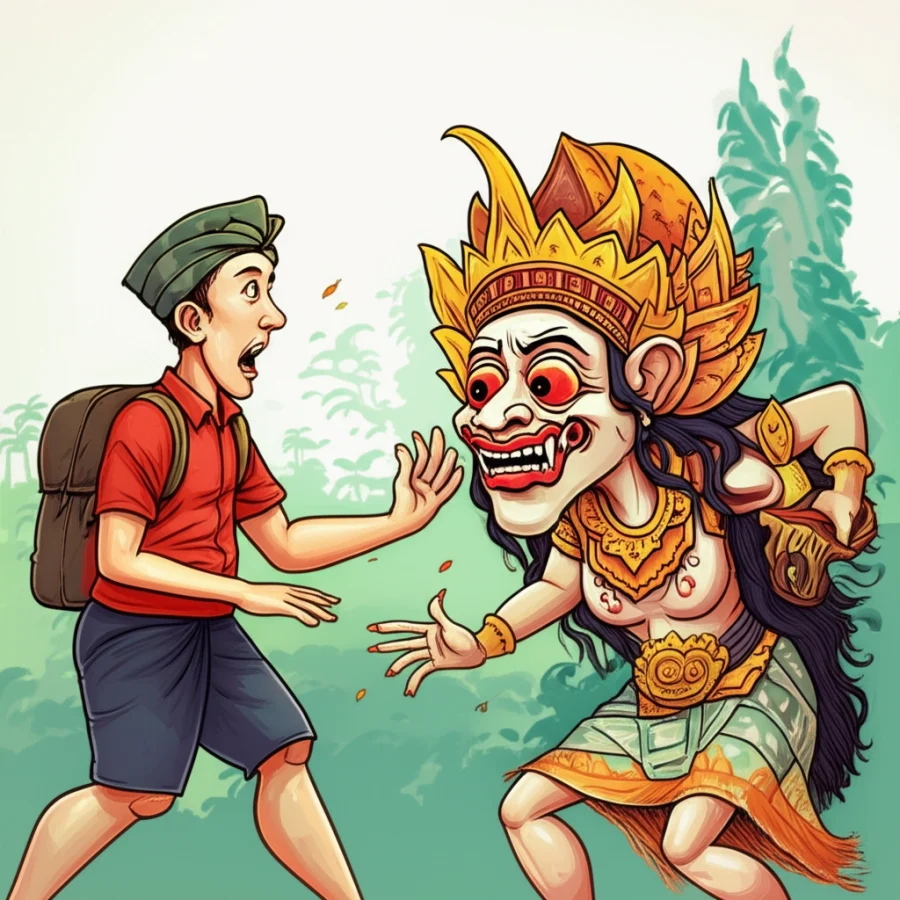
In the vibrant tapestry of Indonesian folklore, few figures command as much mystique and dread as Rangda, the Demon Queen of Bali. This legendary being is not a figure to be believed in the literal sense, but rather a profound traditional story, a powerful narrative spun by ancient people that continues to resonate within Balinese culture today. It is a tale passed down through generations, embodying the rich spiritual and artistic heritage of the island, told not as a factual account but as a symbolic exploration of the human condition and the cosmic order.
Origins and Cultural Background
The myth of Rangda emerges from the deeply spiritual and agrarian society of ancient Bali, an island where Hindu-Balinese traditions beautifully intertwined with older animistic beliefs. In this era, the world was perceived as a living, breathing entity, infused with unseen forces and spirits, both benevolent and malevolent. For the people of that time, every aspect of life – from the rustling of the rice paddies to the volcanic tremors, from bountiful harvests to devastating plagues – was attributed to the intricate dance of these unseen powers.
Their worldview was predicated on the concept of Rwa Bhineda, the sacred duality or balance of opposing forces. Light and shadow, good and evil, creation and destruction were not seen as absolute, but as interdependent elements necessary for universal harmony. Life was a constant negotiation with these forces, maintained through elaborate rituals, offerings, and ceremonial performances. It was within this rich cultural soil that the dramatic narrative of Rangda and her eternal struggle found its roots, serving as a powerful allegory for the unseen dynamics shaping their existence.
Character Description: Rangda, The Destructive Force
Rangda, the mythical antagonist in Balinese lore, is depicted with an appearance designed to evoke primal fear and awe. She is often portrayed with long, unkempt white hair that cascades wildly, pendulous breasts, and long, sharp, claw-like fingernails. Her face, a grotesque mask, features bulging eyes, a protruding tongue that lolls unnaturally, and prominent fangs. Often adorned with a crown or elaborate headdress, her form is an embodiment of fierce, destructive power.
Symbolically, Rangda represents the destructive aspect of nature and the divine, embodying kala – the chaotic and consuming forces of the universe. She is associated with black magic, plague, death, and the unseen forces that bring suffering and misfortune. While terrifying, her existence in the mythology is not merely that of an evil entity; she is also understood as a necessary component within the Rwa Bhineda framework, representing the destructive facet without which creation and renewal cannot occur. She is often linked to the fierce goddess Durga from Hindu mythology, or historical figures like the legendary witch-queen Calon Arang, who wielded dark magic to spread pestilence. Her attributes, therefore, are symbolic expressions of humanity’s fears and understanding of the uncontrollable, destructive elements of life.
Main Story: The Dance of Duality
The most renowned "encounter" with Rangda is not a singular event but a perpetual, ritualistic drama: the Barong and Rangda dance. Imagine the humid air of a Balinese village, thick with the scent of incense and frangipani. The gamelan orchestra begins its mesmerizing, percussive rhythm, a heartbeat setting the stage for an ancient tale. The villagers, gathered in their finery, watch with a mixture of apprehension and reverence.
Suddenly, a palpable shift in the atmosphere heralds her arrival. From the shadows, Rangda emerges, her terrifying mask gleaming under the flickering torchlight. Her movements are sharp, angular, and imbued with an unsettling power. Her long, clawed fingers gesticulate wildly, and the audience, knowing the story, imagines her chanting dark incantations that summon unseen spirits of plague and misfortune. A sense of unease ripples through the crowd, as if her mythical presence is momentarily bringing forth the very real anxieties of disease and chaos that ancient communities faced.
The narrative unfolds: Rangda, in her mythological wrath, is said to have cast a dark spell upon the land, causing a devastating plague that brought suffering and death to the villagers. Crops withered, livestock perished, and despair gripped the hearts of the people. Her cackling laughter, imagined or mimed by the dancer, echoes the chilling sound of misfortune itself.
But just as the darkness seems absolute, a counter-force appears. With a majestic entrance, Barong, the benevolent lion-like creature, strides onto the stage. Adorned with vibrant feathers and intricate carvings, his movements are powerful yet graceful, embodying protection and positive energy. Barong, representing the forces of good, light, and white magic, confronts Rangda.
Their encounter is a dynamic, theatrical struggle. Rangda lunges with menacing gestures, her powerful magic attempting to overwhelm Barong and his followers (represented by male dancers wielding kris daggers). Barong, with his steadfast presence and protective aura, deflects her dark energies. The narrative reaches its climax when Rangda’s magic is so potent that it compels Barong’s followers to turn their kris daggers upon themselves, entering a trance-like state. However, through Barong’s powerful protection, the daggers do no harm, symbolizing the triumph of inner strength and good over self-destructive forces.
This is not a battle where one side definitively "wins" and the other is vanquished forever. Instead, it is an eternal dance, a perpetual ebb and flow of power. Rangda and Barong represent the fundamental, opposing energies that exist within the cosmos. Their struggle concludes not in victory or defeat, but in a restored, albeit temporary, balance, signifying that the forces of good and evil, creation and destruction, are inextricably linked and ever-present.
Symbolism and Meaning
To ancient Balinese people, the myth of Rangda and Barong was far more than mere entertainment; it was a profound lesson in cosmic order and human resilience. Rangda symbolized the destructive aspect of life – plague, famine, death, and the chaotic forces beyond human control. She embodied humanity’s primal fears and the recognition that suffering is an inherent part of existence. Barong, conversely, represented the benevolent forces, the protective spirits, the white magic, and the collective good that strives to maintain harmony.
Their continuous struggle highlighted the core Balinese concept of Rwa Bhineda, the duality of life. It taught that good cannot exist without evil, light without shadow, and creation without destruction. The story did not advocate for the eradication of evil, but rather for its acknowledgment and ritualistic balancing. It was a metaphor for the constant struggle within oneself and in the world, emphasizing the importance of maintaining harmony through spiritual practice, community effort, and an understanding of the interconnectedness of all things. It reinforced the idea that life is a delicate balance, and that even the most terrifying forces have a place within the grand scheme.
Modern Perspective
Today, the myth of Rangda remains a vibrant and integral part of Balinese culture. While no longer seen as a literal truth, her image and story are celebrated through various art forms. The Barong and Rangda dance continues to be a central performance, captivating audiences, both local and international, and serving as a powerful cultural spectacle. Rangda’s terrifying mask and dramatic portrayal are iconic, appearing in intricate wood carvings, paintings, and traditional textiles.
In academic and cultural studies, Rangda is a fascinating subject, offering insights into Hindu-Balinese cosmology, the psychology of fear, and the sophisticated ways ancient societies articulated complex philosophical concepts through storytelling. She inspires artists, writers, and filmmakers, albeit less frequently on a global scale than some other mythologies, yet remains a potent symbol within her native land, representing the enduring power of cultural heritage and the human imagination to grapple with life’s profound mysteries.
Conclusion
The encounter with Rangda, therefore, is not an encounter with a physical entity, but with a cultural narrative – a profound traditional story that has shaped the worldview and artistic expression of Bali for centuries. It is a testament to the power of human imagination to craft tales that explain the inexplicable, explore complex moralities, and provide comfort or caution in the face of life’s uncertainties. As Muslims, we recognize that only Allah is the true Creator and Sustainer, and all power and existence stem from His divine will. We understand that these stories, while rich in cultural heritage and imaginative depth, are products of human artistry and tradition. They serve as valuable windows into the diverse ways humanity has sought to understand its place in the world, reminding us of the enduring legacy of storytelling and the deep cultural roots that bind communities across generations.







