
 fufufafa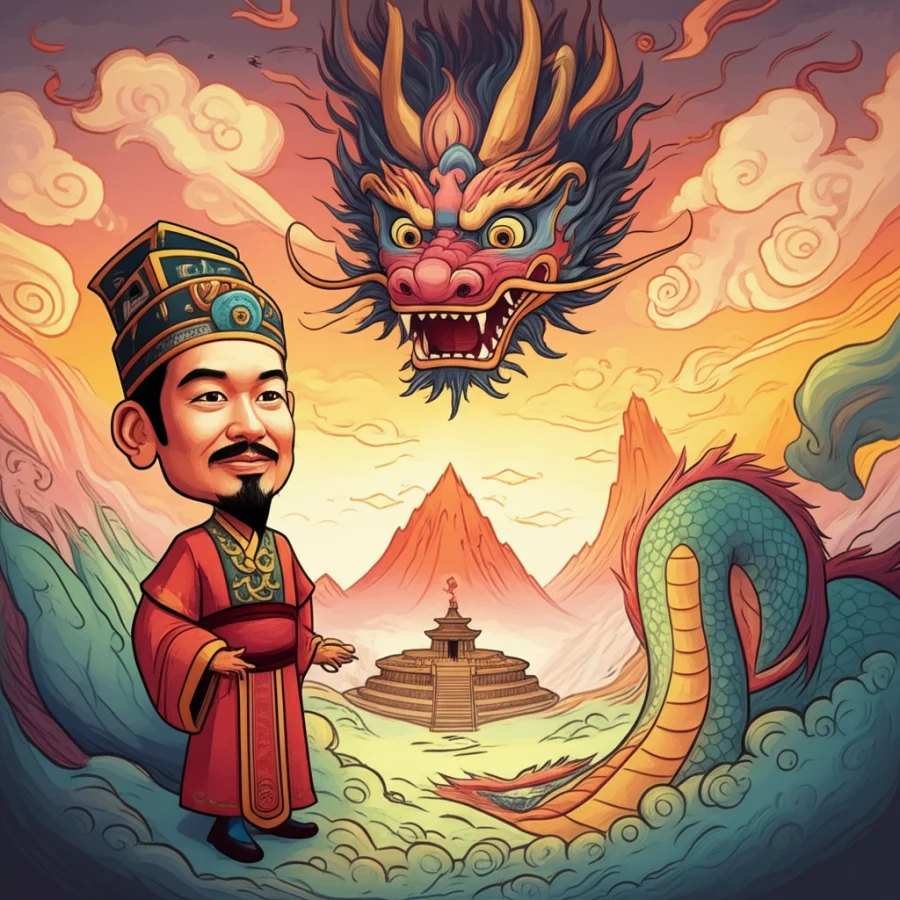
The Serpent’s Ascent: Echoes of Hwanin at the Heavenly Descent Site
An Important Note for the Reader: The following article explores a mythological narrative constructed from elements of traditional Korean folklore. This story is a product of ancient imagination, intended for cultural, historical, and educational understanding. It is not real and is not meant to be believed, worshipped, or practiced.
Introduction
From the mist-shrouded mountains and winding rivers of the ancient Korean peninsula comes a collection of tales that speak to the soul of its people. These are not historical records, but powerful, imaginative stories told by ancient communities to make sense of the world around them. One such narrative, woven from the threads of celestial authority and earthly ambition, is the legend of the Heavenly Descent Site, a place where the Echoes of Hwanin tested the worthiness of the great Imugi. This story, passed down through generations, served as a cultural touchstone, exploring timeless themes of perseverance, wisdom, and the true meaning of power.
Origins and Cultural Background
To understand this legend, one must step back into an era when the world was seen as a tapestry of the divine and the natural. For the people of ancient Korea, life was deeply intertwined with the cycles of the seasons, the bounty of the harvest, and the unpredictable forces of nature. Their worldview was animistic; they believed that spirits resided in mountains, rivers, ancient trees, and even rocks. Mountains, in particular, were considered sacred pillars connecting the earth to the heavens, places where the mortal world could touch the divine.
In this cosmos, the sky was ruled by a celestial sovereign, a figure known in their mythology as Hwanin, the Lord of Heaven. He represented order, cosmic law, and the ultimate source of authority. Below, the earth teemed with creatures of immense power, some benevolent, others fearsome. It was a world where a long and patient life could lead to transformation, and where one’s inner character was believed to be the ultimate measure of worth. This story was likely shared during long winter nights or by elders teaching the young, using the grand scale of mythology to impart lessons about their own lives.
Character and Creature Description
At the heart of this tale are two central figures, one celestial and one terrestrial.
Hwanin, the Celestial Sovereign: In the old myths, Hwanin is not a figure who walks among mortals but an overarching presence, a symbol of divine order and judgment. He represents the unchangeable laws of the universe. In this particular story, he is not a direct actor but the source of the "Echoes"—a lingering remnant of his will and wisdom, a spiritual test embedded into the very fabric of a sacred place. This concept symbolizes an enduring moral standard against which all ambition is measured.
The Imugi: The Imugi (이무기) is one of the most compelling creatures in Korean folklore. It is described as a colossal serpent, a proto-dragon. Lacking the horns, beard, and divine status of a true dragon (Yong), the Imugi is a being of immense potential, trapped in a transitional state. These creatures were said to live in deep bodies of water or hidden caves for a thousand years, honing their patience and strength. The Imugi symbolically represents unrealized potential, immense patience, and the arduous struggle for self-betterment. It is the embodiment of a profound aspiration to transcend one’s limitations and achieve a higher state of being.
The Main Story: The Trial on the Sacred Mountain
As the ancient storytellers would have it, there was a time when the boundary between heaven and earth was thinner. Hwanin, looking down from his celestial court, saw the immense striving of the creatures below. He saw their strength, their cunning, and their ambition. To ensure that only the truly worthy could ascend, he designated a remote, cloud-piercing mountain peak as the Heavenly Descent Site. At its summit, he left an echo of his own essence—not a voice that spoke in words, but a profound spiritual pressure that would test the heart of any who dared approach.
In the cold, dark depths of a southern lake, there lived an Imugi of immense age. For nine hundred and ninety-nine years, it had dwelled in silence, feeling the turn of the seasons only through the shifting temperatures of the water. Its scales, once the color of mud and stone, had taken on a pearlescent sheen. Its eyes, once dull, now held the deep, patient wisdom of centuries. It had felt the call of the heavens its entire life, a yearning to shed its serpentine form and become a true dragon—a guardian of the rains and a master of the clouds.
When its thousandth year arrived, the Imugi knew its time had come. The legend of the Heavenly Descent Site was known among all creatures of power, and the serpent began its great journey. Leaving the familiar comfort of its watery home, it moved across the land. Its colossal body carved a temporary river through dense forests, and its scales scraped against the unforgiving granite of the foothills. The journey was a trial in itself. It endured scorching droughts that cracked the earth beneath it and torrential rains that turned the ground into a treacherous mire. Yet, it never faltered, its focus fixed on the sacred peak that loomed in the distance.
After what seemed an eternity, the Imugi reached the base of the mountain. The air here was different—thin, pure, and heavy with an unspoken power. The final ascent was the most difficult. The cliffs were sheer, the winds howled with punishing force, and the very rocks seemed to test its resolve. Finally, exhausted but resolute, the great serpent coiled itself upon the flat, windswept summit—the Heavenly Descent Site.
There was nothing there but bare rock and swirling clouds. Yet, the Imugi felt a presence that was older than the mountain itself. This was the Echo of Hwanin. A question formed in its mind, not in words, but as a wave of pure understanding.
Why do you seek to ascend? Is it for the power to command the storms? For the glory of a golden form? For dominion over lesser beings?
The Imugi remained still, reflecting on its thousand-year existence. It remembered the suffering of villages during a long drought, the terror of families during a flood. It had watched humanity from its lake, seeing both their frailty and their resilience. Its ambition was not born of pride.
A response formed in its heart, projected back toward the celestial Echo.
I have seen the world suffer from imbalance. I have felt the parched earth cry for rain and the flooded river weep for calm. I seek not dominion, but duty. I seek not glory, but the wisdom to be a guardian. To be a dragon is to be a part of the world’s balance, not its master.
The spiritual pressure on the summit softened. A profound sense of acceptance washed over the Imugi. The clouds above began to churn, and a single, brilliant pillar of light descended from the heavens, enveloping the serpent. Its form began to change. Its body elongated, and its scales shimmered, turning the color of molten gold. A magnificent mane erupted from its neck, and noble horns grew from its brow. Its limbs emerged, powerful and clawed.
The transformation was complete. It was no longer an Imugi, a creature of the earth, but a Yong, a true dragon of the heavens. With a mighty roar that was not of anger but of joyous release, it leaped from the mountaintop, soaring into the sky not as a conqueror, but as a rightful guardian, ready to fulfill its purpose. The Heavenly Descent Site remained, a silent testament to the idea that true power is granted only to those with the wisdom and humility to wield it for the good of all.
Symbolism and Meaning
For the ancient people who told this story, it was rich with meaning.
- Perseverance and Patience: The Imugi’s thousand-year wait and arduous journey symbolized the belief that great achievements require immense dedication and patience. It was a lesson that shortcuts lead to failure, while enduring hardship builds the character necessary for success.
- The Nature of True Leadership: Hwanin’s test was not one of strength, but of intent. The story served as a moral allegory, teaching that true leadership and authority come not from a desire for personal power, but from a sense of responsibility and a commitment to serve the greater good.
- Transformation: The physical transformation of the Imugi into a dragon was a powerful metaphor for spiritual or personal enlightenment. It represented the moment when an individual, after a long struggle, finally realizes their true potential and purpose.
- Balance in Nature: As a dragon, the creature would control the rain, a vital force for an agricultural society. The story reinforced the importance of balance in the natural world and positioned the divine as a force that maintained this equilibrium through worthy guardians.
Modern Perspective
Today, the core elements of this folklore continue to resonate. The figure of the Imugi, in particular, remains a popular character in modern Korean creative works. It frequently appears in webtoons, television dramas (like Tale of the Nine Tailed), and video games. In these modern retellings, the Imugi is often a complex and tragic figure, burdened by its incomplete state and striving to overcome its limitations. This modern interpretation focuses on the internal, psychological struggle of the character, exploring themes of identity, destiny, and the quest for belonging—proof that the symbolic power of this ancient creature still captivates the human imagination.
Conclusion
The tale of the Imugi’s ascent at the Heavenly Descent Site is a beautiful and enduring piece of imaginative folklore. It is a cultural story, a narrative vehicle for conveying the values of an ancient society. It reminds us that for centuries, people have used stories of gods, spirits, and mythical creatures to explore the deepest questions of the human experience: the struggle for greatness, the burden of responsibility, and the quiet wisdom born from patience.
As Muslims, we recognize that only Allah is the true Creator and Sustainer of all things, and these stories are regarded as products of human imagination and cultural heritage, not as literal truths. Nonetheless, by studying them, we gain a deeper appreciation for the rich diversity of human culture and the timeless, universal power of storytelling to shape our understanding of the world and our place within it.







