fufufafa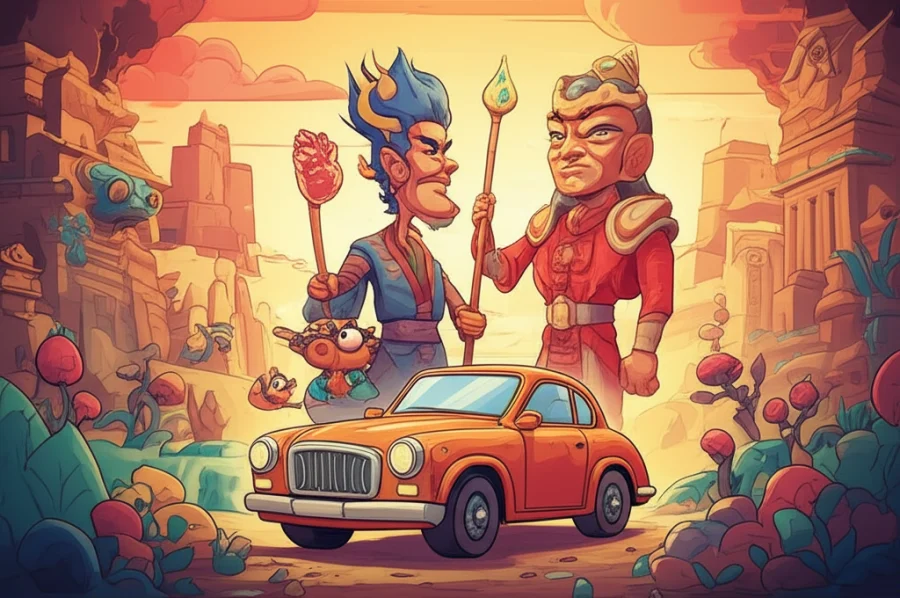
1. Introduction
The tapestry of human civilization is richly interwoven with threads of ancient tales, myths, and legends that speak to the earliest understandings of the world. Among these, the intricate and vibrant narratives originating from ancient China stand out, populated by celestial beings, elemental spirits, and heroic figures. The Chronicle of Zhurong and the Forgotten City is one such traditional story, passed down through generations by ancient people, a testament to their imaginative spirit and their profound connection to the forces of nature. It is a legend that invites us to delve into a world shaped by fire, mystery, and the enduring power of memory.
2. Origins and Cultural Background
This myth emerges from the crucible of ancient Chinese civilization, likely taking root during or after the period of the Three Sovereigns and Five Emperors, an era often considered proto-historical and legendary, preceding the establishment of dynastic rule. In this distant past, society was largely agrarian, deeply reliant on the rhythms of nature for survival. The environment was perceived as a living entity, animated by powerful, often anthropomorphic, spirits and deities.
People of that time viewed the world not as a mechanistic system but as a dynamic interplay of elemental forces: earth, water, wood, metal, and fire. They believed that celestial beings governed these elements, influencing everything from the changing seasons to the bounty of the harvest. Myths served as a crucial framework for understanding natural phenomena, explaining the inexplicable, and imparting moral lessons. They were not mere entertainment but foundational narratives that shaped cultural identity, social norms, and humanity’s place within the vast cosmic order. The reverence for elements like fire, which could both sustain life and bring destruction, naturally led to the creation of powerful deities embodying these forces.
3. Character Description: Zhurong, the Lord of Fire
At the heart of our chronicle stands Zhurong, a venerable figure within Chinese mythology, often revered as the God or Official of Fire. He is not merely a personification of flame but an embodiment of its dual nature – the warmth that sustains life, the light that dispels darkness, and the scorching force that purifies and destroys. Symbolically, Zhurong represents passion, transformative energy, justice, and the illumination of truth.
Ancient texts and oral traditions depict Zhurong with vivid imagery. He is often described with a human face and the body of a beast, sometimes riding a fiery chariot pulled by magnificent dragon steeds. His raiment is said to be the color of brilliant scarlet and molten gold, his skin glowing with an internal heat, and his voice like the crackling of a thousand bonfires. In some accounts, he holds a blazing torch or a fire staff, capable of igniting mountains or melting vast glaciers. His domain is the Southern quarter of the heavens, symbolizing warmth, growth, and the peak of summer. Zhurong is more than a bringer of fire; he is its guardian, ensuring its balance and proper deployment in the cosmic order, mediating between creation and destruction. His presence signifies a force that is both vital and formidable, a cornerstone of the elemental world.
4. Main Story: The Chronicle of Zhurong and the Forgotten City
In the boundless expanse of the celestial realm, where the Five Elements danced in eternal harmony, Zhurong, the Lord of Fire, held sway over all that burned, illuminated, and transformed. His fiery palace shimmered like a distant star, casting benevolent warmth upon the mortal world below. Yet, one cycle, an anomaly disturbed the cosmic balance. A whisper of profound cold, a shadow of inexplicable stillness, began to creep from the deepest strata of the Earth, threatening to quench the very embers of existence. It was a cold that defied Zhurong’s warming touch, a stillness that resisted the vibrant pulse of his flame.
Troubled by this encroaching anomaly, Zhurong descended from his celestial abode, his fiery chariot blazing a path through the clouds. Guided not by sight, but by the subtle tremors in the Earth’s core and the faint echoes of forgotten warmth, he plunged into the subterranean depths. Days turned into nights as he journeyed through vast caverns and labyrinthine tunnels, his presence a comet against the perpetual gloom.
Finally, after an arduous descent that tested even his divine endurance, Zhurong arrived at a colossal, petrified gateway, intricately carved with symbols of ancient elemental mastery, yet shrouded in an unnatural frost. With a mere breath, he parted the ethereal mists, revealing a sight that brought even the Lord of Fire to a contemplative halt: a city. This was Yinmi-cheng, the Hidden Mirror City, a forgotten metropolis of incredible architectural brilliance, perfectly preserved yet utterly devoid of life or warmth.
The buildings, sculpted from obsidian and quartz, rose like silent sentinels, their surfaces reflecting the faint, alien glow of the cavern. Streets were paved with polished jade, leading to temples whose spires reached towards the unseen ceiling. But there was no movement, no sound, only an oppressive chill that seemed to seep into the very essence of Zhurong’s being. This was not a city destroyed by fire, but one frozen in time, buried by a self-inflicted oblivion.
As Zhurong stepped within, his divine flames pulsed, casting dancing shadows that brought a momentary semblance of life to the dormant structures. He perceived echoes of its past: Yinmi-cheng was once home to a civilization of brilliant scholars and artificers who, in their insatiable quest for knowledge and power, had sought to master the very forces of creation. They had delved too deeply into the secrets of the primordial elements, attempting to harness and contain fire, water, earth, and wind within intricate constructs of their own design. Their ambition had been to forge a perfect, unchangeable world, free from the volatile whims of nature.
However, in their hubris, they had forgotten the fundamental truth: elements, particularly fire, cannot be truly contained without consequence. Their grandest invention, a crystalline heart meant to regulate all elemental energies, had instead backfired, drawing all warmth and life into a static, suspended state. The city had not perished in a cataclysm but had been slowly, irrevocably, put to sleep, entombed by its own ambition, its inhabitants frozen in their daily routines, their knowledge locked away.
Zhurong moved through the silent halls, his heart stirring with a mix of awe and melancholy. He saw the intricate libraries filled with scrolls of forgotten wisdom, laboratories brimming with dormant alchemical tools, and observatories where the stars were once charted with impossible precision. He realized that to destroy this city would be to extinguish a vast repository of knowledge, however misguided its creators. To fully awaken it, however, might unleash the very imbalance that had entombed it.
With a deep sigh, Zhurong made his decision. He would not burn Yinmi-cheng to ash, nor would he fully restore it to its former, dangerous glory. Instead, he channeled a portion of his divine flame into the city’s crystalline heart. Not a destructive blaze, but a steady, warm glow. This flame would not thaw the inhabitants or restart their dangerous experiments. Instead, it would act as a beacon, a perpetual lamp that would keep the knowledge within the city from utterly decaying, preserving its wisdom and its cautionary tale for any who might stumble upon its hidden gates in future epochs. The city would remain forgotten by the surface world, but its essence, its history, and its lessons would be preserved, radiating a subtle warmth that balanced the encroaching cold.
Having accomplished his task, Zhurong ascended, leaving Yinmi-cheng once more to its slumber, now infused with a guardian flame. The cold anomaly receded, and the cosmic balance was restored, a silent testament to the Lord of Fire’s wisdom and his understanding of the delicate interplay between destruction, preservation, and the eternal cycle of memory and oblivion.
5. Symbolism and Meaning
To the ancient people, this chronicle likely represented several profound ideas. Zhurong, as the Lord of Fire, embodies the transformative power of nature – capable of both creation and destruction, essential for life yet formidable in its uncontrolled state. The Forgotten City, Yinmi-cheng, serves as a powerful metaphor for humanity’s ambition and potential hubris. It speaks to the dangers of seeking absolute control over nature’s forces and the consequences of forgetting one’s place within the larger cosmic order. The city’s petrified state symbolizes the stagnation that can result from unchecked desire for power or knowledge without wisdom. Zhurong’s decision to preserve rather than destroy highlights the importance of balance, the value of history, and the idea that even cautionary tales hold inherent wisdom worth remembering. It also subtly suggests that true power lies not in domination, but in understanding and maintaining harmony.
6. Modern Perspective
Today, stories like The Chronicle of Zhurong and the Forgotten City continue to resonate, albeit through a different lens. In contemporary literature, films, and video games, Zhurong often appears as a formidable, wise, or sometimes volatile elemental deity, influencing narratives that explore themes of power, balance, and human ambition. His image, and the concept of forgotten cities, are frequently drawn upon in fantasy genres, lending depth and a sense of ancient mystique to fictional worlds.
Culturally, these myths are studied for their insights into ancient Chinese cosmology, philosophy, and societal values. Academics examine them for their literary merit, their linguistic nuances, and their role in shaping collective identity. They are recognized as invaluable cultural heritage, offering a window into the imaginative and spiritual lives of people from a distant past, inspiring new forms of artistic expression and contributing to a global appreciation for diverse storytelling traditions.
7. Conclusion
The Chronicle of Zhurong and the Forgotten City, like countless other myths from around the world, is a vibrant thread in the grand tapestry of human cultural heritage. It is a traditional story, born from the imagination and worldview of ancient peoples, presented here for its cultural, historical, and educational value. It is important to reiterate that these narratives are not meant to be believed, worshipped, or practiced as truth or divine power.
As Muslims, we recognize that Allah (SWT) alone is the true Creator and Sustainer of all existence, the One without peer or partner, and the ultimate source of all knowledge and power. This foundational belief guides our understanding of the world and the tales humanity has told throughout its history. Nevertheless, the enduring power of myths like Zhurong’s chronicle lies in their capacity to reflect universal human experiences – our awe of nature, our quest for meaning, our triumphs, and our follies. They remind us of the richness of human imagination and the timeless tradition of storytelling, which continues to connect us to our past and inspire our future, fostering a deeper appreciation for the diverse ways humanity has sought to understand its place in the universe.