fufufafa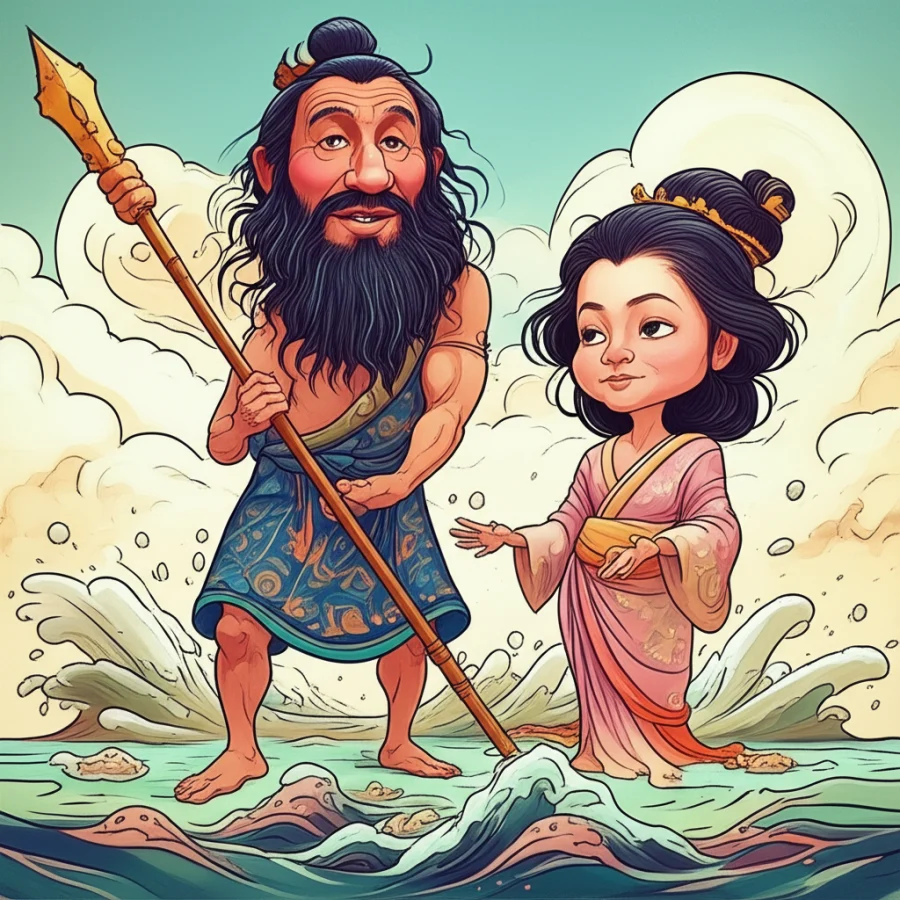
Introduction:
From the mists of ancient Japan, a land steeped in natural beauty and reverence for the unseen, comes a tale of creation: the story of Izanagi and Izanami, and the birth of the Japanese islands. This is not a historical account, but a cherished myth, a traditional story passed down through generations, whispering of the origins of the world as understood by the people of ancient Japan. It is a window into their beliefs, their values, and their understanding of the forces that shaped their world. We explore this story solely for cultural and educational understanding, recognizing its place as a work of imagination and storytelling.
Origins and Cultural Background:
The myth of Izanagi and Izanami originates from the early periods of Japanese history, likely taking shape during the Yayoi period (approximately 300 BCE to 300 CE) and solidifying its place in the collective consciousness during the subsequent Kofun period (approximately 300 to 538 CE). This was a time when agricultural societies were developing, and a deep connection to the land was paramount. Shinto, the indigenous religion of Japan, was taking root, emphasizing the sacredness of nature and the presence of kami (spirits or deities) in all things.
The people of this era viewed the world as an interconnected web of visible and invisible forces. They believed that natural phenomena like storms, earthquakes, and the growth of crops were controlled by the kami. Their worldview was animistic, attributing spirits to mountains, rivers, trees, and even rocks. The myth of Izanagi and Izanami provided a framework for understanding the creation of this world, imbuing the Japanese archipelago with a sense of divine origin and purpose. It reflected their dependence on the land and their reverence for the forces that shaped their lives.
Character / Creature Description:
-
Izanagi: The male deity, whose name translates roughly to "He-Who-Invites." He is often depicted as a strong, decisive figure, representing the masculine principle of creation. He is not to be worshipped, but understood as a personification of the creative force.
-
Izanami: The female deity, whose name translates roughly to "She-Who-Invites." She embodies the feminine principle of creation, representing fertility, nurturing, and the cycle of life and death. Again, she is not to be worshipped, but understood as a symbolic representation.
These figures are not meant to be taken as literal beings with divine power, but as powerful symbols that represent the fundamental forces of creation and the interconnectedness of the universe as understood by the ancient Japanese.
Main Story / Narrative Retelling:
In the beginning, there was only a formless void, a swirling chaos of potential. From this void, the first kami emerged, but they did not yet possess the power to shape the world. It was only with the arrival of Izanagi and Izanami that creation truly began.
The other kami tasked Izanagi and Izanami with the sacred duty of bringing order to the chaos. They were given a jeweled spear, the Amenonuhoko, and instructed to plunge it into the primordial sea. As they stirred the spear, salty droplets fell back into the ocean, congealing and solidifying. These droplets formed the first island, Onogoro-shima.
Izanagi and Izanami descended from the heavens onto Onogoro-shima and built a palace. They then decided to unite and populate the world. They circled a pillar, Izanagi going one way and Izanami the other. When they met, Izanami spoke first, proclaiming her delight at meeting Izanagi. Their first child, however, was deformed and considered a failure. They consulted the other kami, who informed them that Izanami had spoken out of turn, violating the natural order.
They returned to Onogoro-shima and repeated the ritual. This time, Izanagi spoke first, and their union resulted in the birth of the Japanese islands, starting with Awaji Island, then Shikoku, Oki, Kyushu, Iki, Tsushima, and finally, Honshu, the main island of Japan. They continued to create, giving birth to various kami to populate and govern the land.
Tragedy struck when Izanami gave birth to the fire kami, Kagutsuchi. The intense heat severely burned her, leading to her death and descent into Yomi, the land of the dead. Consumed by grief and rage, Izanagi slew Kagutsuchi.
Unable to bear the loss of his beloved, Izanagi journeyed to Yomi to retrieve Izanami. He found her in a darkened palace, but she warned him not to look upon her, as she had already consumed the food of the underworld and was no longer fit for the world of the living. Impatient and filled with longing, Izanagi disobeyed her warning. He lit a torch and beheld her true form: a decaying, maggot-infested corpse.
Horrified, Izanagi fled Yomi. Izanami, enraged by his betrayal, sent demonic pursuers after him. Izanagi battled them, using his sword and throwing peaches, which held a purifying power. Finally, he blocked the entrance to Yomi with a massive boulder, severing his connection with the land of the dead.
Izanagi then performed a purification ritual to cleanse himself of the defilement of Yomi. As he washed his left eye, the sun goddess Amaterasu was born. As he washed his right eye, the moon god Tsukuyomi was born. And as he washed his nose, the storm god Susanoo was born. Thus, from Izanagi’s purification, the three most important kami in the Shinto pantheon came into existence.
Symbolism and Meaning:
The myth of Izanagi and Izanami is rich in symbolism. The creation of the islands represents the formation of the Japanese archipelago and the establishment of a distinct cultural identity. The act of stirring the primordial sea with the jeweled spear symbolizes the creative power of interaction and the emergence of order from chaos.
The birth of the kami represents the forces of nature and the various aspects of human existence. The tragedy of Izanami’s death and Izanagi’s journey to Yomi explores the themes of loss, grief, and the inevitable cycle of life and death. The conflict between Izanagi and Izanami represents the separation of the world of the living from the world of the dead, a fundamental concept in Shinto beliefs.
The myth also explores the importance of proper ritual and order. Izanami’s initial transgression of speaking first during the creation ritual highlights the need for adherence to tradition and the consequences of disrupting the natural order.
Modern Perspective:
The myth of Izanagi and Izanami continues to resonate in modern Japanese culture and beyond. It appears in literature, anime, manga, and video games, often reimagined and reinterpreted for contemporary audiences. In cultural studies, the myth is analyzed for its insights into ancient Japanese beliefs, social structures, and gender roles. It serves as a reminder of the enduring power of mythology to shape cultural identity and inspire artistic expression.
Conclusion:
The story of Izanagi and Izanami is a beautiful and evocative myth, a testament to the power of storytelling and the human imagination. It offers a glimpse into the worldview of the ancient Japanese people and their understanding of the world around them.
As Muslims, we recognize that only Allah is the true Creator and Sustainer of the universe. This story, however, holds value as a piece of cultural heritage, a reflection of the human desire to understand our origins and our place in the cosmos. It is through such stories that we can appreciate the richness and diversity of human culture and the enduring power of the human imagination. We study it to understand and preserve cultural heritage, not as an article of faith.