fufufafa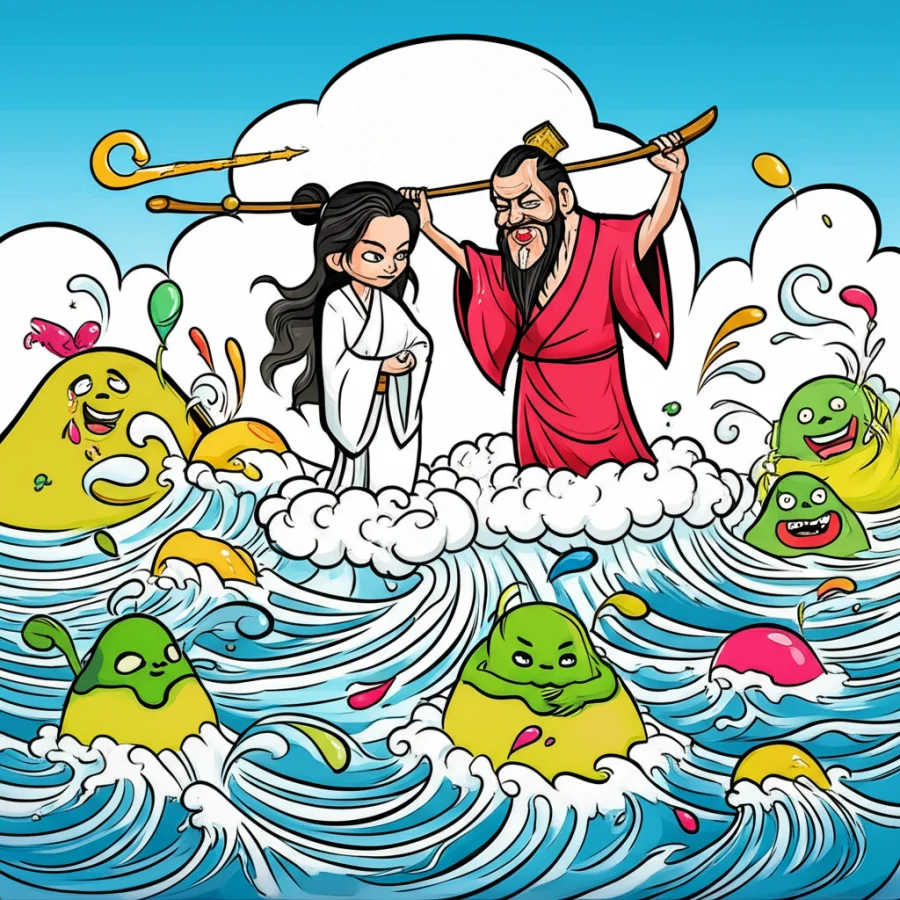
In the vast tapestry of human storytelling, where ancient peoples sought to comprehend the world around them, myths and legends bloom like wild flowers, each with its own unique hue and fragrance. Among these, the captivating narratives of Japan’s Shinto cosmology offer a window into the foundational beliefs and imaginative spirit of a culture deeply attuned to the rhythms of nature and the unseen forces that shape existence. The story of the creation of the islands, often sung and chanted in the mythical realm of Takama-ga-hara, is one such tale, a testament to the enduring power of human curiosity and the desire to explain the inexplicable.
This narrative, passed down through generations in the oral traditions of ancient Japan, predates the written word and emerged from a society deeply intertwined with the natural world. Imagine a time when the land itself felt alive, where mountains were seen as sleeping giants, and the sea, a vast and unpredictable entity, held both life and mystery. The people of this era, often living in close proximity to powerful natural phenomena – earthquakes that shook the earth, volcanoes that spewed fire, and typhoons that raged across the seas – sought explanations for these awe-inspiring and often terrifying events. Their worldview was animistic, attributing spirits and consciousness to all things, from the smallest pebble to the grandest celestial body. The divine was not distant but immanent, woven into the fabric of everyday existence. It was in this fertile ground of awe and wonder that the stories of the kami, the divine beings of Shinto, and their role in shaping the world, took root.
At the heart of this creation narrative lies the concept of Takama-ga-hara, often translated as the "High Plain of Heaven." This is not a physical place in the earthly sense, but rather a spiritual realm, a celestial court where the primordial kami resided. These beings, often depicted with immense power and influence, were not anthropomorphic in the way we might imagine human gods. Instead, they embodied fundamental forces and concepts. One of the most pivotal figures in the creation myth is the concept of Izanagi-no-Mikoto, a male deity, and Izanami-no-Mikoto, a female deity. Their names themselves hint at their roles: "Izanagi" can be understood as "he-who-invites," and "Izanami" as "she-who-invites." This "invitation" can be seen as a call to creation, a beckoning forth of existence from the void. They are not depicted with specific physical forms in the way a modern character might be, but rather as potent, active forces, embodiments of the primal masculine and feminine energies that initiate and sustain life. Their actions, driven by an inherent urge to procreate and form, are the catalyst for the physical world as we know it.
The narrative of the creation of the islands begins with a primordial state of chaos, a vast, undifferentiated expanse. From this nothingness, the kami Izanagi and Izanami were born, or perhaps simply existed as inherent principles. Their task, imbued with an undeniable cosmic imperative, was to bring order and form to this nascent existence. Standing on the Floating Bridge of Heaven, a celestial pathway connecting their realm to the formless expanse below, they were gifted a jeweled spear, the Ame-no-Nuboko. With this spear, they stirred the primeval brine, the chaotic waters of the nascent universe. As they lifted the spear, the salty drops that fell from its tip coalesced, solidifying into the first landmass. This was the genesis of the islands, the very foundation upon which the world would be built.
Their subsequent actions were a continuation of this creative impulse. They descended to the newly formed land and, through a sacred union, began to give birth to the islands of Japan. Each island, from the vast Honshu to the smaller archipelagos, was envisioned as a child born of this divine union. This act of procreation was not merely a physical one but a symbolic representation of the earth’s fertility and the continuous cycle of life. The myth unfolds as a chronicle of their divine parenthood, each island a unique entity brought into being through their shared will and desire. Their interactions, their pronouncements, and even their missteps, like the tragic birth of the fire god Kagutsuchi, which led to Izanami’s death, are all woven into the narrative, shaping not only the physical landscape but also the very nature of life and death.
The symbolism inherent in this creation myth is rich and multifaceted. The act of stirring the brine with a spear represents the imposition of order upon chaos, a fundamental theme in many creation stories. The union of Izanagi and Izanami symbolizes the complementary forces of the masculine and feminine, essential for creation and continuation. The birth of the islands themselves can be interpreted as a personification of the land’s fertility and the deep connection the ancient Japanese felt to their archipelago. The cyclical nature of birth, death, and rebirth, evident in Izanami’s demise and Izanagi’s subsequent journeys, speaks to a profound understanding of the impermanence and interconnectedness of existence. The myth also served to imbue the natural world with divine significance, explaining the origins of mountains, rivers, and even the very soil beneath their feet as the direct result of divine actions.
In the modern world, the story of the creation of the islands of Takama-ga-hara continues to resonate, albeit in different forms. It is a cornerstone of Shinto studies, offering invaluable insights into the historical, cultural, and religious landscape of Japan. In literature, the myth provides rich thematic material for novelists and poets exploring themes of origin, identity, and the relationship between humanity and nature. Popular culture has also embraced these ancient tales. Anime, manga, and video games frequently draw inspiration from Shinto mythology, featuring kami and their stories as central elements, often reinterpreted through a contemporary lens. These adaptations, while imaginative, serve to keep the essence of these ancient narratives alive for new audiences, sparking curiosity about their origins.
It is crucial to reiterate that these are traditional stories, imaginative narratives passed down through the ages by ancient peoples to make sense of their world. As Muslims, we recognize that only Allah (God) is the true Creator and Sustainer of the universe. Our understanding of creation is rooted in divine revelation, which affirms Allah’s absolute power and singular role in bringing all existence into being. This understanding does not diminish the value of appreciating these cultural narratives for what they are: remarkable feats of human imagination, reflections of a particular time and place, and enduring testaments to the universal human drive to understand our origins. The songs of Takama-ga-hara, in their poetic descriptions and symbolic depth, remind us of the power of storytelling to shape our understanding, to connect us to our heritage, and to inspire wonder about the vast and mysterious cosmos. They are echoes of a distant past, whispering tales of creation that continue to captivate and inform, a testament to the enduring legacy of human culture and the boundless realms of imagination.