fufufafa
Introduction:
The mists of November, swirling across the ancient lands of Wales, carried more than just the chill of the coming winter. They whispered tales of a time when the veil between the worlds thinned, when the living brushed shoulders with the shades of the dead. This is the story of Samhain, a festival celebrated in ancient Celtic cultures, and its connection to Annwn, the Otherworld, a realm of mystery and shadow. This narrative is a retelling of a traditional story, a piece of folklore passed down through generations by the ancient people of Wales. It is presented for educational and cultural understanding, acknowledging the imaginative power of storytelling while recognizing it as a product of its time.
Origins and Cultural Background:
The stories of Samhain and Annwn originated within the rich tapestry of Celtic culture, particularly in the British Isles, primarily Wales, Ireland, and Scotland. This was a time of tribal societies, ruled by chieftains and steeped in a deep reverence for nature. Life was intimately connected to the cycles of the seasons. Agriculture, particularly the harvest, dictated survival. The Celts viewed the world as a vibrant, interconnected web, where the natural and supernatural realms intertwined. They believed in a pantheon of gods and goddesses, powerful beings who influenced the human world. Spirits, both benevolent and malevolent, were believed to inhabit the land, the forests, and the waters. Death wasn’t an ending, but a transition to another realm, a continuation of existence. This belief system, shaped by the harsh realities of their environment and the mysteries of the natural world, fostered a rich mythology, full of heroes, monsters, and magical landscapes.
Character / Creature Description:
Annwn, the Welsh Otherworld, was not simply a land of the dead, but a complex and often ambiguous realm. It was a place of eternal youth, of feasting and plenty, but also of danger and enchantment. Its inhabitants were a diverse array of beings, from the shining figures of the gods to the shadowy figures of the dead. It was ruled by a powerful, enigmatic figure, sometimes referred to as Arawn. Arawn wasn’t a god in the traditional sense, but a ruler, a guardian of the Otherworld. He was often depicted as a noble, enigmatic figure, associated with the hunt, the hounds, and the power to command the spirits of the dead. His symbolic attributes represent the transition between life and death, the cyclical nature of existence, and the potential for both bounty and peril that existed beyond the veil of the physical world. Arawn’s power wasn’t a claim to divine authority, but a reflection of the profound respect the ancient Celts held for the unseen forces that shaped their lives.
Main Story / Narrative Retelling:
As the days shortened and the leaves turned gold and brown, the Celts marked the festival of Samhain. It was a time of endings and beginnings, of the final harvest and the anticipation of the winter. During this time, the veil between the worlds thinned. The living could glimpse the Otherworld, and the spirits of the dead were free to roam the land.
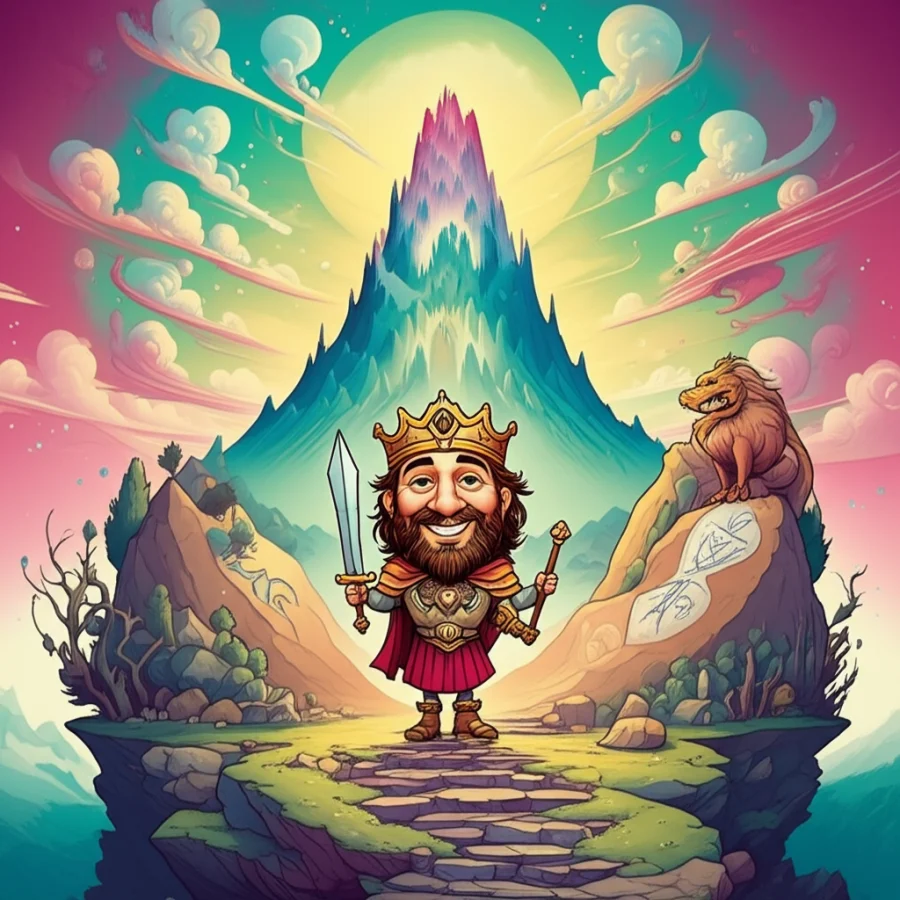
One Samhain, a brave warrior-king named Pwyll, Prince of Dyfed, rode out to hunt. He was known for his courage and his respect for the land. He stumbled upon a strange and unsettling scene. He found a pack of hounds chasing a stag, and another pack of hounds, belonging to a stranger, chasing the same prey. Pwyll, intrigued and slightly bewildered, drove off the stranger’s hounds and sent his own to the chase.
Later, the stranger, Arawn, ruler of Annwn, appeared before Pwyll. Arawn was a figure of imposing stature, with a noble bearing and a deep, knowing gaze. Instead of anger, Arawn spoke with respect. He explained that he had been hunting his own prey, but that Pwyll had unknowingly helped him. He then proposed a bargain. Arawn needed Pwyll’s help to defeat a rival in Annwn, a king who was causing him trouble. In return, Pwyll would be granted the wisdom and strength of the Otherworld.
The agreement was made. For a year and a day, Pwyll would take Arawn’s place in Annwn, appearing as Arawn to the people of the Otherworld. He was to rule with justice and wisdom, and to refrain from any romantic entanglement with Arawn’s wife. Meanwhile, Arawn would take Pwyll’s place in Dyfed.
Pwyll, in the guise of Arawn, ruled the Otherworld with grace. He held feasts, dispensed justice, and maintained the peace. He resisted temptation, remaining true to his word. After a year and a day, the time came for them to switch back. Pwyll and Arawn met, each returned to their own kingdom. Both had learned much. Pwyll, now known as Pwyll, Prince of Annwn, was wiser, more powerful, and a better ruler than before. The encounter with Arawn and the experience in the Otherworld had transformed him. He had faced his fears, resisted temptation, and returned stronger and more attuned to the unseen forces that shaped the world. The songs of Annwn, the echoes of the Otherworld, remained with him, a constant reminder of the mysteries that lay just beyond the veil.
Symbolism and Meaning:
The story of Samhain and Annwn is rich in symbolism. The thinning of the veil during Samhain represents the liminal space between life and death, between the known and the unknown. The journey into Annwn can be seen as a metaphor for the human experience, a journey through the challenges and mysteries of life. The character of Arawn represents the enigmatic nature of the Otherworld and the acceptance of death as a part of life’s cycle. The bargain between Pwyll and Arawn highlights themes of honor, loyalty, and the importance of keeping one’s word. The story also speaks to the transformative power of experience, the idea that facing one’s fears and embracing the unknown can lead to growth and wisdom.
The ritualistic aspect of Samhain further reinforces the symbolism. The lighting of bonfires, for example, was believed to ward off evil spirits and provide light and warmth during the darkest time of year. Feasting and celebrating the harvest symbolized gratitude for the bounty of the earth, while offerings to the dead acknowledged their role in the cycle of life.
Modern Perspective:
The myth of Samhain and Annwn continues to resonate in modern culture. It serves as inspiration for various forms of creative expression. In literature, it has informed fantasy novels, short stories, and poems exploring themes of death, the afterlife, and the relationship between the living and the dead. In film, it has inspired horror movies, fantasy epics, and documentaries exploring Celtic history and mythology. Games, both tabletop and video games, often feature characters and settings inspired by the Otherworld and the Celtic myths. Cultural studies often analyze the story as a reflection of ancient Celtic values and beliefs, examining its historical context and its enduring appeal. The themes of transformation, the journey into the unknown, and the power of storytelling continue to captivate audiences.
Conclusion:
The tales of Samhain and Annwn are not meant to be taken as literal accounts of reality. They are cultural narratives, products of a specific time and place, and were crafted to explain the world as ancient people understood it. These stories were a way for them to grapple with the mysteries of life, death, and the unseen forces that shaped their world. They are a testament to the power of human imagination and the enduring appeal of storytelling.
As Muslims, we believe in the absolute oneness of Allah, the Creator and Sustainer of all things. We recognize that only Allah possesses true power and knowledge. The narratives of the Celtic myths and other similar traditions are valuable for their cultural and historical significance, for they allow us to appreciate the creativity and worldview of other peoples, as well as to reflect on the diversity of human experience. These stories, while beautiful and imaginative, are not to be confused with divine truth. Instead, they are echoes of the past, whispers from a time when people sought meaning and understanding through the power of stories.