fufufafa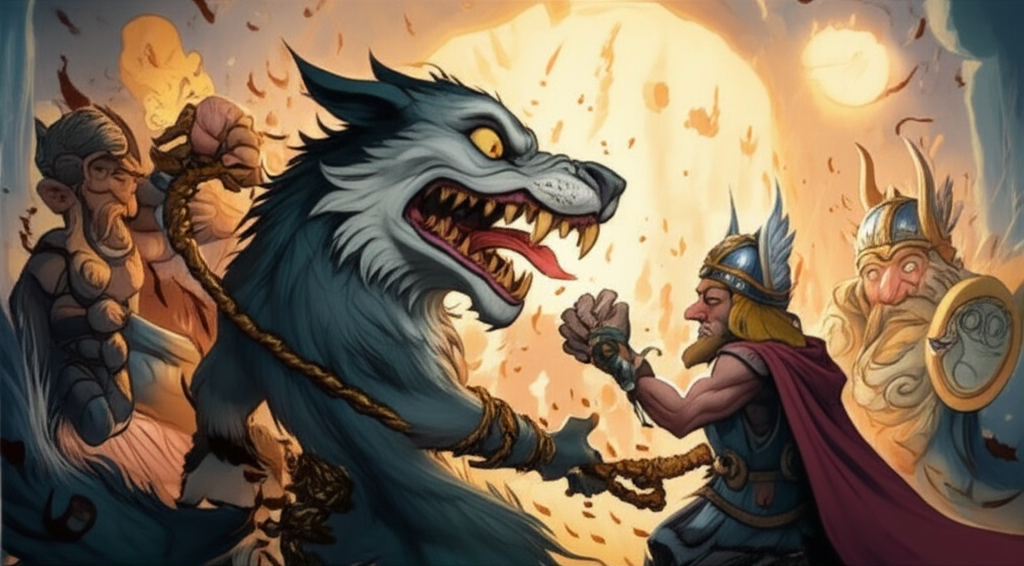
In the frigid north, where the aurora painted the sky with ethereal light and the long winters instilled a deep respect for nature’s raw power, ancient Norse storytellers spun tales of gods, giants, and the cosmic order. These were not mere bedtime stories, but rather complex narratives that helped them understand the world around them, their place within it, and the forces they believed shaped their destinies. Among these compelling myths, one of the most potent and chilling is the prophecy of Fenrir, the monstrous wolf whose fate is inextricably linked to the mighty World Tree, Yggdrasil. This is a traditional story, a testament to the rich tapestry of human imagination and the enduring power of narrative to explore fundamental questions of existence.
The cultural milieu from which this myth arose was that of the early Germanic peoples, particularly those who settled in Scandinavia. Their lives were often harsh, dictated by the rhythms of agriculture, the perils of seafaring, and the constant threat of the elements. Their worldview was deeply imbued with a sense of fate, or wyrd, a cosmic tapestry of interconnected events that even the gods were bound to. They saw the world as a dynamic and often perilous place, where order was fragile and constantly threatened by chaotic forces. The gods, powerful as they were, were not omnipotent in the absolute sense; they too were subject to the grand design of fate, and their ultimate struggle against the forces of destruction was a central theme in their mythology. Their stories were a way to grapple with the cyclical nature of life, death, and rebirth, and the ever-present possibility of annihilation.
At the heart of this particular prophecy lies Fenrir, a creature of immense power and terrifying potential. Fenrir is depicted as a colossal wolf, a monstrous offspring of the trickster god Loki and the giantess Angrboda. His physical attributes are described as immense: a gaping maw that could swallow the sun, teeth sharper than any blade, and a fur coat as dark as the deepest night. However, his symbolic attributes are even more significant. Fenrir represents untamed primal force, chaos, and the destructive potential that lies dormant within the world. He embodies the fear of the uncontrollable, the brute strength that can shatter even the most carefully constructed order. His growth is a terrifying manifestation of this uncontrolled power, a constant threat that looms over the divine realm.
The narrative of Fenrir’s binding begins with the gods, particularly Odin, the All-Father, recognizing the dire prophecy associated with the wolf. They witnessed his rapid and alarming growth, his increasingly aggressive nature, and the chilling whispers of his destined role in Ragnarok, the twilight of the gods. This was not a creature to be merely tamed; its very existence was a harbinger of destruction. Fearing the inevitable, the gods, in their wisdom and perhaps desperation, devised a plan to bind Fenrir. They presented him with a series of increasingly formidable chains, each designed to hold him. The first two, called Gleipnir and Laerding, were easily broken by the wolf’s incredible strength. However, the third, a magical fetter forged by the dwarves from the sound of a cat’s footsteps, the breath of fish, the roots of a mountain, and the sinews of a bear, proved to be the ultimate restraint. This seemingly ephemeral yet incredibly strong binding, named Gleipnir, was a testament to the ingenuity and the desperate measures taken by the gods.
The binding of Fenrir was not a simple act of subjugation. It was a cunning trap, a testament to the Norse gods’ understanding that brute force alone could not contain such a force of nature. The gods approached Fenrir with a deceptive offer of a game, a test of his strength. He was told that they wished to bind him to prove his power. Fenrir, arrogant in his might and perhaps sensing a deeper, inevitable fate, agreed. He allowed the gods to place Gleipnir around his neck. However, as the magical binding tightened, Fenrir realized the deception. He struggled fiercely, but the fetter held fast. In his rage and despair, he bit off the hand of Tyr, the god of law and justice, who had bravely placed his hand in Fenrir’s mouth as a pledge of good faith. This act of defiance and sacrifice became a permanent scar, a stark reminder of the price of confronting unchecked chaos. To prevent Fenrir from ever breaking free, the gods then thrust a sword into his open jaws, its hilt pointing upwards, thus forcing his mouth open and preventing him from closing it. He was then cast into the deepest abyss, chained to the roots of Yggdrasil, the cosmic tree that connected all the realms. There he waits, bound by the prophecy, his howls echoing through the ages, a constant reminder of the impending doom of Ragnarok.
The symbolism embedded within the story of Fenrir’s binding is rich and multifaceted. Fenrir himself can be seen as a symbol of unchecked ambition, uncontrolled power, and the destructive forces that lie dormant within any society. His eventual breaking of his bonds and his role in Ragnarok represent the inevitable triumph of chaos over order, a recurring theme in Norse mythology, suggesting that even the gods’ efforts to maintain balance are ultimately temporary. The binding itself, particularly the use of Gleipnir forged from intangible elements, can be interpreted as a representation of how true control is not always achieved through physical might, but through cunning, understanding, and the manipulation of intangible forces like trust and deception. Tyr’s sacrifice of his hand symbolizes the cost of leadership and the necessary sacrifices required to protect the community from grave threats. Yggdrasil, the World Tree, acts as a symbol of cosmic order and interconnectedness. Fenrir’s binding to its roots signifies that even the most destructive forces are ultimately part of the larger cosmic structure, albeit a disruptive one.
In the modern world, the myth of Fenrir continues to resonate. It finds expression in literature, from fantasy novels that draw inspiration from Norse lore to academic studies of mythology. Fenrir is a popular figure in video games, where he often serves as a formidable antagonist, embodying raw power and destructive intent. These interpretations often focus on his ferocity, his connection to the apocalypse, and the epic struggle against him. Scholars of cultural studies analyze these narratives to understand the anxieties, values, and worldview of the societies that created them. The enduring appeal of Fenrir lies in his primal nature and the universal themes of control, chaos, and the inevitability of change.
In conclusion, the binding of Fenrir is a profound narrative from the ancient Norse tradition, a story that offered their people a framework for understanding the world, the forces of nature, and the concept of fate. It is a powerful tale born from imagination, reflecting their anxieties about chaos and their reverence for order. As Muslims, we recognize that only Allah, the Almighty, is the true Creator and Sustainer of all existence. Our understanding of the world is guided by divine revelation and the teachings of Islam. However, by studying these ancient stories, we gain valuable insight into the rich tapestry of human cultural heritage, the enduring power of storytelling, and the diverse ways in which humanity has sought to make sense of the mysteries of life. These myths serve as a reminder of our shared human capacity for imagination and the diverse ways in which cultures have grappled with fundamental questions about existence, order, and destruction.