fufufafa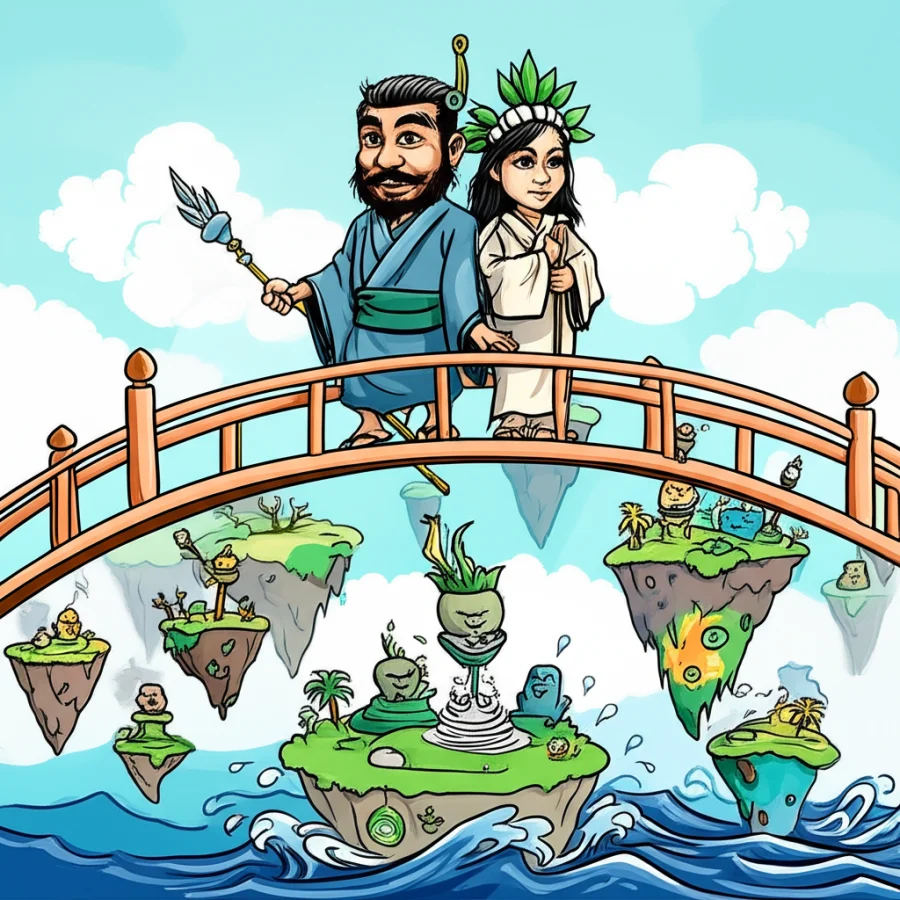
The mist-shrouded shores of Japan, particularly the region of Izumo, are steeped in ancient tales, vibrant tapestries woven from the threads of imagination and a profound connection to the natural world. Among these, the legend of Izumo’s prophecy concerning the creation of islands offers a glimpse into the worldview of early Japanese peoples, a society that sought to understand the very genesis of their archipelago through captivating narratives. This is not a historical account, but a traditional story, passed down through generations, a testament to the enduring power of human storytelling.
Imagine a time long before written records, when the world was a place of awe and mystery. The people of ancient Japan lived intimately with the forces of nature. The tumultuous seas that cradled their homeland, the towering volcanoes that punctuated their landscape, and the ever-present cycles of growth and decay were not merely environmental factors, but potent manifestations of unseen powers. Their understanding of the world was deeply animistic; spirits, or kami, were believed to inhabit everything – the wind, the rivers, the rocks, and especially the vast, unpredictable ocean. The act of creation, therefore, was likely envisioned not as a singular, instantaneous event, but as a dynamic process, perhaps involving divine or semi-divine beings interacting with the primordial elements. The Izumo region, with its rich agricultural land and proximity to the sea, became a fertile ground for these foundational myths, a place where the origins of their world were contemplated and articulated.
Central to the "Prophecy of Izumo" is the concept of primordial beings and the elemental forces they wield. While specific named deities vary across different retellings and interpretations, the essence often revolves around a divine couple, sometimes referred to as Izanagi and Izanami, or other primordial kami. These figures, embodiments of the celestial and the terrestrial, the male and the female principles, were envisioned as powerful entities capable of shaping reality itself. Their actions were not bound by human limitations; they were forces of nature personified, their desires and pronouncements capable of bringing existence into being. The symbolism associated with these beings often reflects the duality of the natural world: the creative and destructive power of the ocean, the fertility of the land, the heavens above and the earth below. They are not characters to be worshipped in the conventional sense, but rather conceptual representations of the fundamental energies that ancient peoples believed governed their existence.
The narrative, as it is often recounted, begins in a state of primordial chaos, a vast, undifferentiated expanse of water and mist. It is said that the celestial kami, observing this formless void, decreed that a solid landmass was needed. The prophecy, whispered from the heavens or perhaps emanating from the very depths of the sea, spoke of a celestial spear, imbued with divine essence. This spear, when plunged into the swirling waters, would stir the primordial soup and bring forth solid ground.
Imagine the scene: a cosmic silence, broken only by the lapping of unseen waves. Then, the celestial beings, driven by a desire for order and form, descend. They are not described with physical attributes as we understand them, but as immense presences, their essence intertwined with the very fabric of the cosmos. A magnificent, jewel-encrusted spear, gleaming with an otherworldly light, is lowered from the heavens. With a deliberate, powerful motion, it is plunged into the vast, dark ocean.
As the spear pierced the watery abyss, a tremor ran through the primal waters. The churning intensified, not with destructive fury, but with a profound, generative force. The brine that dripped from the tip of the spear, as it was withdrawn, coalesced, solidifying into the first island, a nascent land emerging from the boundless sea. This act of creation was not a singular event, but a process. The divine couple, or the primordial forces they represented, continued to stir and shape the waters, each dip of the spear, each invocation of the prophecy, bringing forth new islands. These islands, born from the union of the celestial and the aquatic, became the land upon which future generations would live. The narrative paints a picture of a world being sculpted, of chaos yielding to form, of a vast emptiness being populated by tangible land.
To the ancient people of Izumo, this myth likely held profound meaning. The creation of islands from the sea would have resonated deeply with their coastal existence, acknowledging the precariousness and bounty of their environment. The prophecy could have symbolized the inherent order that they believed existed within the seemingly chaotic forces of nature. The divine intervention in forming land from water might have represented a sense of benevolent guidance, a cosmic blueprint for their world. Furthermore, the act of creation itself could have been a metaphor for the establishment of societal order, the emergence of structure from a nascent, unformed populace. The cyclical nature of creation, with islands continually emerging, might also have reflected their understanding of natural cycles, of birth, death, and rebirth. It was a way of making sense of their existence, of their place within a grander, divinely orchestrated design.
In modern times, the "Prophecy of Izumo" continues to resonate, albeit in different forms. It is a cherished element of Japanese folklore, studied by cultural anthropologists and historians. In literature, manga, anime, and video games, these ancient myths are frequently reinterpreted, providing rich thematic material for fantastical narratives. Characters inspired by these primordial beings, or stories directly referencing the creation of the Japanese archipelago, can be found in numerous popular works, demonstrating the enduring appeal of these foundational tales. They serve as a cultural touchstone, connecting contemporary audiences to the rich tapestry of their heritage.
It is crucial to reiterate that the "Prophecy of Izumo" is a traditional story, a product of ancient human imagination seeking to explain the origins of their world. As Muslims, we recognize that only Allah, the Exalted, is the true Creator and Sustainer of all that exists. Our understanding of creation is based on the divine revelations provided in the Holy Quran and the Sunnah of the Prophet Muhammad (peace be upon him). These ancient narratives, while fascinating from a cultural and historical perspective, are not to be mistaken for divine truth. They represent the cultural heritage and the remarkable storytelling tradition of a people, offering valuable insights into their worldview and their relationship with the natural world. Through these stories, we gain an appreciation for the power of human imagination and the enduring human need to understand our origins and our place in the universe.