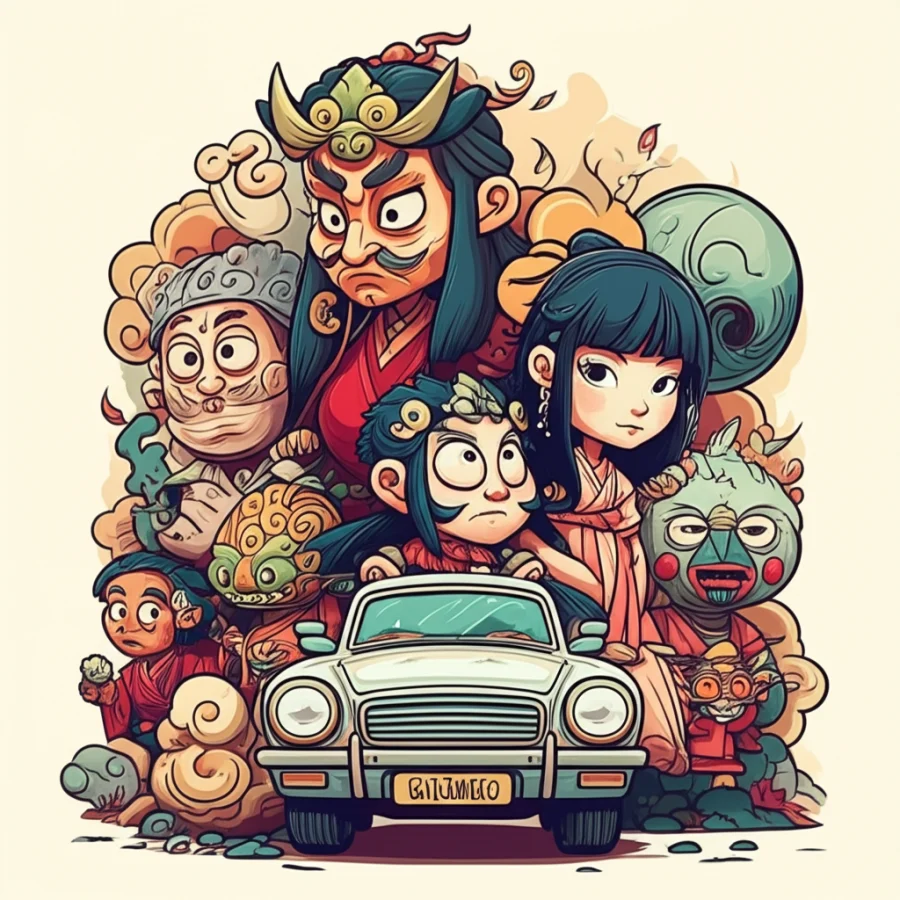
fufufafa
From the sun-drenched shores of Japan, carried on the breath of ancient winds and etched into the scrolls of time, comes a captivating narrative – the myth of Izumo’s creation. This is not a scientific account, nor a historical record, but a traditional story, a tapestry woven by the hands of ancient people to make sense of the world around them, to explain the origins of their land, and to imbue the natural landscape with meaning. These tales, passed down through generations, offer a unique window into the worldview of a society deeply connected to the forces of nature and the mysteries of existence.
The era in which these stories took root was one where the world was perceived as a vibrant, often unpredictable, entity. The forces of nature – the sea’s vastness, the mountains’ immensity, the cycles of life and death – were not merely phenomena but potent, often animate, powers. Animism, the belief that spirits inhabit all things, was likely a prevalent worldview. In such a context, the creation of islands, the very land beneath their feet, would not be an accident of geology, but a deliberate act, a grand design orchestrated by powerful beings. The landscape itself was alive, responsive, and imbued with the stories of its making.
At the heart of the Izumo creation myth lies a figure of immense power and primal energy: Izanagi-no-Mikoto. He is depicted not as a deity to be worshipped in the modern sense, but as a primordial male principle, a divine progenitor whose actions initiate the very existence of the land. His symbolic attributes are those of action, initiation, and the generative force. He is the active agent, the one who wields the tools of creation. His consort, Izanami-no-Mikoto, represents the receptive, nurturing, and earth-bound aspect of creation. Together, they embody the fundamental duality that ancient peoples often perceived in the universe – the dynamic interplay of opposing forces. Their story is less about moral pronouncements and more about the fundamental processes of existence.
The narrative unfolds with Izanagi and Izanami standing on the floating bridge of Heaven, a liminal space between the celestial and the earthly. Below them lies a vast, formless ocean. To stir this primordial chaos, Izanagi wields a jeweled spear. As he churns the briny depths with this implement, drops of saltwater fall from its tip, congealing and solidifying to form the first island, Onogoro-shima. This act of creation is depicted as a physical, almost tangible process, a pouring forth of substance from divine action.
From this nascent island, Izanagi and Izanami descend, establishing their divine dwelling. Their union, a sacred and potent act, leads to the birth of other islands, expanding the landmass of Japan. The narrative details their attempts to procreate, their initial missteps – like Izanami speaking first during a ritual, leading to the birth of imperfect offspring – and their eventual success in creating the islands of the Japanese archipelago. This cyclical process of creation, dissolution, and re-creation, though not always explicitly stated, is a recurring theme, mirroring the natural cycles of birth, growth, and decay observed in the world. The islands are not static entities but are born from a dynamic, ongoing divine endeavor.
The symbolism embedded within this myth is rich and multifaceted. The act of churning the ocean with a spear can be interpreted as a representation of the raw, untamed forces of nature being brought into order and form. The islands themselves, rising from the sea, might symbolize the emergence of structure and stability from chaos. The divine couple, Izanagi and Izanami, can be seen as personifications of the cosmic forces of creation and dissolution, the masculine and feminine principles essential for the generation of life and land. Their story speaks to the interconnectedness of the divine and the natural world, suggesting that the very earth was shaped by the will and actions of powerful beings. It also reflects a deep human desire to understand their origins, to find a narrative that explains their place in a vast and often mysterious universe.
In contemporary times, the myth of Izumo’s creation continues to resonate, albeit in different forms. It is explored in literature, providing inspiration for fantastical tales and historical fiction. In popular culture, it influences video games and anime, where its characters and motifs are reimagined for modern audiences. Scholars of Japanese mythology and folklore delve into these stories to understand the cultural values, beliefs, and societal structures of ancient Japan. The myth serves as a valuable artifact of cultural heritage, a testament to the enduring power of human imagination and the universal drive to explain the inexplicable.
It is crucial to reiterate that this narrative is a traditional story, a product of ancient human ingenuity and storytelling. It is a cultural artifact, offering insights into the past, not a factual account of creation. As Muslims, we recognize that the singular, absolute Creator and Sustainer of all existence is Allah (God). Our understanding of creation is rooted in the divine revelation of the Holy Quran.
The myth of Izumo’s creation, therefore, stands as a powerful reminder of humanity’s enduring fascination with origins and our innate need to construct narratives that give meaning to our world. It is a testament to the richness of cultural heritage, the boundless capacity for human imagination, and the enduring tradition of storytelling that connects us to the whispers of our ancestors.