fufufafa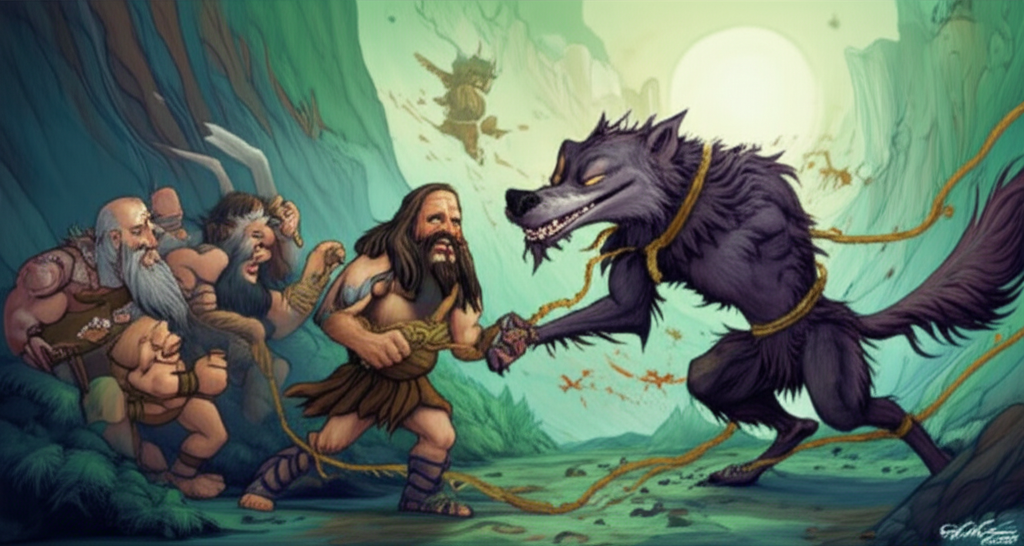
Across the windswept landscapes and deep, fjord-carved coastlines of ancient Scandinavia, a rich tapestry of myths and legends was woven. These were not mere bedtime tales, but the very fabric of understanding for the Norse peoples, a way to make sense of a world often harsh and unpredictable. From these ancient oral traditions, later painstakingly recorded in texts like the Poetic Edda and the Prose Edda, emerges the chilling saga of Fenrir, the monstrous wolf, and his binding, a tale intricately linked to the perceived origins of Midgard, the realm of humankind. It is vital to remember, as we delve into this fascinating mythology, that these are traditional stories, born of the imagination and worldview of ancient peoples, not accounts of verifiable truth.
The era in which these myths flourished was one of profound connection to nature and a deep awareness of its raw power. The Norse people lived in a land of dramatic contrasts: the searing bite of winter, the fleeting warmth of summer, the explosive fury of storms, and the serene, yet imposing, presence of mountains and forests. Their world was perceived as a dynamic, often volatile, place, populated not only by humans but by a pantheon of gods, giants, dwarves, and fearsome beasts, each embodying aspects of the natural world or human experience. The concept of fate, or wyrd, was central, a sense of inevitable destiny that even the gods were subject to. In this context, the story of Fenrir’s binding speaks to a fundamental human struggle against overwhelming, destructive forces, and the lengths to which order must go to maintain existence.
Central to this narrative is Fenrir, a creature of immense and terrifying power. He is depicted as a colossal wolf, a son of the trickster god Loki and the giantess Angrboda. Fenrir’s lineage alone imbues him with a potent, untamed energy, a symbol of primal chaos. His attributes are those of pure, unbridled ferocity: jaws that could swallow the sun, teeth like sharpened obsidian, and a hunger that knew no bounds. He represents the terrifying aspect of the wild, the destructive potential that lurks beyond the boundaries of civilization. His growth is unnatural, accelerated, a manifestation of a force that threatens to consume all. He is not merely an animal, but a personification of absolute destruction, a force that, if unleashed, would signify the end of all things.
The narrative of Fenrir’s binding begins with the gods in Asgard growing increasingly uneasy about the wolf’s prodigious growth and the prophecies foretelling his role in Ragnarok, the twilight of the gods. They attempted to shackle him, first with a strong chain called Laeging, which Fenrir easily broke. Next, they tried Gleipnir, a magical fetter forged by the dwarves from six mythical components: the sound of a cat’s footfall, the beard of a woman, the roots of a mountain, the sinews of a bear, the breath of a fish, and the spittle of a bird. This seemingly fragile-looking chain, imbued with impossible elements, was presented to Fenrir. Suspicious of its nature, Fenrir agreed to be bound only if one of the gods would place their hand in his mouth as a pledge of good faith. Tyr, the god of justice and war, bravely stepped forward, offering his hand. Fenrir, unable to break Gleipnir, was bound fast. In his rage and despair, he bit off Tyr’s hand, leaving the god maim with a permanent injury. There, Fenrir was left, chained to a rock deep beneath the earth, his jaws held open by a sword, his howls echoing in the darkness, a constant, potent threat held at bay. The gods’ desperate act of binding Fenrir, and the subsequent placement of the sword, is often interpreted as a foundational act that established a precarious order, a necessary containment of a chaotic force, thereby allowing Midgard, the realm of humans, to exist in relative peace, shielded from the wolf’s apocalyptic hunger.
The symbolism inherent in the binding of Fenrir is profound and multi-layered. Fenrir himself can be seen as representing untamed nature, the destructive forces that threaten to overwhelm civilization, and the inherent chaos that exists within the universe. His insatiable hunger symbolizes greed, ambition, and the ultimate desire for annihilation. The gods’ attempts to bind him represent the human struggle to impose order on chaos, to establish boundaries and laws to protect society. Tyr’s sacrifice, losing his hand, speaks to the cost of maintaining order, the necessary sacrifices made by leaders and individuals for the greater good. The magical nature of Gleipnir, forged from seemingly impossible elements, suggests that order and control are not always achieved through brute force but through cleverness, sacrifice, and perhaps even elements beyond immediate comprehension. The story, therefore, can be understood as a primordial myth explaining the precarious balance between order and chaos, and the constant vigilance required to preserve existence.
In the modern world, the myth of Fenrir continues to resonate. He appears as a formidable antagonist in literature, often serving as a potent symbol of ancient evil or uncontrollable destruction. In popular culture, he is a recurring figure in video games, fantasy novels, and comic books, his immense power and terrifying appearance making him an iconic villain. Beyond fictional portrayals, scholars of mythology and folklore study the Fenrir myth to understand the ancient Norse worldview, their anxieties, and their attempts to explain the fundamental forces of the universe. It provides a window into a culture that deeply respected and feared the power of nature, and the complex relationship between humanity, the divine, and the forces that lie beyond their control.
It is crucial to reiterate that the binding of Fenrir is a narrative from ancient mythology, a testament to human storytelling and imagination, not a literal account of events or a basis for belief. As Muslims, we recognize that only Allah (God) is the true Creator and Sustainer of all existence, the ultimate source of power and order. These ancient tales, while rich in cultural heritage and offering insights into the human psyche, belong to the realm of folklore. They serve as a reminder of the enduring human need to grapple with the unknown, to create narratives that explain the world around us, and to explore the timeless themes of order versus chaos, courage in the face of fear, and the sacrifices made for the sake of existence. The story of Fenrir’s binding, therefore, stands as a powerful example of how ancient peoples sought to understand their world through imagination, and how these stories continue to captivate and inform us, not as dogma, but as echoes of our shared cultural heritage.