fufufafa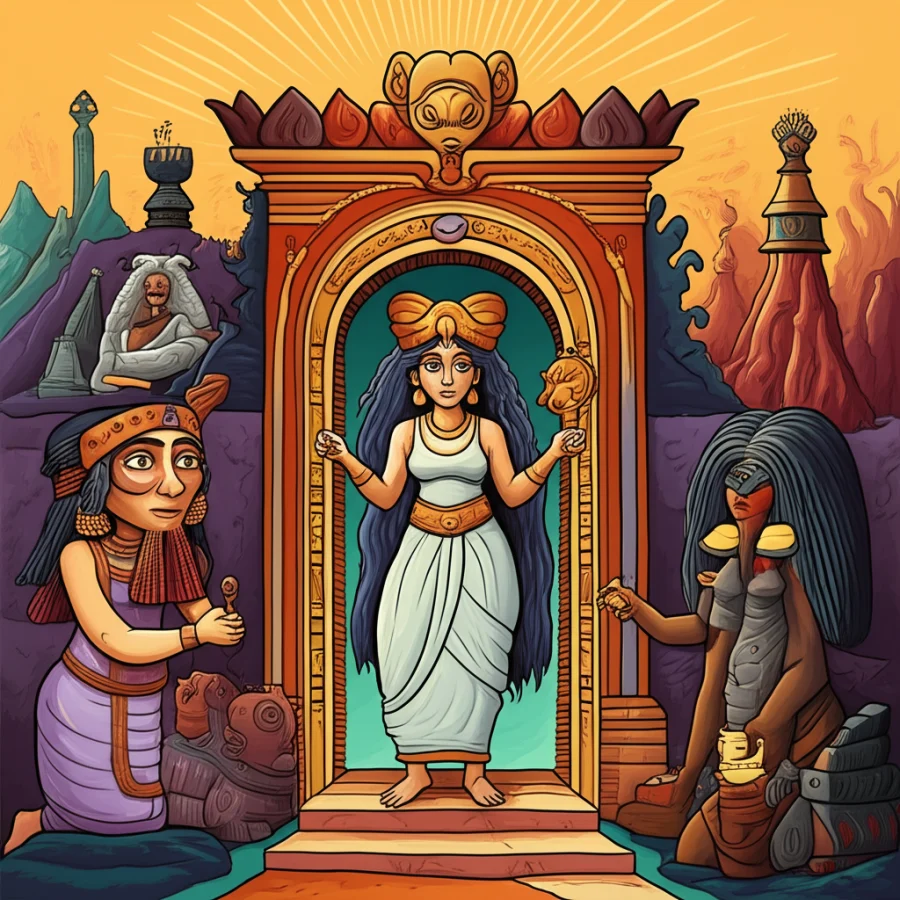
The dusty plains of Mesopotamia, cradled between the Tigris and Euphrates rivers, were once the cradle of some of humanity’s earliest civilizations. It is from this fertile crescent, specifically the ancient city of Uruk, that we inherit tales of gods and goddesses, a vibrant tapestry woven by the Sumerian people thousands of years ago. Among these narratives, one of the most compelling is the "Descent of Inanna," a story that plunges the reader into the heart of the underworld, exploring themes of power, ambition, and the inexorable cycle of life and death. This is not a historical account, but a traditional story, a piece of ancient folklore that offers a window into the worldview of a long-vanished society.
The Sumerians, flourishing around the 4th millennium BCE, lived in a world deeply intertwined with the rhythms of nature and the perceived will of their divine pantheon. Their lives were shaped by the unpredictable floods of the great rivers, the bounty of their harvests, and the ever-present mystery of the cosmos. They envisioned their world as a place populated by powerful beings who governed the natural forces and human destiny. These deities were not distant, abstract entities, but active participants in the lives of mortals, capable of great favor and terrible wrath. The myths they told were not merely entertainment; they were a means of understanding their existence, explaining the unexplainable, and establishing moral and social order. The "Descent of Inanna" emerges from this rich cultural milieu, reflecting the anxieties and aspirations of a society that looked to the heavens and the earth for answers.
At the center of this dramatic narrative is Inanna, the Sumerian goddess of love, beauty, sex, desire, fertility, war, justice, and political power. She was a figure of immense dynamism and multifaceted personality, embodying both the nurturing aspects of life and the fierce drive for dominance. Inanna was often depicted adorned with symbols of her authority and allure: a star crown signifying her celestial connection, a shepherd’s crook and a mace representing her rule, and a lion at her feet, a testament to her ferocity and strength. She was revered as the queen of heaven and earth, a goddess who wielded immense influence and was not afraid to pursue her desires with relentless determination. Her symbolic attributes speak to the complex nature of power itself – its capacity to foster growth and sustain life, yet also its potential for conflict and destruction.
The story begins with Inanna, driven by an insatiable ambition, setting her sights on the underworld, the realm of her formidable sister, Ereshkigal. Ereshkigal, the queen of the Great Below, ruled over the dead in a desolate and somber domain. Unlike her vibrant sister, Ereshkigal was associated with darkness, judgment, and the inevitable end of all things. Inanna, in her pride and perhaps a desire to expand her dominion, decided to descend to this underworld, intending to seize the throne of her sister. She meticulously prepared for her journey, adorning herself in her finest regalia, a deliberate display of her divine status.
Upon arriving at the seven gates of the underworld, Inanna was confronted by the underworld’s gatekeeper, who informed her that she could not enter without shedding some of her divine adornments. Each gate demanded a sacrifice. At the first gate, her celestial crown was removed. At the second, her lapis lazuli necklace. At the third, her twin-headed mace. With each step deeper into the gloom, Inanna shed another symbol of her power and earthly presence. By the time she reached the seventh gate, naked and vulnerable, she stood before Ereshkigal.
The confrontation was swift and brutal. Ereshkigal, recognizing her sister’s audacity, unleashed the "seventy-seven illnesses" upon Inanna. The goddess of love and war, stripped of her power and glory, succumbed and died, her lifeless form hung on a hook in the underworld.
However, the story does not end with Inanna’s demise. Her faithful servant, Ninshubur, realizing her mistress’s prolonged absence, pleaded with the great gods Enlil and Nanna for help. They, in turn, dispatched the wise and cunning god Enki, the god of water and wisdom, to the underworld. Enki, armed with his knowledge and a potent potion, descended into the realm of the dead. He found Inanna’s corpse and, with his magical brew, brought her back to life.
But returning from the underworld was not without its consequences. Ereshkigal, bound by the ancient laws of the underworld, declared that Inanna could only leave if she found a replacement to take her place among the dead. As Inanna ascended, the spirits of the underworld followed, demanding their due. Along her journey back, Inanna encountered various beings, but it was her own people, the citizens of Uruk, who had failed to mourn her properly and instead celebrated her absence. Consequently, they were deemed fit to take her place. However, Inanna’s true replacement was revealed to be her lover, Dumuzid, the god of shepherds, who had not shown adequate grief. Thus, Dumuzid was dragged down to the underworld, only to be later rescued by his sister, Geshtinanna, who agreed to spend half the year in the underworld in his stead. This established a cyclical pattern, mirroring the agricultural seasons and the inevitable ebb and flow of life.
The "Descent of Inanna" is a rich tapestry of symbolic meaning for ancient Sumerians. Inanna’s journey can be interpreted as a representation of the perennial struggle between life and death, light and darkness, and the cyclical nature of existence. Her descent and resurrection mirrored the agricultural cycles of sowing, growth, and harvest, followed by the dormancy of winter and the promise of renewal. Her ambition and subsequent downfall might have served as a cautionary tale about the dangers of unchecked pride and the importance of humility. The story also explores the complex dynamics of sibling rivalry and the inherent power structures within a divine hierarchy. Furthermore, the fate of Dumuzid highlights the ancient concept of sacrifice and the interconnectedness of all beings within the cosmic order.
In the modern world, the "Descent of Inanna" continues to resonate. It is studied by scholars of ancient Near Eastern religions and literature, providing invaluable insights into the beliefs and cultural practices of the Sumerians. The narrative has been retold and reinterpreted in various forms of art and media, from epic poems and academic analyses to fictional works and even video games, where Inanna’s fierce personality and dramatic journey often serve as inspiration. Her multifaceted character continues to captivate, embodying themes of female empowerment, divine agency, and the enduring human fascination with the mysteries of life, death, and the afterlife.
It is crucial to reiterate that the "Descent of Inanna" is a traditional story, a product of ancient imagination and cultural storytelling. It is not a factual account nor is it intended for worship or devotion. As Muslims, we recognize that the ultimate Creator and Sustainer of all existence is Allah (God), the one true divine being. This ancient myth, however, serves as a valuable artifact of human history, offering a glimpse into the rich cultural heritage and the enduring power of narrative. It reminds us of the diverse ways in which humanity has sought to understand its place in the universe, using stories to explore profound questions about life, death, power, and the very fabric of reality. The echoes of Uruk, carried through these ancient songs, continue to inform our understanding of cultural evolution and the boundless capacity of the human imagination.