fufufafa
The sands of time hold countless stories, whispers of ancient beliefs and imaginings that have shaped human understanding of the world. Among these, the vibrant tapestry of ancient Egyptian mythology offers a fascinating glimpse into a civilization deeply connected to its environment and its understanding of life, death, and the cosmos. From this rich cultural heritage emerges the tale of Sobek, the crocodile god, and his integral role in the ultimate judgment of the soul – the Weighing of the Heart. This narrative, passed down through generations, is not a testament to literal belief today, but a valuable window into the worldview of a bygone era, offering insights into their moral compass, their fears, and their hopes for an afterlife.
The ancient Egyptians flourished for millennia along the life-giving banks of the Nile River. Their society was intrinsically tied to the rhythm of the river’s inundation, the fertile soil it deposited, and the predictable cycle of its rise and fall. This environment, brimming with both bounty and peril, shaped their understanding of the divine. They saw the natural world as infused with spiritual power, and many of their gods were personifications of natural forces and creatures. The Nile itself was a divine entity, and the creatures that inhabited it, like the formidable crocodile, held a special significance. In this context, it is understandable that a creature capable of both providing sustenance and posing a deadly threat would be imbued with powerful symbolism. The Egyptians were a pragmatic people, but their worldview was also steeped in a profound sense of order, justice, and the cyclical nature of existence, including the transition from life to what lay beyond.
Central to this narrative is Sobek, often depicted as a man with the head of a crocodile, or sometimes as a full crocodile. This formidable figure embodied the dual nature of the crocodile: its immense power, its predatory prowess, but also its association with fertility and the life-giving waters of the Nile. Sobek was not solely a terrifying force; he was also a protector, a deity associated with strength, virility, and the preservation of order. His symbolic attributes were those of the predator – sharp teeth, watchful eyes, and an unyielding grip – but these were interwoven with the life-giving aspects of the Nile, representing a raw, untamed power that could be both destructive and nurturing. He was seen as a guardian of the Pharaoh and a force that could ward off evil, embodying a primal strength essential for survival in their world.
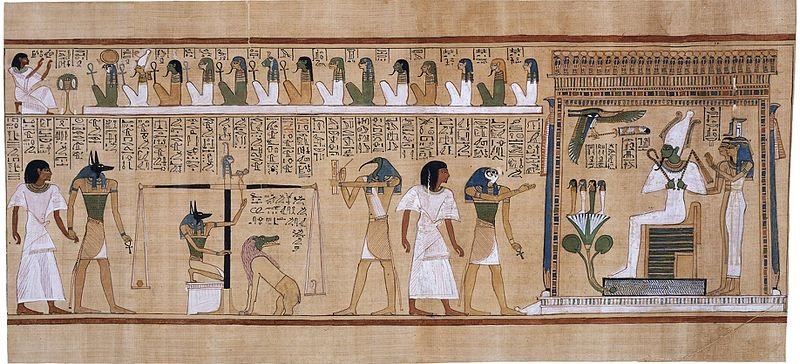
The journey of the soul after death, in the ancient Egyptian imagination, was a perilous passage culminating in a monumental judgment. This was the Weighing of the Heart, a crucial ceremony presided over by Osiris, the god of the underworld. Here, the heart of the deceased, believed to be the seat of intellect, emotion, and morality, was placed on one pan of a celestial scale. On the other pan rested the feather of Ma’at, the goddess of truth, justice, and cosmic order. It was in this sacred space, within the Hall of Two Truths, that Sobek played a pivotal role.
Imagine the scene: the deceased, guided by the jackal-headed Anubis, enters the grand hall. The air is thick with anticipation, the silence broken only by the faint whisper of ancient chants. Osiris sits upon his throne, his gaze steady and impartial. Beside the scales, the scribe Thoth meticulously records the proceedings. The heart, heavy with the weight of a lifetime’s deeds, is carefully placed on the scale. And then, there is Sobek. Positioned as a watchful guardian, his reptilian eyes, sharp and unblinking, survey the scene. His presence is a reminder of the potent forces at play, the primal power that underpins the very fabric of existence and judgment. If the heart was lighter than the feather of Ma’at, signifying a life lived in accordance with truth and justice, the deceased would be deemed worthy and granted passage into the blissful afterlife of the Field of Reeds. However, if the heart was heavier, burdened by sin and wrongdoing, it would be consumed by Ammit, a monstrous creature with the head of a crocodile, the body of a lion, and the hindquarters of a hippopotamus. This ensured eternal oblivion for the unworthy. Sobek’s presence here, therefore, was not as a judge himself, but as a powerful, symbolic witness, a force that underscored the gravity and the undeniable finality of this cosmic reckoning.
The symbolism embedded within the story of Sobek and the Weighing of the Heart is multifaceted. Sobek, as the crocodile god, represented the raw, untamed forces of nature, a power that demanded respect and understanding. His involvement in the judgment ceremony highlighted the ancient Egyptian belief that even in the afterlife, the fundamental principles of order and justice, embodied by Ma’at, were paramount. The weighing of the heart was a profound metaphor for accountability. It suggested that every action, every thought, had consequences, and that the true measure of a person’s worth was not in their earthly possessions or status, but in the purity of their heart and their adherence to ethical principles. The fear of Ammit’s devouring maw served as a powerful deterrent against wickedness, reinforcing the societal need for moral conduct.
In the modern world, the myth of Sobek and the Weighing of the Heart continues to resonate, albeit through different lenses. It is a popular motif in literature, art, and popular culture, often appearing in stories and visual media exploring ancient Egypt. Game developers frequently incorporate elements of this mythology into their creations, allowing players to interact with these ancient concepts in imaginative ways. Academically, the myth is studied by Egyptologists and scholars of comparative mythology, offering valuable insights into ancient religious beliefs, ethical frameworks, and their understanding of the human condition. It serves as a potent example of how ancient cultures grappled with universal questions about life, death, and morality.
It is crucial to reiterate that the story of Sobek and the Weighing of the Heart is a cultural narrative, a product of ancient human imagination and a reflection of their worldview. It is not a belief system to be adopted or practiced. As Muslims, we recognize that only Allah (God) is the true Creator and Sustainer of all existence, and that all judgment ultimately rests with Him. The stories of ancient peoples, while rich in cultural heritage and imaginative power, are distinct from divine revelation.
The enduring appeal of these ancient tales lies in their ability to transport us to different times and perspectives. They remind us of the vast spectrum of human storytelling traditions, the intricate ways in which civilizations have sought to make sense of the universe and their place within it. The myth of Sobek and the Weighing of the Heart, with its powerful imagery and its emphasis on moral accountability, stands as a testament to the enduring human fascination with the journey of the soul and the quest for justice, a story etched in the sands of time for us to learn from and appreciate as a remarkable piece of our shared cultural heritage.