fufufafa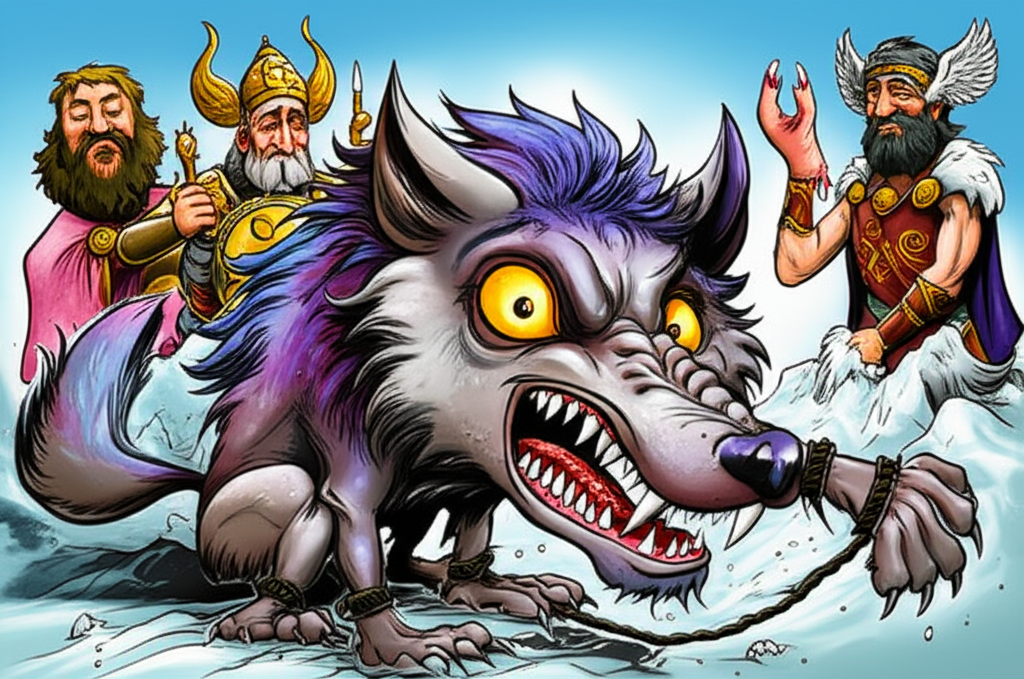
The Unbreakable Chain: Fenrir’s Binding and the Lingering Shadow Over Asgard
Disclaimer: This article explores a mythological story from Norse folklore. It is presented for cultural, historical, and educational understanding. The characters, events, and beliefs described are part of an ancient storytelling tradition and are not real. They are not intended for worship or practice.
Introduction
From the cold, windswept lands of ancient Scandinavia, a region of deep fjords, dark forests, and long, unforgiving winters, comes a rich tapestry of myths and legends. These tales, passed down through generations of Norse peoples, particularly during the Viking Age, were first spoken and sung by skalds (poets) in mead halls before being recorded centuries later, most notably in the 13th-century Icelandic texts known as the Poetic Edda and the Prose Edda. Among the most profound and ominous of these stories is the binding of the great wolf, Fenrir. This is not a simple tale of good versus evil, but a complex narrative about order, chaos, sacrifice, and the inescapable nature of destiny that haunted the imagination of the people who first told it.
Origins and Cultural Background
To understand the myth of Fenrir, one must understand the world of the Viking Age (roughly 8th to 11th centuries CE). This was a society shaped by a harsh and often brutal environment. Life was a constant struggle against the elements, and survival depended on strength, community, and a measure of luck. Their worldview was imbued with a sense of fatalism, encapsulated in the concept of Wyrd, or fate. Unlike many other belief systems where deities are all-powerful and eternal, the Norse gods, known as the Æsir and Vanir, were themselves subject to a pre-ordained doom. They were powerful, but not invincible; they were wise, but not omniscient. They knew their world, the Nine Realms, had a beginning and was prophesied to have a violent, fiery end: Ragnarök, the Twilight of the Gods. This story unfolds under the heavy shadow of that impending apocalypse.
Character Description: Fenrir, the Prophesied Doom
Fenrir, also known as Fenrisúlfr, is one of the most formidable figures in Norse mythology. He is a monstrous wolf, one of the three terrifying children of the trickster god Loki and the giantess Angrboða. His siblings were Jörmungandr, the World Serpent fated to encircle the ocean, and Hel, the half-living, half-dead ruler of the underworld. From his birth, Fenrir was a creature of alarming growth and untamed power. He was not inherently evil in the modern sense; rather, he was a being of pure, primal chaos.
Symbolically, Fenrir represents the untamable forces of nature and the destructive potential that lies just beyond the boundaries of civilization. He is the embodiment of a prophecy, a living countdown to the end of days. His ever-increasing size and strength symbolized the growing threat that the gods perceived in the wild, chaotic forces they could not control. His story is a powerful allegory for the idea that some things, no matter how ferociously they are resisted, are simply inevitable.
The Main Story: The Price of a Broken Oath
The tale begins in Asgard, the celestial stronghold of the Æsir. The gods, led by the all-father Odin, learned of a prophecy foretelling that the children of Loki would bring about their ultimate ruin. Moved by fear, Odin acted swiftly. He cast Jörmungandr into the great sea surrounding Midgard (the world of humans) and banished Hel to the grim, frozen depths of Niflheim to preside over the dead. But Fenrir was different. Perhaps seeing a chance to control the prophecy, or perhaps out of a mixture of caution and curiosity, the gods brought the young wolf cub to Asgard to raise among them.
It was a decision they would soon regret. Fenrir grew at a terrifying rate, his strength and size becoming a source of daily anxiety. Soon, only Týr, the god of law, courage, and heroic glory, was brave enough to approach the wolf to feed him. The other gods watched from a distance, their unease growing with every passing day. The prophecy echoed in their minds: this creature would one day be the death of Odin himself. They knew they had to act. They could not slay Fenrir, for to spill his blood on the sacred ground of Asgard would be an unforgivable stain, but they could not allow him to roam free. Binding him was their only option.
Their first attempt was a mighty iron fetter they called Læðingr. Presenting it to Fenrir as a game, they challenged him to test his legendary strength against it. The wolf, proud and suspecting no foul play, agreed. With a single, powerful flex of his muscles, he shattered the chain to pieces. The gods hid their dismay and praised his might, while secretly forging a second, far stronger chain named Drómi. Again, they challenged Fenrir, claiming that his fame would be eternal if he could break a fetter of such renowned craftsmanship. Fenrir hesitated, noting its strength, but his pride won out. He allowed them to bind him, and with a tremendous struggle that shook the very ground, he too broke Drómi, sending shards of iron flying.
Now, terror gripped the hearts of the Æsir. They knew no earthly chain could hold him. In desperation, Odin dispatched a messenger to Svartalfheim, the realm of the dwarves, the master craftsmen of the Nine Realms. He tasked them with forging a chain that could not be broken. The dwarves, using their deep magic, created a fetter unlike any other. They named it Gleipnir. It was as thin and soft as a silk ribbon, but it was forged from six impossible things: the sound of a cat’s footfall, the beard of a woman, the roots of a mountain, the sinews of a bear, the breath of a fish, and the spittle of a bird.
The gods took Fenrir to the isolated island of Lyngvi and presented him with the silken ribbon. They challenged him one last time, saying there could be no glory in breaking such a slender band. But Fenrir was no fool. He sensed deceit. "This thin ribbon seems to be crafted with more cunning and magic than strength," he snarled. "If I cannot break it, I will be left bound. If I do break it, the glory is small. I have no desire to be bound by it. However, lest you call me a coward, I will agree, but only if one of you places your hand in my mouth as a pledge of good faith—a guarantee that this is no trick."
A heavy silence fell over the gods. They looked at one another, none willing to make such a sacrifice. It was then that Týr, the bravest and most honorable among them, stepped forward. Without hesitation, he placed his right hand between the wolf’s colossal jaws. The other gods quickly bound Fenrir with Gleipnir. The wolf strained, thrashed, and fought with all his might, but the magical ribbon only grew tighter the more he struggled. He was trapped.
A great cheer of relief went up from the gods—all except Týr. Realizing he had been betrayed, Fenrir snapped his powerful jaws, severing Týr’s hand at the wrist. The aftermath was grim. Though secure, the gods had achieved their goal through deception and a broken oath. They took the end of Gleipnir and tied it to a great boulder, which they anchored deep within the earth. To silence his ceaseless howling, they wedged a sword in his mouth, the hilt on his lower jaw and the point against his upper jaw. There, on that lonely island, Fenrir remains bound. From his gaping mouth, a river of foam called Ván (Expectation) flows, a constant reminder of his rage and his patience. Asgard was safe, for a time, but a deep shadow had fallen. They had bought themselves a temporary peace at the cost of honor, and now a maimed god stood among them as a living symbol of their compromise. The wolf was bound, but Ragnarök was now not just a prophecy, but a promise of vengeance.
Symbolism and Meaning
To the ancient Norse people, this myth was a powerful exploration of several key themes. It represented the eternal struggle between order (the gods and their society in Asgard) and chaos (Fenrir, the untamed wilderness). The story suggests that maintaining order is a difficult, costly, and morally ambiguous task. The sacrifice of Týr is particularly poignant; the god of law and justice must sacrifice a part of himself through a dishonorable act to preserve the law and protect his people. It is a stark acknowledgment that securing civilization sometimes requires terrible compromises. Most importantly, the story is a profound statement on fate. Despite their power and cunning, the gods could not prevent their doom; they could only delay it and, in doing so, perhaps make it even more certain.
Modern Perspective
The myth of Fenrir continues to fascinate modern audiences. It has been reinterpreted in countless forms of media. In literature, authors like Neil Gaiman in his book Norse Mythology have retold the saga for a new generation. In film, the Marvel Cinematic Universe features a creature named Fenris Wolf in Thor: Ragnarok, though it is depicted as a more straightforward monstrous beast without the deep, tragic backstory of the original myth. Video games have explored the theme with greater depth; the God of War series, for instance, delves into the complex and tragic nature of Fenrir and the other figures in the Norse pantheon, focusing heavily on the themes of prophecy and the struggle to defy one’s destiny. In cultural and historical studies, the myth is analyzed as a window into the Viking psyche, revealing a worldview that accepted the harsh realities of life and the inevitability of an eventual end.
Conclusion
The Binding of Fenrir is far more than a simple monster tale; it is a profound cultural story born from a world that understood hardship and the inescapable march of time. It is a product of human imagination grappling with timeless questions of order, chaos, sacrifice, and fate. As a story, it has endured for over a millennium, not as an object of belief, but as a powerful piece of our shared global heritage.
As Muslims, we recognize that only Allah is the true Creator and Sustainer, the sole source of all power and the ultimate arbiter of destiny. These ancient myths, while not reflecting theological truth, serve as a valuable lens through which we can appreciate the diversity of human culture and the enduring power of storytelling to explore the deepest questions of the human condition. They remind us that for millennia, people all over the world have used stories to make sense of the universe, their place within it, and the shadows that lie just beyond the firelight.