
 fufufafa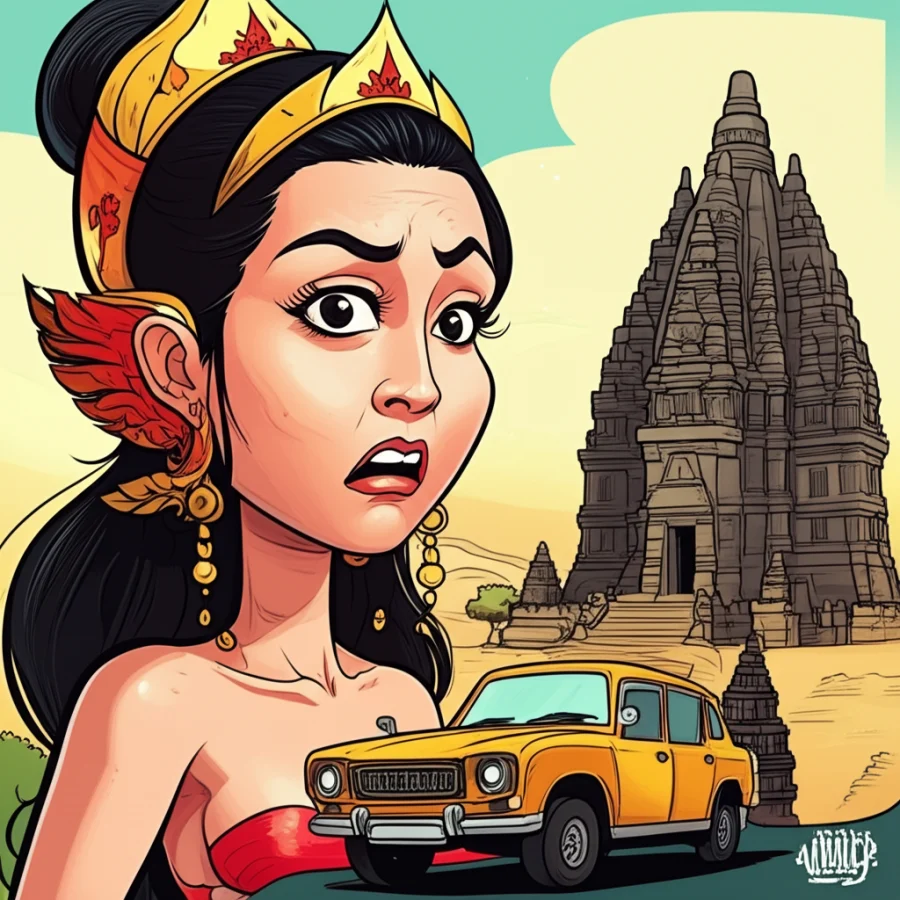
The Stone Princess and the Impossible Dawn: An Exploration of Javanese Folklore
An Important Note for the Reader: The following article explores a traditional myth from Indonesian folklore. This story is a product of ancient imagination and oral tradition, intended for cultural, historical, and educational understanding. It is not a factual account and is not meant to be believed, worshipped, or practiced.
Introduction
From the verdant, volcanic heart of the island of Java, Indonesia, arise whispers of ancient kingdoms, supernatural power, and timeless legends. These stories, passed down through generations, were the way ancient people sought to understand the world around them—from the formation of mountains to the creation of magnificent temples. Among the most enduring of these tales are two powerful, yet distinct, legends that share a common thread: a formidable woman who challenges a suitor to an impossible, nocturnal task. The first is the Sundanese legend of Dayang Sumbi and her son Sangkuriang, which explains the origin of the Tangkuban Perahu volcano. The second is the Central Javanese story of Roro Jonggrang and the powerful Bandung Bondowoso, a myth that breathes life into the stone walls of the magnificent Prambanan temple complex. While the prompt title combines them, this article will focus on the dramatic tale behind Prambanan, often called the "Oath of Prambanan," while acknowledging its thematic twin, the story of Dayang Sumbi.
Origins and Cultural Background
These legends emerged from a time in Javanese history steeped in a syncretic blend of animism, Hinduism, and Buddhism, long before the arrival of Islam. During the era of great kingdoms like the Mataram Kingdom (8th to 10th centuries), the world was not seen as mere matter. It was a place alive with energy and spirit. Mountains were the abodes of gods, forests were home to mystical creatures, and certain individuals were believed to possess sakti—a form of spiritual or magical power that allowed them to command nature and spirits. In this worldview, monumental feats like the construction of the Prambanan temples were so awe-inspiring that they demanded a supernatural explanation. These stories were not just entertainment; they were a framework for understanding history, morality, and the very landscape upon which people lived.
The Characters of the Legend
The story of Prambanan revolves around two central figures, each representing a powerful archetype.
-
Roro Jonggrang: Her name translates to "slender virgin." She is the daughter of the slain King Boko and a figure of legendary beauty, intelligence, and unyielding will. In the folklore, she is not a passive damsel but a symbol of clever resistance against a conquering force. Her wit is her primary weapon, representing the triumph of intellect over brute strength. She embodies the tragedy of a princess caught between duty to her lost kingdom and her own desire for freedom.
-
Bandung Bondowoso: A prince from the Pengging Kingdom, he is depicted as a warrior of terrifying might and ambition. His symbolic significance lies in his immense sakti, a power so great that legend claims he could command an army of subterranean spirits, or jinn. He represents unchecked ambition, hubris, and the destructive nature of spurned love and rage. His power is elemental and overwhelming, a force of nature that can raise temples from the earth but is ultimately blind to subtle deception.
The Oath of Prambanan: A Narrative Retelling
The story begins in the aftermath of a great war. The ambitious Bandung Bondowoso had led his forces against the kingdom of King Boko, and in the decisive battle, he slew the king and conquered his realm. As he entered the palace to claim his prize, he laid eyes upon the king’s daughter, the breathtakingly beautiful Roro Jonggrang. Instantly captivated, he declared his intention to make her his queen.
Roro Jonggrang was filled with grief and hatred for the man who had destroyed her family and her kingdom. However, she knew that a direct refusal would mean certain death for herself and the remaining people of her court. Thinking quickly, she devised a plan—a condition for marriage so monumental, so utterly impossible, that even a man of Bondowoso’s power could not hope to achieve it.
"I will accept your proposal," she announced, her voice steady despite her racing heart, "but on one condition. You must build for me one thousand temples, and you must do it in a single night, before the first rooster crows at dawn."
A challenge of this magnitude would deter any mortal man, but Bandung Bondowoso was no ordinary mortal. He smiled, his confidence unshaken by the audacity of her request. He accepted the terms, seeing it not as an obstacle, but as a chance to display his magnificent power.
As dusk settled, casting long shadows over the plains, Bondowoso stood in an open field, closed his eyes, and began to chant ancient incantations. The ground trembled, and from fissures in the earth rose a spectral army of jinn and spirits. With a single command, he set them to work. The air filled with the otherworldly sounds of chisels ringing against stone and massive blocks being lifted as if they were pebbles. Under the silver light of the moon, a city of stone began to rise from the earth with impossible speed.
From a high window in her palace, Roro Jonggrang watched in growing horror. Temple after temple materialized from the darkness, their spires reaching for the stars. The spirits worked tirelessly, their shadowy forms flitting between the rising structures. By the deep hours of the night, she counted them—990, 995, 998… The 999th temple was nearly complete. Panic seized her. Bondowoso was going to succeed.
Refusing to be defeated, her mind raced for a solution. Her gaze fell upon the sleeping villages nearby. An idea, born of desperation and genius, sparked in her mind. She roused her ladies-in-waiting and sent them to awaken all the women in the surrounding villages. "Light fires in the east!" she commanded. "And begin pounding your rice pestles, just as you do every morning!"
Soon, a faint crimson glow began to stain the eastern horizon, mimicking the first light of dawn. The rhythmic thump-thump-thump of countless women pounding rice echoed through the still night air. The roosters, confused by the light and the familiar sounds of morning activity, began to crow their welcome to a false dawn.
The effect on Bondowoso’s supernatural army was immediate. The jinn, creatures of the night, feared the sacred light of the sun. Believing their time was up, they shrieked and vanished back into the earth, leaving the final temple unfinished.
Bandung Bondowoso stood amidst the 999 stone structures, his victory snatched away at the last moment. As the true dawn broke, he realized he had been tricked. A terrible fury consumed him. He stormed to the palace and confronted Roro Jonggrang.
"Your deception has cost me my thousandth temple," he roared, his voice thundering with rage. "You are made of stone, just like these temples you desired! So a stone you shall be!"
He raised his hand, and a wave of dark energy struck the princess. Her body grew rigid, her skin hardening into cold, grey granite. She was transformed into a magnificent statue, the final masterpiece to complete his collection. Legend says that the statue of the goddess Durga in the northern chamber of Prambanan’s main Shiva temple is the petrified princess herself, forever completing the thousandth temple and standing as an eternal monument to the tragic tale.
Symbolism and Meaning
For the ancient Javanese, this story was rich with meaning. It was, first and foremost, an etiological myth that provided a fantastical origin for the sprawling Prambanan temple complex, explaining its grandeur as the work of supernatural forces. On a deeper level, it represented the timeless struggle between intellect and brute force, where Roro Jonggrang’s cleverness outwits Bondowoso’s raw power. It also explores themes of resistance against tyranny, the hubris of conquerors, and the tragic consequences of rage. The race against the dawn is a powerful metaphor for the victory of the natural order (the sun) and human ingenuity over the chaotic forces of the night.
Modern Perspective
Today, the legend of Roro Jonggrang remains a vibrant part of Indonesian culture. It is the narrative centerpiece of the famous Sendratari Ramayana ballet, a spectacular open-air performance with the illuminated Prambanan temples as its backdrop. The story is retold in children’s books, comics, and films, cementing its place in the national consciousness. Modern interpretations sometimes cast Roro Jonggrang as a proto-feminist icon—a symbol of female resistance who uses her intelligence to subvert an oppressive patriarchal power, even at a great personal cost.
Conclusion
The stories of Roro Jonggrang and Dayang Sumbi are more than just myths; they are cultural heirlooms, rich tapestries woven from the imagination, history, and spiritual beliefs of an ancient people. They offer a window into a worldview where the landscape itself was a storyteller. As we explore these fascinating narratives, it is essential to appreciate them as works of folklore and cultural heritage, not as articles of faith.
As Muslims, we recognize that only Allah is the true Creator and Sustainer of the universe, and these stories are products of human culture, not divine revelation. Their value lies in what they teach us about history, human creativity, and the enduring power of storytelling to shape identity and explain the mysteries of our world. They are a testament to the timeless human need to find meaning in our surroundings and to preserve our heritage through the boundless power of imagination.







