
 fufufafa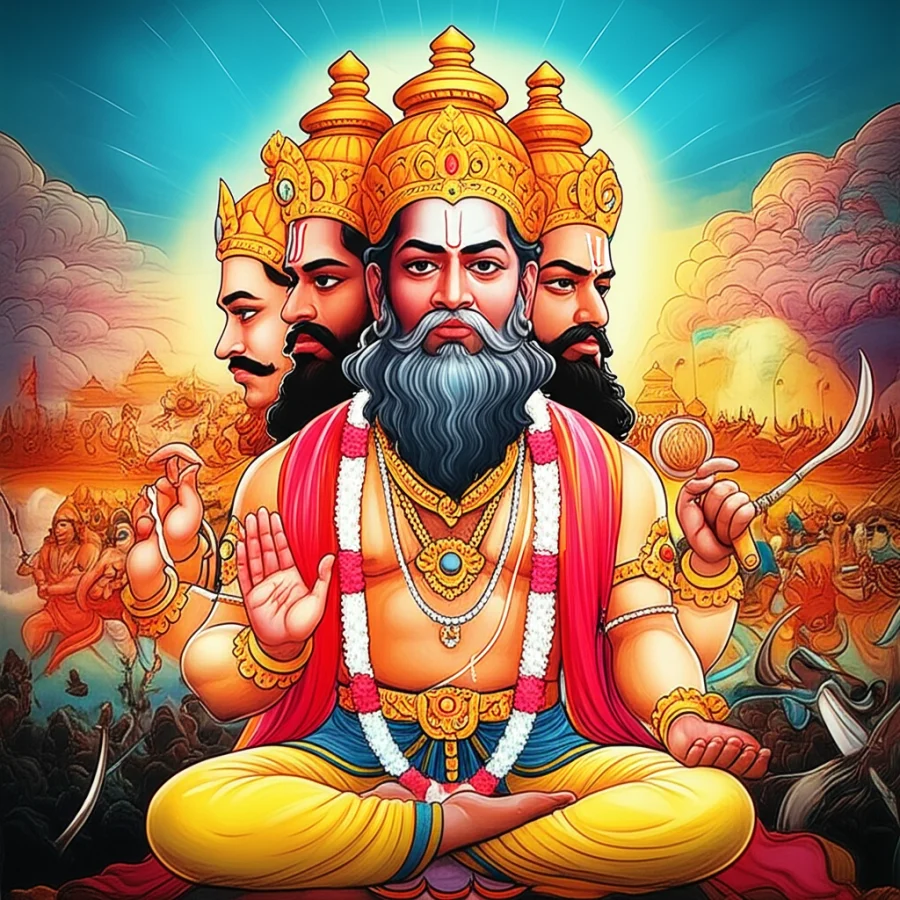
Brahma and the War of Mahabharata Episodes: A Tale from Ancient India
1. Introduction:
The Mahabharata, a sprawling epic originating from ancient India, is a cornerstone of Hindu mythology and a rich source of cultural narratives. Within its vast tapestry of characters, battles, and philosophical dialogues, we find stories that attribute influence, directly or indirectly, to the deity Brahma, the creator god in the Hindu Trimurti (the triad of Brahma, Vishnu, and Shiva). This is a traditional story passed down through generations, reflecting the worldview and values of ancient Indian society. It’s crucial to remember that this account is a product of human imagination and cultural expression, not a factual historical record.
2. Origins and Cultural Background:
The Mahabharata is believed to have been composed over centuries, with its earliest layers dating back to around the 8th or 9th century BCE. The society that nurtured this epic was one deeply rooted in the Vedic tradition, emphasizing dharma (righteous conduct), karma (action and consequence), and the cyclical nature of time. The world was perceived as a complex interplay of divine forces, human actions, and cosmic order. Deities were not seen as remote figures but as active participants in human affairs, influencing events and shaping destinies. Kings were often considered representatives of the gods on earth, and their actions had cosmic implications. The concept of ‘yuga’ (an epoch or era) was prominent, with each yuga characterized by a gradual decline in righteousness. The Mahabharata itself is set at the transition between Dvapara Yuga and Kali Yuga, a period marked by moral decay and conflict. The story reflects the social structures of the time, with its emphasis on caste, family obligations, and the duties of a warrior.
3. Character Description: Brahma
Brahma, in Hindu mythology, is the creator of the universe and all beings. He is typically depicted with four heads, each reciting one of the four Vedas (ancient scriptures). He is often shown seated on a lotus flower, symbolizing purity and divine origin. His vehicle (vahana) is the hamsa, a swan or goose, representing discernment and wisdom. Brahma’s attributes are symbolic rather than literal. His four heads can be interpreted as representing the four directions, the four Vedas, or the four aspects of the human personality. The lotus seat signifies his detachment from the material world, while the hamsa embodies his ability to distinguish between right and wrong. It is important to see these representations as metaphors for abstract concepts like creation, knowledge, and spiritual awareness.
4. Main Story / Narrative Retelling:
The influence of Brahma on the Mahabharata, while not always direct and explicit, can be discerned in several key episodes. One such instance relates to the origins of the Kurukshetra War itself. The story goes that the earth, overburdened by the weight of evil kings and their armies, pleaded to Brahma for relief. Distressed by the plight of the earth, Brahma convened a meeting of the gods and devised a plan to reduce the earth’s burden.
Brahma decreed that portions of the gods themselves would incarnate as humans on earth to participate in a great war that would cleanse the world of its wickedness. This, in essence, set the stage for the Mahabharata. The Pandavas and Kauravas, the central figures of the epic, were, in this narrative, partial incarnations of various deities, including aspects of Brahma himself.
Another episode where Brahma’s influence is alluded to is during the great battle itself. Arjuna, the Pandava warrior, faced moral conflict when he had to battle his own kin, including his grandfather Bhishma and his teacher Drona. Overcome with grief and reluctance, Arjuna refused to fight. Lord Krishna, Arjuna’s charioteer and an avatar of Vishnu, then revealed to Arjuna his divine form, showing him the cosmic consequences of action and inaction. While Krishna’s divine form isn’t directly attributed to Brahma, the underlying message of dharma and the cyclical nature of creation and destruction, which Krishna explains to Arjuna, are concepts closely associated with Brahma’s role as the creator. Krishna’s explanation reinforces the idea that the war is a necessary part of the cosmic order, a cleansing fire that will pave the way for a new cycle of creation, a concept aligned with Brahma’s role.
Moreover, the epic itself begins with a grand sacrifice organized by King Janamejaya, a descendant of the Pandavas. It is during this sacrifice that the entire story of the Mahabharata is narrated. The setting of a sacrifice, a ritual deeply rooted in the Vedic tradition, highlights the importance of cosmic order and the role of the gods in human affairs, further connecting the narrative to Brahma, the ultimate creator.
5. Symbolism and Meaning:
The stories associating Brahma with the Mahabharata likely represented several things to ancient people. First, they provided a framework for understanding the origins of good and evil. The idea that the gods themselves were involved in the war offered an explanation for the immense suffering and destruction it caused. Second, these stories reinforced the importance of dharma and the consequences of deviating from it. The war was seen as a necessary evil, a cosmic cleansing that would restore balance to the world. Third, the tales may have served as a reminder of the cyclical nature of time and the inevitability of change. The Mahabharata marked the end of one era and the beginning of another, symbolizing the constant flux of creation and destruction. The concept of divine intervention provided comfort and meaning in the face of chaos and uncertainty.
6. Modern Perspective:
Today, the Mahabharata and its associated myths, including the role of Brahma, are interpreted in various ways. In literature and films, the epic is often used as a source of inspiration for exploring themes of morality, leadership, and the human condition. In cultural studies, the Mahabharata is analyzed as a reflection of ancient Indian society, its values, and its beliefs. Video games often incorporate characters and storylines from the Mahabharata, introducing these ancient myths to a new generation. Scholars analyze the Mahabharata as a complex and multifaceted text, examining its historical, social, and religious significance. The story of Brahma’s involvement, or perceived involvement, is viewed as a symbolic representation of cosmic forces at play in human affairs.
7. Conclusion:
The stories linking Brahma to the Mahabharata war are fascinating examples of cultural storytelling from ancient India. These narratives, passed down through generations, offer insights into the worldview and values of the people who created them. It is important to remember that these are cultural stories, not factual accounts or objects of religious belief.
As Muslims, we believe that Allah alone is the true Creator and Sustainer of the universe. These ancient narratives are part of our shared human heritage, demonstrating the power of imagination and the enduring tradition of storytelling. They offer valuable lessons about cultural understanding, historical context, and the diverse ways in which humans have sought to make sense of the world around them.







