fufufafa
Introduction: Echoes from the Ancestral Home
Deep in the vast expanse of the Pacific Ocean, where countless islands dot the azure waters, a rich tapestry of myths and legends was woven by the ancient peoples of Polynesia. Among these captivating narratives are the stories of Hawaiki, the mythical ancestral homeland from which all Polynesians are believed to have originated, and its formidable guardians: the Mo’o. These tales, passed down through generations via oral tradition, offer a profound glimpse into the worldview of these seafaring communities. It is essential to understand that these are traditional stories, shared by ancient peoples to explain their world, impart lessons, and connect with their heritage, rather than accounts to be taken as literal truth or worshipped.
Origins and Cultural Background: A World Shaped by the Ocean
The myths surrounding Hawaiki and the Mo’o emerged from a vibrant cultural era spanning centuries, particularly within the Hawaiian archipelago, where the Mo’o are especially prominent. This was a time when Polynesian societies thrived, guided by intricate social structures, profound spiritual beliefs, and an unparalleled mastery of navigation. Life was intimately connected to the land (ʻāina) and the sea (moana), where every natural element – from towering volcanoes and lush valleys to the vast ocean and its creatures – was imbued with spiritual significance.
The people of this era viewed the world through an animistic lens, believing that spirits and divine power (mana) resided within all things. Their universe was not just physical but also profoundly spiritual, populated by gods (akua), lesser deities (kupua), and powerful ancestral spirits (aumakua). Hawaiki was not merely a geographical location but a sacred concept, representing a place of origin, power, and the spiritual realm where ancestors resided. It was a source of life, fertility, and the wellspring of their culture. In such a world, creatures like the Mo’o served as potent symbols, embodying the raw power and mystery of the natural environment, often acting as protectors of sacred places or testing the resolve of those who dared to trespass.
Character Description: The Enigmatic Mo’o
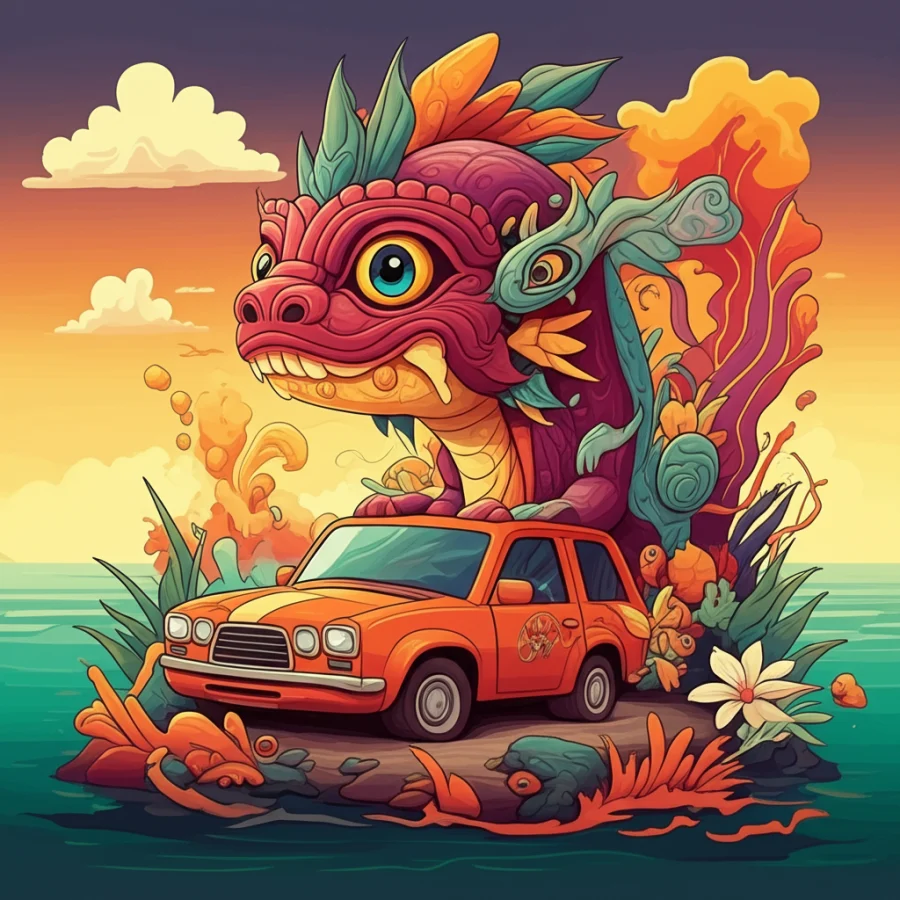
The Mo’o are among the most fascinating figures in Polynesian, particularly Hawaiian, folklore. They are typically depicted as giant lizards or geckos, often of immense size, ranging from a few feet to colossal proportions capable of spanning entire valleys or islands. What makes the Mo’o truly captivating is their ability to shapeshift, transforming into beautiful women, handsome men, or even elements of the landscape like rocks, trees, or ponds. This transformative power highlights their deep connection to the land and water they guard.
Symbolically, Mo’o are guardians of sacred spaces, particularly fresh water sources such as springs, streams, fishponds (loko iʻa), and even entire islands. They embody the life-giving and destructive forces of nature. While some Mo’o were benevolent, offering guidance or protection to worthy individuals, many were feared for their fierce temperaments, territorial nature, and their role as stern enforcers of kapu (sacred laws or prohibitions). Their presence served as a powerful reminder of the delicate balance of nature and the consequences of disrespecting the sacred environment. They were not to be worshipped as deities but respected as powerful manifestations of the land’s spirit, demanding reverence and careful interaction.
Main Story: The Guardian of the Sacred Spring
In the heart of Hawaiki, nestled deep within a verdant valley where mist perpetually clung to the towering peaks, lay the Wai Ola – the Waters of Life. It was a spring of unparalleled purity, its crystalline waters believed to hold the essence of creation, capable of bestowing vitality and wisdom upon those who drank from it with a pure heart. But the Wai Ola was not unguarded. Its keeper was a Mo’o named Kawehi, a being of immense power and ancient lineage.
Kawehi was usually unseen, manifesting as a shimmering distortion in the air above the spring or as the subtle, watchful gleam in the eyes of a particularly large, iridescent gecko that darted across the mossy stones. But to those who approached with disrespect or greed, Kawehi would reveal its true, fearsome form.
One cycle, as the stars aligned for a great journey, a young chief, Keone, was tasked by the elders of Hawaiki to seek a blessing from the Wai Ola before embarking on a perilous voyage to discover new lands. Keone was strong and courageous, but also possessed a youthful eagerness that sometimes bordered on impetuousness. He approached the sacred spring with his offering of lei and kapa, his heart filled with both reverence and a subtle pride in his important mission.
As he knelt by the spring’s edge, a tremor ran through the earth. The air grew heavy, and the gentle gurgle of the spring deepened into a resonant hum. From the shadows of a giant fern, a form began to coalesce. It was Kawehi, not in its full, terrifying majesty, but as a colossal lizard, its scales shimmering like polished obsidian, eyes like molten gold fixed upon Keone. Its tongue flicked, tasting the air, and a low rumble emanated from its throat, vibrating through Keone’s very bones.
"Who approaches the Wai Ola?" Kawehi’s voice, though unspoken, echoed in Keone’s mind, a confluence of rushing water and rustling leaves.
Keone, though trembling, gathered his courage. "I am Keone, son of the chief, seeking the blessing of the Wai Ola for our voyage. We seek new homes, new beginnings, but wish to carry the spirit of Hawaiki with us."
Kawehi observed him, its massive head tilting. "The Wai Ola grants not just strength, but wisdom. What wisdom do you carry from this land, young chief? Do you understand the value of what you leave behind, or merely covet what lies ahead?"
Keone faltered. He had focused so much on the journey, on the promise of discovery, that he had perhaps taken the gifts of Hawaiki for granted. He spoke of the lessons of the ocean, of navigation, of community. But Kawehi pressed him, asking about the balance between taking and giving, between ambition and humility. The Mo’o spoke not in riddles, but in profound questions that forced Keone to look inward, to acknowledge his own pride and the true cost of leadership.
Hours passed under Kawehi’s silent, piercing gaze and its probing mental inquiries. Keone eventually confessed his moments of arrogance, his impatience, and his occasional disregard for the elders’ more cautious counsel. He spoke of his true desire: to lead his people not just to new shores, but to a life lived in harmony with the land, just as they had learned in Hawaiki.
When Keone finally stood, humbled and truly enlightened, a subtle nod passed through Kawehi’s massive frame. The shimmering form began to recede, melting back into the shadows and the very fabric of the valley. A gentle breeze stirred the leaves, and the spring water, now clearer than ever, seemed to beckon. Keone drank deeply, feeling not just the physical refreshment, but a profound sense of clarity and purpose. He had not just received a blessing; he had undergone a transformation, guided by the ancient guardian of Hawaiki.
Symbolism and Meaning: Lessons from the Land
To the ancient Polynesians, stories of Mo’o like Kawehi were far more than simple tales of monsters. They were potent allegories embodying deep-seated cultural values and anxieties. The Mo’o represented the raw, untamed power of nature, reminding people of their place within the ecosystem. Their guardianship of water sources symbolized the vital importance of fresh water for survival and the need for its respectful use and protection – a concept of environmental stewardship centuries ahead of its time.
The Mo’o’s ability to shapeshift also spoke to the transformative power of the land itself and the fluidity between the physical and spiritual realms. They instilled a sense of caution and respect for kapu, reinforcing moral codes and social norms. Encountering a Mo’o, as Keone did, often meant a test of character, wisdom, and humility. It taught that true power lay not in dominance, but in understanding, respect, and a harmonious relationship with the natural world. These narratives served to transmit knowledge, reinforce community values, and ensure the careful preservation of resources that were essential for the survival of island communities.
Modern Perspective: Echoes in Contemporary Culture
Today, the tales of Mo’o and Hawaiki continue to resonate, though their interpretation has evolved. In modern Hawaiian and Polynesian cultural contexts, these myths are celebrated as invaluable parts of their heritage. They are studied in schools, inspiring contemporary artists, writers, and filmmakers. Mo’o often appear in local literature, children’s books, and cultural festivals, no longer as figures of literal fear, but as powerful symbols of identity, resilience, and the enduring connection to the land.
Anthropologists and folklorists examine these stories to understand ancient Polynesian worldviews and the sophisticated environmental wisdom embedded within them. The Mo’o, as guardians of water, have even become symbols in modern environmental movements, representing the call to protect Hawaii’s precious natural resources against exploitation and pollution. While not worshipped, the respect for what they represent—the spirit of the land and water—remains a powerful current in contemporary Polynesian thought, serving as a reminder of the ancestral charge to care for the islands.
Conclusion: A Legacy of Imagination and Heritage
The stories of Hawaiki and its Mo’o guardians stand as a testament to the profound imagination and rich cultural heritage of the ancient Polynesian people. These are not beliefs to be adopted or practices to be followed, but rather narratives to be appreciated for their historical significance, their cultural depth, and the enduring human capacity for storytelling.
As Muslims, we recognize that the true Creator and Sustainer of all existence is Allah (God), the One who fashioned the heavens and the earth, and everything in between, with perfect wisdom and power. Our belief rests solely in His Oneness and His divine attributes. However, acknowledging this truth does not diminish the value of studying and understanding the diverse cultural narratives that humanity has woven throughout history. The tales of the Mo’o, like countless myths worldwide, offer a window into the human condition, our ancestral relationship with nature, and the creative ways societies have sought to make sense of their world. They remind us of the universal threads of imagination, morality, and the yearning for meaning that bind all human cultures, enriching our understanding of our shared past and the diverse expressions of human creativity.