
 admin
admin
The sands of ancient Egypt whisper tales of gods and pharaohs, of cosmic cycles and the eternal struggle between order and chaos. Among these enduring narratives, the legend of Ra and his perilous nightly journey through the underworld, guarded by a fearsome gate, stands as a potent testament to the worldview of a civilization deeply intertwined with the rhythms of the natural world. This is not a matter of historical fact or divine revelation, but a rich tapestry woven from the imagination of a people who sought to explain the mysteries of existence.
Echoes from the Nile: Origins and Cultural Background
The myths of ancient Egypt emerged from a civilization that flourished along the fertile banks of the Nile River for millennia, roughly from the predynastic period (c. 6000-3100 BCE) through the Ptolemaic Kingdom (305-30 BCE). Their society was agrarian, their lives dictated by the predictable inundation of the Nile, the scorching heat of the desert sun, and the vast, star-filled night sky. This environment fostered a profound connection to the celestial and the cyclical. The Egyptians viewed the world as a place of inherent duality: light and darkness, life and death, order (Ma’at) and chaos (Isfet). The sun, personified as Ra, was the ultimate symbol of this order, its daily journey across the sky a visible representation of creation and renewal. The night, however, held its own mysteries, a time when the sun seemingly vanished, prompting questions about its fate and the forces that governed the unseen realms.
Ra: The Sun-Disc and its Symbolic Resonance
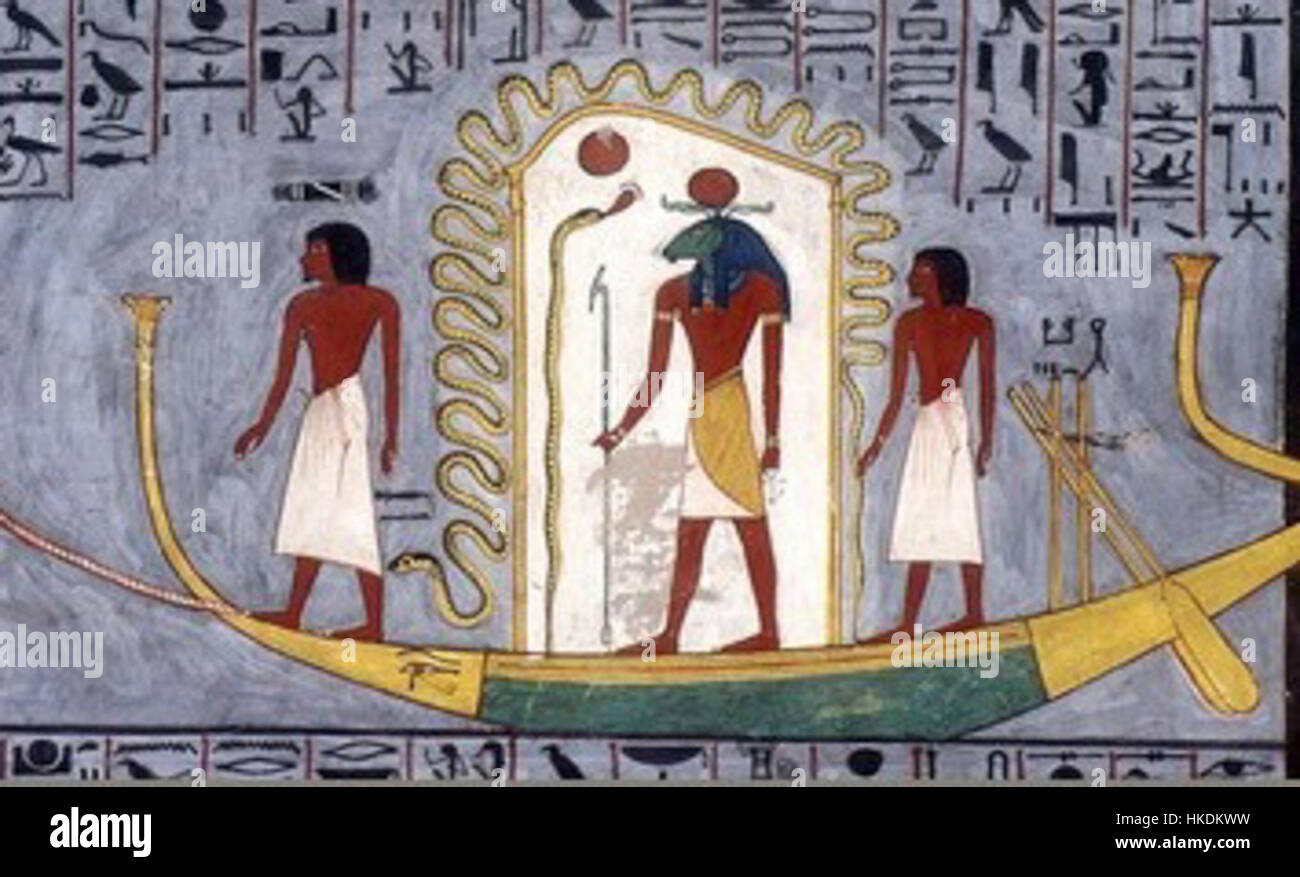
In these ancient narratives, Ra is depicted not as a physical being in the human sense, but as a powerful, cosmic entity. He is often represented as a man with the head of a falcon, crowned with a solar disc encircled by a cobra, the uraeus, a symbol of divine authority and protection. This imagery is rich with symbolic meaning. The falcon’s keen sight and ability to soar represent Ra’s dominion over the heavens. The solar disc embodies the life-giving energy of the sun, its warmth, light, and the very essence of creation. The uraeus, with its venom and protective nature, signifies the fierce power that defends against threats and maintains cosmic balance. Ra’s journey was not merely a passive transit but an active, vital process essential for the continued existence of the world.
The Nightly Voyage: Ra’s Descent into the Duat
As the sun, Ra, sank below the western horizon, his journey was far from over. The ancient Egyptians believed that with the setting of the sun, Ra embarked on a perilous voyage through the Duat, the Egyptian underworld. This realm was not a place of eternal damnation in the modern sense, but a transitional space, a testing ground, and a place of rebirth. The Duat was envisioned as a subterranean landscape, filled with mysterious inhabitants, treacherous passages, and formidable guardians.
Ra’s solar barque, his celestial vessel, carried him through these shadowy depths. Each night, he faced the ultimate challenge: the gate of the underworld. This was not a simple portal but a formidable barrier, often described as being guarded by terrifying beings and guarded by powerful spells. The most formidable of these guardians was Apep, a colossal serpent embodying chaos and darkness, who perpetually sought to swallow Ra and plunge the cosmos into eternal night.
The legend depicts Ra, armed with his divine might and the wisdom gained from his journey, confronting Apep. This was a titanic struggle, a cosmic battle waged in the heart of the underworld. Ra’s triumph over Apep was not a guaranteed victory but a hard-won achievement, achieved through his courage, his unwavering determination, and the support of other deities who aided him on his quest. The gate itself was a manifestation of this struggle, a symbolic barrier that Ra had to overcome to emerge reborn each dawn. The narrative of this nightly voyage was a powerful way for the Egyptians to understand the cycles of life, death, and rebirth, and to reaffirm their belief in the eventual triumph of light over darkness.
Symbolism Etched in Sand: The Meaning Behind the Myth
The legend of Ra and the Underworld Gate was far more than just a fanciful story. For the ancient Egyptians, it was a profound exploration of fundamental truths. The nightly descent of Ra represented death, the cessation of life, and the transition into the unknown. His arduous journey through the Duat symbolized the challenges and trials that individuals faced in their own lives, as well as the spiritual journey of the deceased after death.
The gate served as a powerful metaphor for the boundaries between worlds, between life and death, and between order and chaos. Overcoming this gate was essential for Ra’s rebirth and the renewal of the world. This resonated deeply with the Egyptian obsession with resurrection and the afterlife. The constant threat of Apep embodied the ever-present forces of chaos that sought to undermine cosmic order. Ra’s struggle against him underscored the importance of maintaining Ma’at, the principle of truth, justice, and cosmic harmony. Ultimately, the myth offered a profound sense of hope and reassurance: even in the face of darkness and oblivion, the sun would rise again, and order would prevail.
Modern Echoes: The Legend in Contemporary Culture
While the gods of ancient Egypt no longer hold sway in the modern world, their stories continue to captivate the human imagination. The legend of Ra and his journey through the underworld has found new life in various forms of contemporary media. In literature, it has inspired countless fantasy novels and historical fiction that explore ancient mythologies. In films and video games, the imagery of Ra, the Duat, and the formidable guardians of the underworld often serves as dramatic backdrops and compelling antagonists. These interpretations, while entertaining, often focus on the adventure and the fantastical elements, sometimes glossing over the deeper symbolic meanings that were so crucial to the ancient Egyptians. Furthermore, in academic circles, the myth remains a vital subject of study in Egyptology, religious studies, and comparative mythology, offering invaluable insights into the beliefs, fears, and aspirations of one of the world’s most enduring civilizations.
A Legacy of Storytelling
It is crucial to reiterate that the legend of Ra and the Underworld Gate is a traditional story, a product of ancient human imagination seeking to comprehend the universe. As Muslims, we recognize that only Allah (God) is the true Creator and Sustainer of all that exists. Our understanding of the divine is rooted in the revelations of the Quran and the teachings of Prophet Muhammad (peace be upon him).
However, the enduring power of such myths lies not in their literal truth, but in their ability to illuminate the human condition, to explore universal themes of life, death, struggle, and hope. The tales of ancient Egypt, like the legend of Ra’s nightly voyage, are a testament to our shared human heritage of storytelling, a tradition that allows us to connect with the past, understand different cultures, and reflect on the boundless creativity of the human mind. They serve as a reminder that even in the absence of belief, the power of narrative and the exploration of the imagination can offer profound insights and a rich understanding of the diverse tapestry of human cultural expression.


 rifanmuazin



