
 admin
admin
Origins and Cultural Background
The myths surrounding Hera and the other Olympians flourished in ancient Greece, a civilization spanning from roughly the 8th century BCE to 600 CE. This was a polytheistic society where a vast pantheon of gods and goddesses was believed to inhabit Mount Olympus, ruling over different aspects of the natural world and human life. For the ancient Greeks, these deities were not distant, abstract concepts; they were anthropomorphic beings, possessing human-like emotions, virtues, and flaws, albeit on a grander, more powerful scale. The world was perceived as being directly influenced by the whims and decrees of these gods, with natural phenomena and human events attributed to divine intervention. Justice, morality, and social order were often seen as reflections of divine laws or the consequences of displeasing the gods. Myths served not only as entertainment but also as explanations for the inexplicable, justifications for societal norms, and moral lessons for the populace, shaping their understanding of their place in the universe.
Character Description: Hera
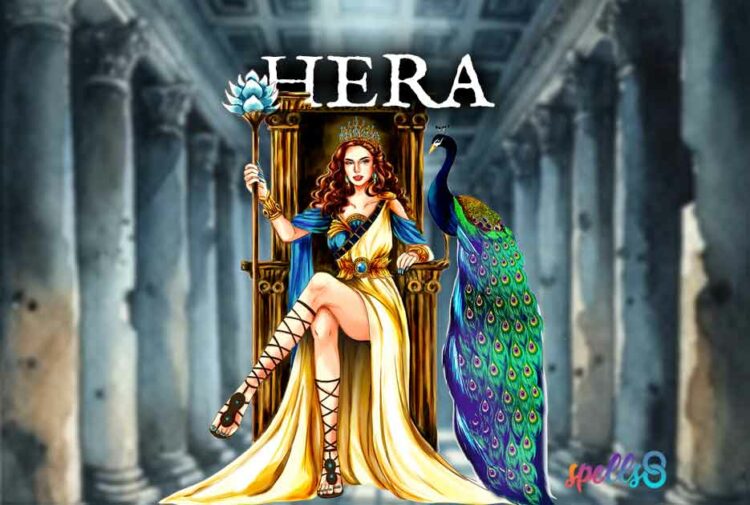
Hera, in this mythological framework, is depicted as the formidable Queen of the Olympian gods, a figure of immense power and dignity. She is revered as the goddess of marriage, women, childbirth, and family, embodying the sanctity of marital bonds and the domestic sphere. Symbolically, she is often portrayed wearing a diadem, signifying her royal status, and holding a scepter, representing her authority. Her sacred animal is the peacock, its thousand "eyes" believed to symbolize her ever-watchful nature. While she is celebrated as a protector of marriage and women, her mythological narratives often highlight her intense jealousy and vengeful wrath, primarily directed at Zeus’s many lovers and their offspring. These attributes, however, are not presented for glorification, but rather as symbolic representations of complex human emotions and societal pressures within the mythological context. Hera embodies the powerful, yet often constrained, role of women in ancient society, representing fierce protectiveness over the sacred institutions of marriage and family.
Main Story / Narrative Retelling: The Rise of Hera and the Eternal Flame
Before the Olympian gods, the cosmos was a tumultuous realm dominated by the elder Titans. Cronus, the fearsome ruler, devoured his children to prevent a prophecy of his downfall. Yet, one child, Zeus, was saved by his mother Rhea, and upon reaching adulthood, he challenged his tyrannical father. From Cronus’s belly, Zeus forced forth his swallowed siblings, among them Hera, his eldest sister, destined to become his queen.
Hera emerged from that dark confinement with a spirit of quiet strength and an innate understanding of order and structure, a stark contrast to the chaotic forces that had governed her early existence. As the Olympians ascended, overthrowing the Titans, a new cosmic order began to take shape. Zeus, charismatic and powerful, sought to establish his dominion, but even he recognized the need for a stable foundation, a partner who could embody the sanctity of their newfound reign. It was Hera, with her regal bearing and connection to family principles, whom he pursued.
Their courtship, as told in the myths, was fraught with challenges, a tempestuous dance between divine power and will. Zeus, resorting to cunning, transformed himself into a frail, shivering cuckoo, seeking refuge from a fabricated storm. Hera, ever compassionate, cradled the bird to her bosom. It was then that Zeus revealed his true form, pressing his suit. After much deliberation and a symbolic period of resistance, Hera agreed to become his consort, solidifying the new Olympian order through their sacred union.
Their marriage was not merely a romantic entanglement; it was a cosmic event, celebrated with unparalleled splendor. The very fabric of reality seemed to hum with the significance of their vows. As Queen of the Gods, Hera was not merely a figurehead; she was a co-ruler, her domain extending over the most fundamental aspects of human existence: marriage, childbirth, and the hearth—the very heart of family and home.
It was in the aftermath of this celestial wedding, or perhaps during the consecration of her first grand temple, that the myth of the Eternal Flame took root. In the hallowed halls of Olympus, or within the sacred precincts of her earthly sanctuaries like the renowned Heraion of Argos, a flame was kindled. This was no ordinary fire, said to have been lit by Hera’s divine spark or perhaps by Hephaestus, the god of the forge, as a tribute. This flame was destined to burn ceaselessly, never consuming its fuel, never dimming.
This Eternal Flame became the potent symbol of Hera’s enduring power and the unbreakable vows she guarded. It represented the perpetual warmth of the marital home, the constant presence of the divine in human unions, and the unbroken chain of generations. It was a beacon of constancy in a world often swayed by transient passions and fleeting desires. Its steady glow was a silent promise of continuity, a reminder that principles of marriage, family, and order, overseen by Hera, would persist. For those who honored her, the flame was a source of comfort and strength, a visible manifestation of sacred commitment. It stood as a testament to Hera’s unwavering vigilance and her eternal role in the divine hierarchy.
Symbolism and Meaning
To the ancient Greeks, the myth of Hera and the Eternal Flame carried profound symbolic weight. Hera herself represented the vital importance of marriage as the cornerstone of society, the sanctity of vows, and the authority of female figures within the domestic sphere. Her occasional wrath and jealousy, though often depicted negatively, could symbolize the fierce protectiveness required to uphold these sacred institutions. The "Eternal Flame," therefore, served as a powerful metaphor. It symbolized the enduring nature of marital commitment, the continuity of family lineage, and the perpetual presence of the divine blessing upon the home. It represented purification, the sacredness of the hearth as the center of family life, and the inextinguishable spark of life itself. The flame’s constancy mirrored the hope for stability and permanence in human relationships and the eternal cycle of existence, providing a tangible link between the mortal and divine realms.
Modern Perspective
In contemporary times, the figure of Hera, and by extension, the mythological concept of an "Eternal Flame," continues to resonate, though through a different lens. In literature, films (such as Clash of the Titans or the Percy Jackson series), and video games (God of War), Hera is often portrayed as a powerful, formidable, and sometimes tragic figure, frequently embodying themes of female agency, the complexities of power dynamics within relationships, and the consequences of infidelity. Scholars and cultural critics interpret her stories as reflections of ancient Greek societal values concerning marriage, gender roles, and divine authority. The "Eternal Flame" concept, while not always explicitly attributed to Hera, appears as a recurring motif in cultural narratives, symbolizing hope, remembrance, enduring love, or an unbreakable spirit. It is studied not as a religious truth, but as a rich source of archetypal imagery and narrative structures that continue to inform our understanding of storytelling, human psychology, and the historical evolution of cultural norms.
Conclusion
The narrative of Hera and the Eternal Flame, like all myths, stands as a testament to the boundless imagination and cultural ingenuity of ancient peoples. It is a story, meticulously crafted and passed down through generations, offering a window into the beliefs, fears, and aspirations of a civilization that sought meaning in the world around them. It is crucial to remember that this tale is a product of its time and culture, a traditional legend, and not a doctrine to be believed or practiced. As Muslims, we recognize that only Allah is the true Creator and Sustainer of the heavens and the earth, the One who is unique in His essence and attributes, and to Him alone belongs all worship and praise. The study of such myths serves not as a validation of their content, but as a valuable exercise in understanding cultural heritage, appreciating the universal human impulse for storytelling, and reflecting on how humanity has sought to comprehend existence through narrative.



 rifanmuazin


