fufufafa
In the verdant heart of the South Pacific, where volcanic peaks meet the endless embrace of the ocean, lie the Samoan Isles. These islands, steeped in a rich tapestry of oral tradition, are the birthplace of countless myths and legends that once explained the inexplicable and wove a vibrant narrative around the lives of their ancient inhabitants. Among these cherished tales, often recounted by the flicker of firelight or under the vast, star-dusted sky, are those that speak of formidable beings and profound connections to the natural world. This article delves into one such traditional story, focusing on the figure of the Mo’o and its mythical presence within the ancient Samoan imagination, often echoing themes and powers attributed to figures like Tagaloa (the Samoan equivalent of Tangaroa, a prominent Polynesian deity of the sea). It is crucial to understand from the outset that this is a traditional story, a product of human imagination and cultural heritage, told by ancient people to make sense of their world, and not a reflection of reality or an object of belief, worship, or practice.
Origins and Cultural Background: The Tapestry of Ancient Samoa
To truly appreciate the tales of the Mo’o, one must first step back into the cultural era of ancient Samoa, a time long before the arrival of foreign influences. Life on these idyllic islands was inextricably linked to the land (eleele) and the sea (sami). The rhythms of daily existence were dictated by the tides, the seasons, and the bounty of nature. Communities lived in close-knit villages, bound by strong family ties (aiga) and the guiding principles of fa’a Samoa, the Samoan way – a system emphasizing respect, hospitality, and communal harmony.
In this world, the distinction between the physical and the spiritual was fluid. Ancient Samoans viewed their environment as imbued with life force and populated by spirits (aitu) and powerful deities. The ocean, in particular, was revered as the domain of Tagaloa, often considered the supreme creator god, responsible for the heavens, the land, and the life within the sea. Every coconut palm, every coral reef, every gust of wind carried a potential story or a deeper meaning. Oral tradition was the cornerstone of their society, serving as the primary means of education, entertainment, and the preservation of history and cultural values. Through captivating narratives, generations learned about their ancestors, the origins of their islands, the consequences of their actions, and the awesome powers believed to reside in the world around them. It was within this vibrant, animistic worldview that figures like the Mo’o took shape, embodying elements of both fear and reverence, mystery and power.
The Mo’o: A Creature of Myth and Symbolism
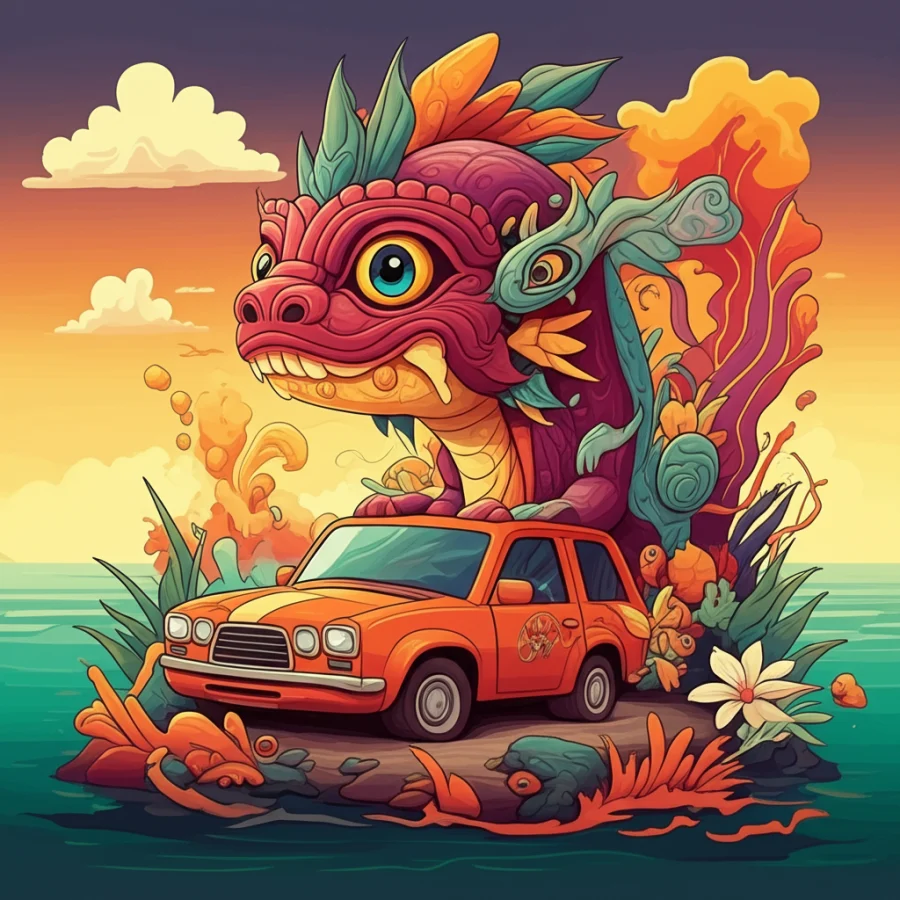
In the rich tapestry of Polynesian mythology, the Mo’o stands out as a fascinating and often formidable creature. In the Samoan context, while mo’o is the common word for a lizard, in ancient lore, it referred to something far grander and more potent: immense, reptilian beings, often described as giant lizards or dragon-like entities. These mythical Mo’o were not mere animals but were imbued with supernatural characteristics and significant power.
Narratives describe the Mo’o as creatures of immense size, with scales that might shimmer like obsidian or glow with an otherworldly luminescence. They were said to inhabit specific, often sacred, locations: deep freshwater pools, volcanic caves, hidden valleys, or the treacherous edges of the reef where the land met Tangaloa’s vast domain. Their presence was believed to be a sign of ancient power, an echo of the primal forces that shaped the islands. Symbolically, the Mo’o represented a multitude of concepts to the ancient Samoans. They could embody the raw, untamed power of nature – the sudden fury of a volcanic eruption, the destructive force of a tsunami, or the deep, mysterious currents of the ocean. They were often considered guardians of sacred places, ancient knowledge, or precious resources like fresh water. In some tales, they could be benevolent protectors, while in others, they were fearsome adversaries, testing the courage and wisdom of chiefs and heroes. Their shape-shifting abilities, often attributed to them in broader Polynesian lore, added to their mystique, allowing them to manifest in various forms, from a harmless gecko to a towering, earth-shaking beast. It is vital to reiterate that these descriptions are purely mythological, reflecting the imaginative capacity of ancient cultures to personify and understand the powerful forces of their environment.
The Tale of Fa’atoto and the Guardian Reef
Ancient tales whisper of a time when the Samoan Isles were young, their shores still fresh from the ocean’s sculpting hand. It was said that in the deep, crystalline waters surrounding the island of Savai’i, a colossal Mo’o named Fa’atoto resided. Unlike the fierce beasts of some legends, Fa’atoto was a creature of immense antiquity, a silent guardian of the outer reef, a place where the powerful currents of Tagaloa’s ocean met the gentle lapping waves of the lagoon. His scales, it was believed, were the color of the deepest indigo sea, flecked with bioluminescent patterns that mirrored the stars on moonless nights.
Fa’atoto was not a deity, nor was he worshipped, but his presence was a recognized force in the ancient ecosystem. He was said to slumber in a vast, hidden grotto beneath the waves, waking only when the delicate balance of the ocean or the islands was threatened. The people of Savai’i, particularly the fishermen who braved the treacherous currents beyond the reef, spoke of Fa’atoto with a mixture of respect and caution. They believed that when the fishing grounds were depleted, or when destructive storms lashed the coast, it was a sign that the harmony Fa’atoto protected had been disturbed.
One season, a long and devastating drought gripped the land. The sun beat down relentlessly, scorching the taro patches and drying up the freshwater streams. The people suffered, and their prayers to the heavens seemed to go unanswered. Desperate, a young, wise chief named Leilani sought guidance from the oldest fale aitu (spirit house) elder, a woman whose eyes held the wisdom of generations. The elder spoke of Fa’atoto, the ancient Mo’o of the reef, and the sacred balance he was said to uphold. She explained that the land and the sea were intertwined, and that the ocean, Tagaloa’s domain, held secrets to the land’s well-being. Perhaps, she suggested, the drought was not merely a punishment from the sky, but a consequence of a forgotten respect for the ocean’s gifts.
Chief Leilani, accompanied by her bravest warriors, embarked on a perilous journey to the outer reef. There, amidst the crashing waves, they offered a sacred ava ceremony, not as worship to Fa’atoto, but as an ancient plea for understanding and renewed harmony with the natural world. As the ava mingled with the sea, the ocean began to stir. The waves grew larger, and a deep, resonant rumble echoed from beneath the surface. From the depths, a colossal form slowly emerged – not in anger, but with an ancient, deliberate majesty. It was Fa’atoto, his immense, reptilian head breaking the surface, his eyes, like ancient pools, observing the people.
The chief, undeterred, spoke of the people’s plight, of their respect for the sea, and their desire to restore balance. It was said that Fa’atoto, in his silent wisdom, did not speak with words but with the very movements of the ocean. He slowly turned, his massive body creating a powerful current that drew the chief’s gaze to a distant, uncharted part of the reef. It was an area known to be barren, avoided by fishermen. The chief understood this as a sign, a direction.
Following Fa’atoto’s silent guidance, the fishermen discovered a vast, untouched spring of freshwater bubbling up from the seafloor in that desolate region, creating a rich, new fishing ground teeming with life. This spring, previously unknown, had been shielded by a specific coral formation that Fa’atoto had silently maintained for centuries. By revealing it, the Mo’o was said to have shown the people that the answer to their drought lay not in waiting for the heavens, but in understanding the deeper connections between land and sea, and in exploring the hidden bounties of Tagaloa’s realm. The drought eventually broke, and the people learned to seek balance and innovation, respecting the seen and unseen forces of their islands. Fa’atoto returned to his slumber, his legendary presence continuing to remind the people of the profound, often mysterious, interconnectedness of their world.
Symbolism and Meaning: Lessons from the Ancient Past
To the ancient Samoans, the story of Fa’atoto and other Mo’o narratives served as powerful allegories, offering insights into their world and their place within it. The Mo’o could symbolize the immense, often incomprehensible, forces of nature that governed their lives. The fear they inspired was a respectful fear of the ocean’s power, the earth’s unpredictability, and the consequences of disrupting ecological balance. Fa’atoto, as a guardian of the reef and a silent guide, represented the inherent wisdom within the natural world itself – a wisdom that, if understood and respected, could provide solutions and sustain life.
These tales instilled a sense of humility, reminding people that they were but a part of a larger, intricate system. They encouraged careful observation of their environment, fostering a deep understanding of marine ecosystems and the subtle signs of change. The narrative of Chief Leilani’s quest for understanding, rather than confrontation, highlighted the value of wisdom, respectful engagement, and seeking harmony over domination. The Mo’o, therefore, was not merely a monster, but a potent symbol of nature’s duality: its capacity for both destruction and sustenance, its hidden depths, and the profound lessons it held for those who paid attention. It emphasized the importance of stewardship – caring for the land and sea – a core value in fa’a Samoa.
Modern Perspective: Echoes in Contemporary Culture
Today, the myths of the Mo’o and figures like Tagaloa continue to resonate within Samoan culture, though their interpretation has evolved. They are no longer objects of belief but cherished elements of a rich cultural heritage. These stories are preserved through various mediums: they are recounted in educational settings to teach children about their ancestors’ worldview, they inspire contemporary Samoan artists, writers, and storytellers, and they are sometimes referenced in literature, poetry, and even tourism, offering visitors a glimpse into the unique cultural fabric of the islands.
The imagery of the Mo’o might appear in carvings, tattoos (tatau), or modern art, symbolizing strength, guardianship, or connection to the ancestral lands and seas. Academics and cultural scholars study these myths as invaluable ethnographic records, providing insights into ancient belief systems, social structures, and environmental knowledge. While no longer believed to be physically present, the spirit of these stories – the lessons of respect for nature, community, and the interconnectedness of life – remains a powerful force in modern Samoan identity, fostering a sense of pride in their unique heritage.
Conclusion: The Enduring Power of Storytelling
The tale of the Mo’o and its connection to the vast domain of Tagaloa in the Samoan Isles serves as a powerful reminder of the human capacity for imagination and the enduring significance of storytelling. These narratives, born from the creative spirit of ancient peoples, provided frameworks for understanding their world, instilling moral values, and preserving cultural identity across generations. It is important to reiterate that these myths, while culturally rich and historically significant, are products of human creativity and do not represent truth or reality. As Muslims, we recognize that Allah (SWT) is the one true Creator and Sustainer of the heavens and the earth, and of all that exists within them, seen and unseen. Our faith affirms that only Allah possesses divine power and knowledge.
Nevertheless, the study of such cultural narratives offers invaluable insight into the diverse ways humanity has sought to comprehend its existence. They stand as testaments to the power of imagination, the ingenuity of human expression, and the enduring human desire to connect with the world through narrative. The echoes of Tangaroa and the legends of the Mo’o continue to remind us of the profound heritage embedded in cultural stories, inviting us to reflect on the universal themes they explore and to appreciate the intricate tapestry of human experience.