fufufafa
This article delves into a traditional story from the rich tapestry of Celtic mythology, specifically drawing from the ancient narratives of Ireland. It presents a fictional tale, inspired by the figure of Manannán mac Lir, a prominent deity in these myths, and weaves an imaginative narrative around the concept of a "forgotten mountain." It is crucial to understand that this is a traditional story, told by ancient peoples, reflecting their worldview and cultural heritage, and is presented here purely for cultural, historical, and educational understanding.
Origins and Cultural Background
The myths surrounding figures like Manannán mac Lir emerged from a vibrant and complex cultural era in ancient Ireland, primarily during the pre-Christian Iron Age and early medieval period. This was a time when society was deeply intertwined with the natural world. People lived in close proximity to vast forests, rugged coastlines, and mysterious bogs, their lives dictated by the rhythms of the seasons and the power of the elements. Their worldview was animistic and polytheistic, perceiving the world as alive with spirits, deities, and unseen forces.
The natural landscape was not merely scenery but a living entity, imbued with a spiritual presence. Mountains were often considered sacred, homes of gods or gateways to other realms, while the sea was a formidable, life-giving, and often terrifying force. Ancient Celts believed in an Otherworld, a parallel dimension often described as a land of eternal youth, beauty, and abundance, which could sometimes intersect with the mortal realm. Their stories, therefore, were not just entertainment but profound expressions of their understanding of existence, morality, the unknown, and humanity’s place within a powerful, often capricious, natural and supernatural order.
Character Description: Manannán mac Lir
Manannán mac Lir, whose name translates to "Manannán, son of the Sea," is one of the most intriguing and powerful figures in Irish mythology. He is often depicted as a sea deity, a formidable warrior, and a wise king, closely associated with the mysterious Otherworld. His symbolic attributes are many and varied: he is the master of mists and illusions, capable of creating veils that conceal islands, ships, or even entire realms from mortal sight. He possesses a magical boat, the Scuabtuinne (Wave-Sweeper), which requires no sails or oars, and a magnificent horse, Aonbharr, which can travel over land and sea.
Symbolically, Manannán embodies the unpredictable and profound power of the ocean – its life-giving bounty, its destructive potential, and its vast, unknowable depths. He represents the liminal spaces, the thresholds between worlds, and the allure of the unseen. He is also a guardian, particularly of the Otherworld realms like Tír na nÓg or Emain Ablach, ensuring the balance between the mortal and immortal. His portrayal in myth is not meant to be a literal depiction of a real being, but rather a powerful personification of elemental forces, ancient wisdom, and the mysteries that lie just beyond human perception.
The Main Story: Manannán and the Forgotten Mountain
The restless currents of the Western Sea whispered secrets to Manannán mac Lir, secrets carried on the spray of waves and the mournful cries of gulls. For centuries, he had ruled his watery domain, his enchanted boat, Scuabtuinne, effortlessly gliding over the deepest troughs and highest crests. From his misty island fortress, Emain Ablach, he observed the ebb and flow of existence, the bustling lives of mortals, and the timeless serenity of the Otherworld. But a subtle discord had begun to hum beneath the surface of his perception, a faint tremor in the delicate balance he so diligently guarded.
It began as a slight thinning of the magical veils that separated the realms, a fleeting scent of decay carried on the wind where only the fresh tang of salt should be. Manannán, ever attuned to the pulse of his world, consulted the ancient tides, and they spoke of a forgotten place, a nexus point on the mortal isle of Éire that had once pulsed with potent magic but now lay dormant, its power draining away like water from a cracked vessel. This was the Forgotten Mountain, a place known only to the oldest spirits of the land, a peak whose name had vanished from mortal tongues millennia ago.
Legend spoke of this mountain as a place where the earth’s raw power converged, a silent sentinel that had once anchored the boundary between the earthly realm and a particularly wild, untamed corner of the Otherworld. Its forgetting had not been an accident, but a slow erosion of memory, as mortals turned their gaze from the ancient ways. As the mountain slept, so too did the protective enchantments it once generated, allowing a subtle corruption to seep through the thinning veil, threatening to destabilize the very fabric of Manannán’s hidden realms.
Donning his cloak of mists, Manannán set forth from Emain Ablach. The Scuabtuinne cut through the waves with silent speed, carrying him towards the western shores of Éire. He disembarked on a deserted strand, the air thick with the scent of bog and bracken. The journey inland was arduous, even for a deity. The land seemed to resist him, ancient forests growing denser, rivers swelling unexpectedly, as if nature itself had forgotten the path to its own heart.
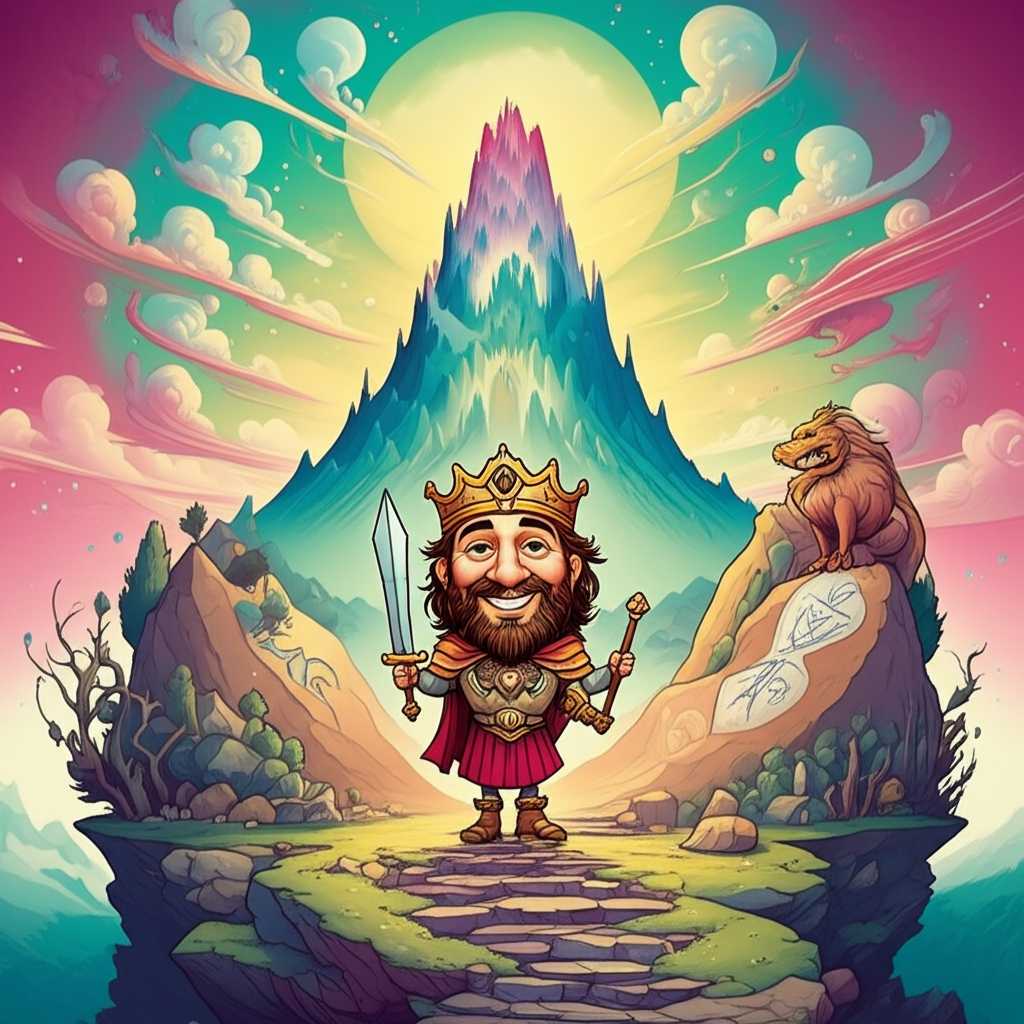
He journeyed for days, guided by the subtle discord, until he stood before it – a mountain, not grand or imposing in the way of the celebrated peaks, but stoic and ancient, its slopes covered in gnarled, forgotten trees and choked undergrowth. A palpable sense of melancholy hung about it, a shroud of neglect. As he ascended, the mountain seemed to sigh beneath his feet. Ancient stones, once vibrant with runes, were now overgrown with moss, their magic faded to a whisper. He found an entrance to a hidden cavern, dark and silent, its air stale with the dust of ages.
Inside, the energy was almost completely extinguished. He placed his hands upon the cold, unyielding rock. He could feel the residual hum, like a dying ember. The corruption, he realized, wasn’t malicious, but a consequence of neglect. The magical anchor was simply rusting away. Manannán, master of illusion and weaver of the Otherworld, understood that this mountain needed more than just repair; it needed remembrance, a spark to rekindle its ancient purpose.
He did not battle a monster or overcome a specific foe. Instead, he drew upon his own immense power, the very essence of the sea and the Otherworld, and began to sing. His voice, deep and resonant, echoed through the cavern, a melody born of crashing waves, whispering winds, and the deep, silent wisdom of the ocean floor. He sang of the mountain’s forgotten glory, of its role as a guardian, of the balance it maintained. He poured his essence into the inert stone, awakening the dormant energies, coaxing the ancient magic back to life.
Slowly, imperceptibly at first, the mountain responded. A faint warmth spread through the rock. The moss-covered runes began to glow with a faint, inner light. The air in the cavern cleared, taking on the fresh scent of earth after rain. Outside, the gnarled trees seemed to straighten, their leaves taking on a healthier hue. The veils between worlds solidified around the mountain, strengthened by the resurgence of its ancient power.
Manannán knew that mortals would not suddenly remember the mountain’s name or its true significance. Its purpose was not to be celebrated by them, but to serve as a silent anchor, a steadfast guardian. He had restored the balance, not by force, but by remembrance and revitalization. As he departed, a faint mist rose from the mountain’s summit, a subtle nod to the Sea Lord, and a promise that it would not be forgotten again, at least not entirely. Its power, once more, flowed through the land, an unseen current protecting the delicate tapestry of realms.
Symbolism and Meaning
The tale of Manannán mac Lir and the Forgotten Mountain, while a constructed narrative, draws upon deep symbolic meanings inherent in Celtic mythology. Manannán himself symbolizes the profound and often mysterious power of the sea – its creative force, its destructive potential, and its liminal nature as a boundary between the known and unknown. He embodies wisdom, protection, and the mastery over illusion, representing the ever-present but often unseen forces that govern the world.
The Forgotten Mountain, in this context, symbolizes neglected knowledge, the power of nature that exists independently of human recognition, and the consequences of forgetting our connection to the ancient world. It represents the idea that powerful forces and sacred places, if left unattended and unremembered, can wane, leading to imbalance. Its reawakening by Manannán signifies the importance of maintaining harmony, of recognizing the inherent power in the natural world, and perhaps, a call to remember the ancient wisdom that once guided societies. The story also speaks to the cyclical nature of time, where things forgotten can be rediscovered, and dormant powers can be revitalized through conscious effort and respect.
Modern Perspective
Today, figures like Manannán mac Lir and the narratives of Celtic mythology continue to resonate, though their interpretation has shifted from religious belief to cultural appreciation. In modern literature, film, and video games, Manannán often appears as an inspiring figure for characters embodying wisdom, magical prowess, or a connection to the sea and other dimensions. His mastery of mists and illusions provides rich material for fantasy narratives, influencing countless stories of hidden realms and powerful sorcerers.
Academically, these myths are subjects of extensive study in folklore, comparative mythology, and cultural history. Scholars analyze them to understand the societal structures, belief systems, and psychological archetypes of ancient peoples. Far from being seen as literal truths, they are valued as profound expressions of human imagination, storytelling prowess, and a window into the pre-scientific understanding of the world. They serve as a wellspring of inspiration, allowing contemporary artists and thinkers to explore themes of nature, power, identity, and the enduring human fascination with the unknown.
Conclusion
The Tale of Manannán mac Lir and the Forgotten Mountain is a cultural story, a narrative born of ancient imaginations, not a belief system to be adopted. It offers a glimpse into the rich cultural heritage of the Celtic peoples, demonstrating how they sought to explain the world around them through compelling stories and powerful figures. As Muslims, we recognize that only Allah is the true Creator and Sustainer of the universe, and all power, wisdom, and majesty belong solely to Him.
These mythological tales, while not reflecting our own faith, serve as valuable tools for understanding the diverse tapestry of human thought and culture throughout history. They remind us of the enduring power of imagination, the human need to make sense of the world, and the timeless tradition of storytelling that connects generations across centuries and continents.