fufufafa
1. Introduction
From the mists of ancient Ireland, where the wild Atlantic Ocean met rugged shores and verdant lands, sprung a rich tapestry of myths and legends. Among these enduring narratives is the captivating tale of Manannán mac Lir, the enigmatic sea deity, and whispers of a forgotten city lost to his mystical influence. This is not a historical account, nor a divine revelation, but a traditional story, woven by the ancient Celtic peoples, passed down through generations around hearth fires and under star-strewn skies, reflecting their understanding of the world and the powerful forces that shaped it.
2. Origins and Cultural Background
The myth of Manannán mac Lir and similar tales belong to the vast body of Celtic mythology, particularly vibrant in pre-Christian Ireland, often referred to as the Iron Age or early medieval period. In this era, before the widespread adoption of Abrahamic religions, the world was perceived through a lens deeply intertwined with nature and the supernatural. The ancient Irish people lived in a landscape dominated by powerful natural forces: the relentless sea, the shifting bogs, the ancient forests, and the towering mountains. These elements were not merely inanimate features but were often seen as imbued with spirit, inhabited by deities, spirits, and otherworldly beings.
The sea, in particular, held immense significance. It was a source of sustenance, a pathway for trade and invasion, and a terrifying, unpredictable force that could swallow ships whole. To these ancient islanders, the line between the mundane and the magical was thin, often blurred by mists and moonlight. They believed in an Otherworld (often called Tír na nÓg, the Land of Youth, or Mag Mell, the Plain of Delight), a realm of eternal youth and beauty, accessible through various portals—sometimes beneath the waves, sometimes within fairy mounds, or beyond the western horizon. It was within this worldview, where powerful figures like Manannán mac Lir personified the very essence of the ocean and the mysteries it held, that such stories found their fertile ground.
3. Character Description: Manannán mac Lir
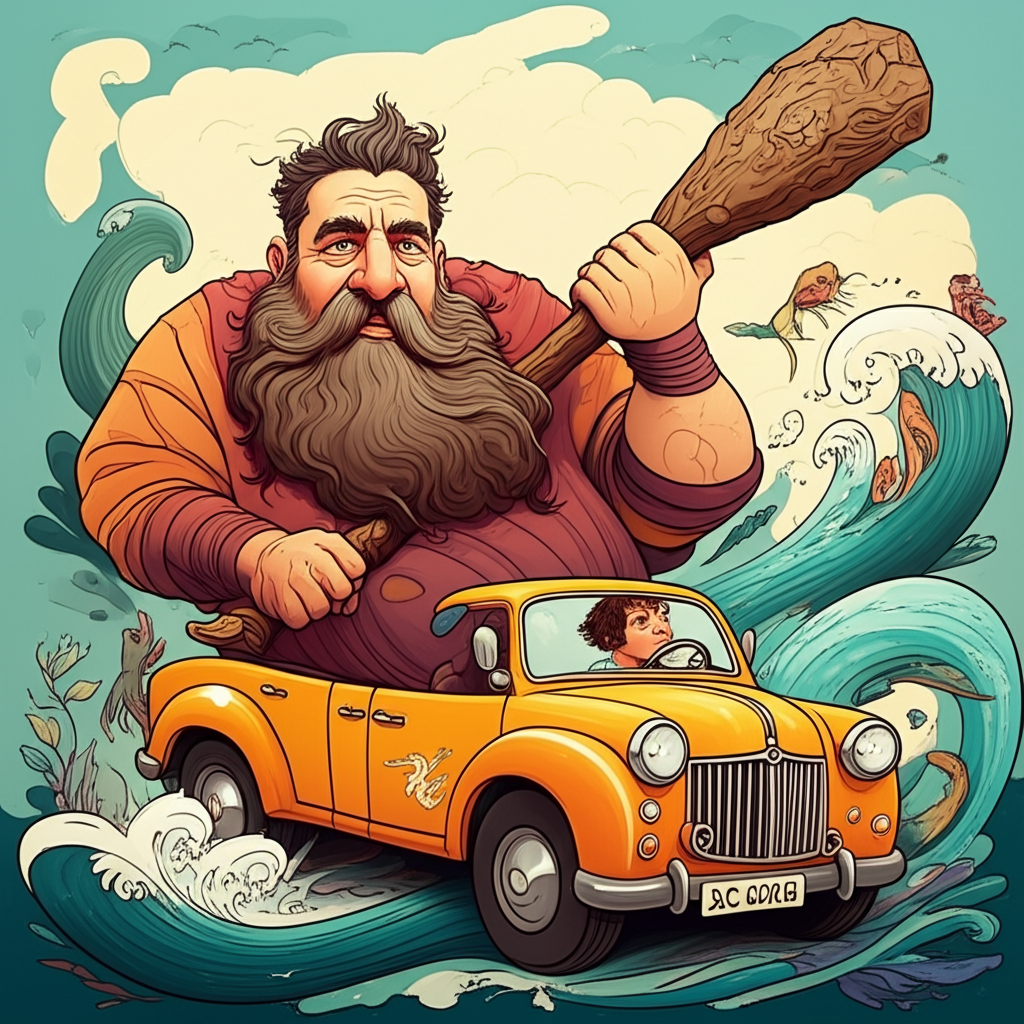
At the heart of many Irish sea legends stands Manannán mac Lir, a figure of immense power and mystique. His name, "mac Lir," translates to "son of the sea," hinting at his profound connection to the ocean itself. He is often depicted as a majestic, wise, and sometimes capricious being, the lord of the sea and the protector of the Otherworld. Manannán is not a "god" in the sense of an omnipotent creator, but rather a powerful, supernatural entity within the Celtic pantheon, embodying the vastness and inscrutability of the ocean.
His symbolic attributes are numerous and evocative. He is renowned as a master of illusion and shapeshifting, capable of conjuring mists to hide islands or cities, or transforming himself into various creatures. His magical possessions include his horse, Aonbharr, which could travel over land and sea, and his boat, Scuabtuinne ("Wave Sweeper"), which needed no oars or sails, obeying only thought. He wielded a magical sword, Fragarach ("The Answerer"), and possessed a cloak of mist that rendered him invisible. More than a bringer of storms or calm, Manannán represented the sea’s boundless mysteries, its hidden depths, and the veil between the mortal world and the enchanting, often dangerous, Otherworld. He was a guardian of ancient wisdom, a purveyor of magical gifts, and a force to be reckoned with, reflecting the awe and respect the ancient Irish held for the ocean.
4. Main Story / Narrative Retelling: The Tale of the Forgotten City
In a time long past, on the western coast of Éire, nestled beside a deep, sheltered bay, lay the city of Aedon. It was a place of vibrant life and prosperity, its docks teeming with ships laden with exotic goods, its markets overflowing, and its halls echoing with the laughter of its people. The citizens of Aedon were skilled craftspeople, daring sailors, and shrewd merchants, their fortunes intertwined with the bounties of the sea. Yet, as their wealth grew, so too did their pride, and with pride came a subtle forgetfulness. They began to see the ocean not as a powerful entity to be respected, but merely as a resource to be exploited, its vastness taken for granted, its ancient mysteries dismissed as old wives’ tales.
Manannán mac Lir, whose domain stretched from the sun-drenched surface to the deepest, lightless trenches, watched Aedon with a gaze as ancient as the tides. He saw the gleam of their gold overshadowing the sparkle of the sea, heard their boastful songs drown out the murmur of the waves. The people of Aedon, once offering small tributes to the sea for safe passage and bountiful catches, now offered nothing, their hearts turned to earthly gain.
One fateful year, a series of strange occurrences began. The fishing boats returned with empty nets, their usual grounds barren. Storms, unlike any seen before, rose suddenly from calm skies, battering the coastline and swallowing ships whole. The people of Aedon, bewildered and fearful, sought answers, but found only despair. They had forgotten how to listen to the whispers of the sea, how to read the moods of the waters that had once been their lifeblood.
Manannán, cloaked in the shifting hues of the twilight ocean, decided that Aedon, in its arrogance, had become a blight upon the sacred balance between land and sea. He did not seek to destroy it, for there was still beauty in its stone and spirit in its people, but rather to teach them a lesson, to make them remember the profound power they had dismissed. And so, under the cover of a night darker than a whale’s belly, Manannán began his work.
He called upon the mists, ancient and profound, to rise from the depths. They swirled and billowed, thicker than any fog, creeping inland, wrapping around the city’s towers, its bustling markets, its very foundations. As the mists enveloped Aedon, Manannán worked his greatest illusion. He did not sink the city, nor did he transport it to the Otherworld in its entirety. Instead, he made it forgotten. He pulled it from the conscious memory of the land, making it invisible to all but the most perceptive, or the most unfortunate.
When dawn broke, the mists had receded, but Aedon was gone. In its place stood only a rugged, unremarkable stretch of coastline, indistinguishable from any other. The bay was still there, but where the grand docks had been, only weathered rocks now stood. Travelers seeking Aedon would find themselves inexplicably turning away, their minds clouded, their memories of the city fading like smoke. Generations passed, and Aedon became less a place, and more a whisper, a half-remembered dream, the "Forgotten City" of old tales. Only occasionally, when the mists were thickest and the moon hung low, a lone fisherman, lost in the fog, might glimpse a fleeting vision: the faint glow of ancient lights beneath the waves, the phantom clang of a distant bell, or the faint outline of towering spires, before the mists closed in again, and the vision vanished, leaving him to question if he had seen anything at all, or if the sea had merely played a trick on his mind.
5. Symbolism and Meaning
The tale of Manannán mac Lir and the Forgotten City resonated deeply with the ancient Celtic people, embodying several profound symbolic meanings. Firstly, Manannán himself is the ultimate representation of the sea’s immense power, its capricious nature, and its profound mystery. He embodies both its life-giving bounty and its terrifying destructive potential. The "Forgotten City" of Aedon, in turn, symbolizes human hubris and the consequences of losing respect for the natural world. Its prosperity, built upon the sea, ultimately led to its undoing when its people forgot their deference to the very force that sustained them.
The act of the city being "forgotten" rather than utterly destroyed is significant. It suggests that while human constructs and achievements can be fleeting, the power of nature, symbolized by Manannán, is eternal and can simply erase or veil what it deems unworthy. It served as a cautionary tale, reminding people of their place within the natural order and the need for balance and respect. Moreover, the lingering whispers and fleeting glimpses of the city represent the enduring allure of the unknown, the thin veil between the mundane world and the magical Otherworld, and the idea that profound truths or lost wonders might lie just beyond our perception, hidden by forces greater than ourselves. It speaks to the fragility of human memory and the enduring power of ancient wisdom.
6. Modern Perspective
In contemporary times, the myth of Manannán mac Lir and similar Celtic narratives continue to captivate and inspire. While no longer believed literally, these stories are cherished for their cultural, historical, and literary value. Manannán mac Lir appears in various forms in modern literature, from fantasy novels that draw upon Celtic mythology (such as those by Patricia Kennealy-Morrison or Neil Gaiman’s American Gods, where Manannán has a descendant) to children’s books that introduce young readers to ancient legends.
His character and the concept of a forgotten, mist-shrouded realm find echoes in movies, video games, and even tabletop role-playing games, where hidden cities, powerful sea deities, and magical illusions are common tropes. Academically, these myths are subjects of extensive study in folklore, mythology, and cultural studies departments, offering invaluable insights into the worldview, societal values, and artistic imagination of ancient peoples. They remind us of the universal human quest to understand the forces of nature, the mysteries of existence, and the consequences of human actions, providing a rich foundation for storytelling and philosophical reflection.
7. Conclusion
The tale of Manannán mac Lir and the Forgotten City is a testament to the enduring power of storytelling, a vibrant thread in the rich tapestry of Celtic cultural heritage. It is presented here purely for cultural, historical, and educational understanding, recognizing it as a product of ancient human imagination striving to make sense of the world around them.
As Muslims, we recognize that only Allah is the true Creator and Sustainer of all existence, and that He alone possesses ultimate power and wisdom. We affirm that all forms of worship and belief must be directed solely to Him. This myth, like countless others from various cultures, serves as a fascinating window into the past, illustrating how different societies have expressed their awe, fear, and wonder through narrative. It reminds us of the universal human capacity for imagination, the deep-seated desire to explain the inexplicable, and the timeless tradition of sharing stories that continue to echo across generations, enriching our understanding of human culture and history.