fufufafa
1. Introduction
Nestled deep within the rich tapestry of ancient European oral traditions lies a captivating body of myths and legends, none more vibrant than those emanating from the Celtic lands. Among these, the tales of ancient Ireland, specifically those concerning the Tuatha Dé Danann, stand out for their imaginative power and profound connection to the natural world. This article explores one such narrative, "The Tale of Dagda and the Hidden Sea," a traditional story passed down by the ancient peoples of Ireland. It is presented here purely for cultural, historical, and educational understanding, recognizing that these are imaginative stories and not meant to be believed, worshipped, or practiced as truth.
2. Origins and Cultural Background
The myths surrounding figures like Dagda emerged from a pre-Christian, Iron Age society in Ireland, a time when life was intrinsically linked to the land and its cycles. This was an agrarian society, deeply reliant on the bounty of nature for survival, and consequently, its people viewed the world through a lens of intricate spiritual connection to their environment. Every mountain, river, forest, and spring was imbued with spirit and meaning, often associated with powerful deities or ancestral beings.
Their worldview was animistic, recognizing a living essence in all things. The veil between the physical world and the Otherworld—a mystical realm of gods, spirits, and magic—was perceived as thin and permeable. Storytelling was not merely entertainment but a vital means of preserving history, explaining natural phenomena, teaching moral lessons, and understanding their place in a complex, often mysterious universe. The gods and goddesses of the Tuatha Dé Danann were seen as progenitors, protectors, and sometimes adversaries, embodying the very forces of nature and human experience.
3. Character Description: Dagda, the Good God
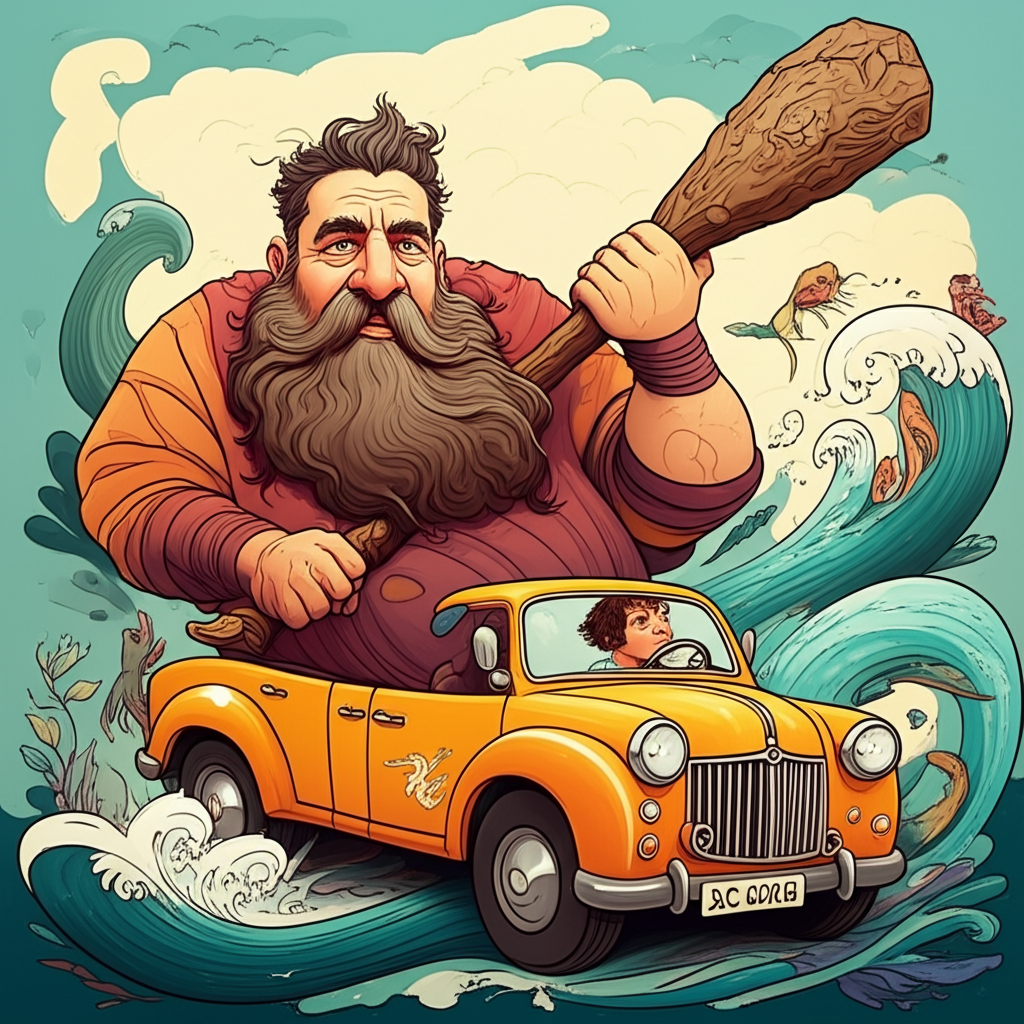
At the heart of many Irish myths stands Dagda, often translated as "the Good God" or "the Great Father." He is a central figure among the Tuatha Dé Danann, portrayed as a powerful and benevolent chieftain, a god of fertility, abundance, wisdom, and magic. Descriptions of Dagda often emphasize his immense physical presence, sometimes even depicted as somewhat rustic or earthy, yet possessing immense magical prowess.
His most iconic attributes include three potent magical items. First, the Lorg Mór, his mighty club, capable of both slaying nine men with one end and bringing them back to life with the other, symbolizing his power over life and death. Second, the Coire an Dagda, the Cauldron of Abundance, which was said to always be full, satisfying the hunger of all who partook from it, representing endless provision and sustenance. Third, Uaithne, his magical harp, which could play tunes that induced laughter, tears, or sleep, signifying the power of music and emotion, and perhaps even fate itself.
Symbolically, Dagda embodied the benevolent aspects of leadership, the cyclical nature of life and death, and the crucial concept of abundance necessary for a thriving society. He was the protector of the land and its people, a figure whose actions in myth often centered around restoring balance, ensuring prosperity, and wielding ancient wisdom. It is important to remember that these are symbolic representations within a mythological framework, serving to illustrate abstract concepts rather than promoting belief in literal divine power.
4. The Main Story: Dagda and the Hidden Sea
In the lore of ancient Ireland, there came a time of deep disquiet across the emerald land of Éire. A subtle sorrow permeated the very air, dulling the vibrant greens of the hills and silencing the joyous songs of the rivers. The once-bountiful harvests dwindled, and a strange lethargy settled upon the hearts of the Tuatha Dé Danann and the mortals alike. The land itself seemed to sigh, yearning for a forgotten vitality.
Dagda, the Great Father, felt this imbalance keenly. From his seat in the ancient mounds, he observed the growing pallor, the wilting spirit. He consulted the wisest druids and the oldest seers, but their knowledge, vast as it was, offered no immediate remedy. The prophecies spoke only in riddles, hinting at a "Sea Within the Land," a source of primeval power that had receded, its waters now still and dormant. It was not a sea of crashing waves and salty spray, but a metaphorical ocean of life-force, hidden from the eyes of the world.
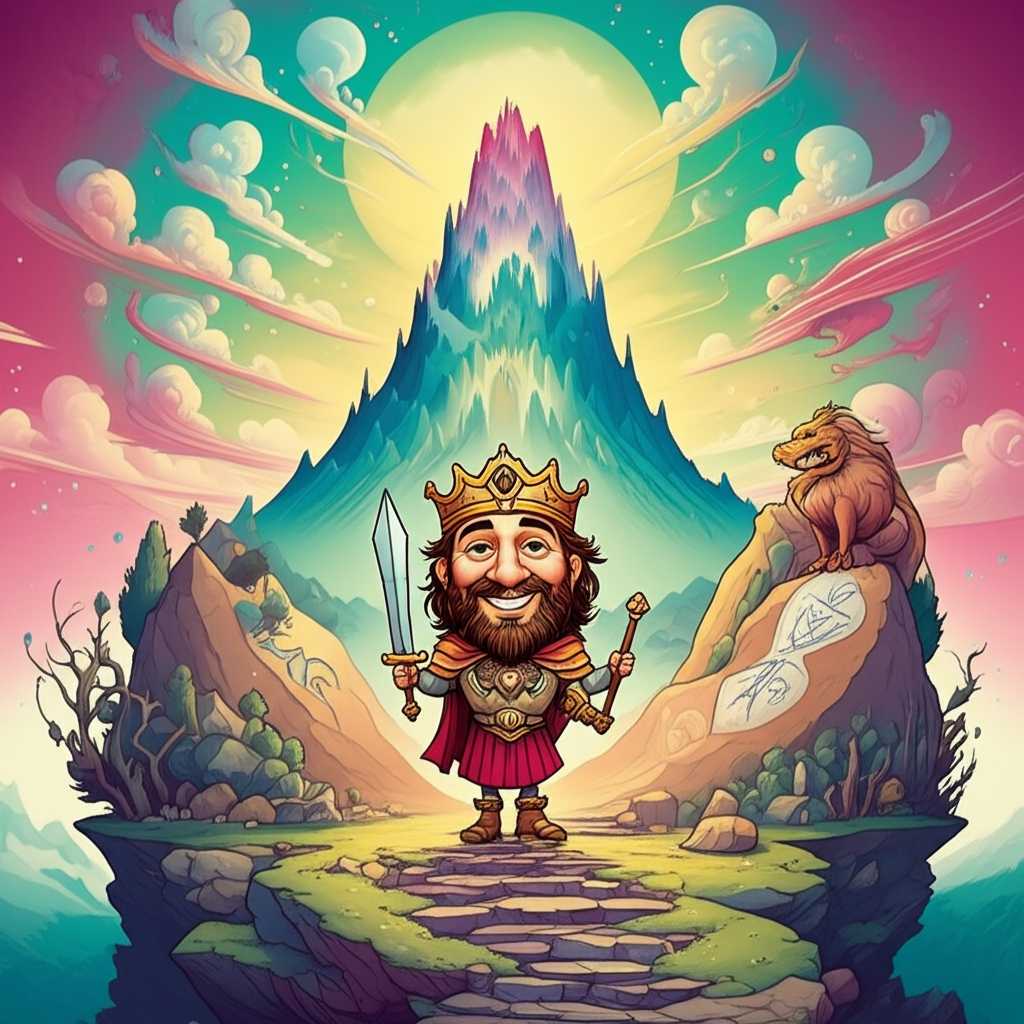
Driven by his benevolent nature and his duty to his people, Dagda resolved to seek this Hidden Sea. He hefted his mighty Lorg Mór onto his shoulder, its ends glowing faintly with ancient magic, and slung the Coire an Dagda at his side, its empty depths awaiting the return of abundance. His magical harp, Uaithne, pulsed with a low, mournful hum, as if echoing the land’s sorrow.
His journey was long and fraught with mystical challenges. He navigated through forests where the trees whispered forgotten secrets, across plains where ancient stones pulsed with latent energy, and into mist-shrouded valleys where time itself seemed to ripple. He encountered spectral guardians of old pathways and solved riddles posed by ancient spirits of the earth. His club cleared paths where none seemed to exist, and his cauldron provided him sustenance from the sparse wilderness, reminding him of the abundance he sought to restore.
Finally, deep within a labyrinthine cavern system, far beneath a sacred mountain whose peak touched the clouds, Dagda sensed a profound shift in the very fabric of reality. The air grew heavy with an ethereal stillness, and a soft, luminous glow emanated from the depths. Following this otherworldly light, he descended into a vast, subterranean chamber.
There, before him, lay the Hidden Sea. It was not a vast expanse but a shimmering, crystalline lake of pure magical essence, its surface perfectly still, reflecting the faint glow of the cavern walls like a thousand distant stars. Its waters pulsed with a slow, almost imperceptible rhythm, but its energy, though present, felt constrained, like a heart beating weakly. An ancient, unseen barrier seemed to hold its full power in check.
Dagda understood. The Hidden Sea was the wellspring of Éire’s spiritual vitality, its lifeblood, and it required reawakening. He took up Uaithne, his magical harp, and began to play. The initial notes were hesitant, seeking resonance, but as Dagda poured his heart into the melody, the music swelled. It was a tune of deep sorrow for the land’s suffering, a melody of hope for its renewal, and a rhythm echoing the ancient heartbeat of the world.
As the harmonious notes filled the cavern, the surface of the Hidden Sea began to ripple. The ethereal light intensified, swirling with colours never before seen. Dagda then dipped the end of his Lorg Mór into the glowing waters, gently stirring them. The contact unleashed a torrent of energy, and the magical barrier shimmered and dissolved. The waters of the Hidden Sea surged, not spilling over, but flowing outwards through unseen channels, revitalizing the very bedrock of Ireland.
A wave of vibrant energy pulsed upwards, spreading across the land. The sorrow lifted like a morning mist. Rivers once again flowed with joyous abandon, crops burst forth with renewed vigour, and the songs of the bards returned, sweeter and more profound than ever before. Dagda, having restored the balance and reconnected the land to its deepest source of magic, returned to his people, bringing with him the renewed spirit of Éire, embodied in the abundance that once again flowed from his ever-full cauldron. This tale, in its essence, speaks not of literal oceans, but of the profound, unseen forces that were believed to sustain the world.
5. Symbolism and Meaning
"The Tale of Dagda and the Hidden Sea" is rich with symbolic meaning, offering insights into the ancient Celtic worldview. Dagda himself symbolizes the ideal leader: powerful yet benevolent, responsible for the welfare and prosperity of his people. His club, cauldron, and harp represent sovereignty, sustenance, and the power of inspiration and fate, respectively.
The Hidden Sea, in this context, embodies the primal source of life, fertility, and spiritual energy within the land. It represents the forgotten or subconscious wellspring of vitality, perhaps even the collective unconscious of a people or the hidden wisdom that sustains all existence. Its receding nature could symbolize periods of spiritual or physical decline, while its restoration signifies renewal, rebirth, and the cyclical nature of prosperity and adversity. Dagda’s quest highlights the importance of seeking out these fundamental sources, understanding that true abundance comes from a deeper connection to the essence of life itself, and that leadership often involves a spiritual journey to restore balance. It speaks to the ancient understanding that the health of the land and its people were intertwined, dependent on a mysterious, sacred harmony.
6. Modern Perspective
Today, "The Tale of Dagda and the Hidden Sea," like many Celtic myths, continues to resonate, albeit through a different lens. It is no longer viewed as a literal account but as a foundational piece of cultural heritage and a powerful narrative that inspires contemporary art and thought. Its themes of nature’s vitality, the quest for wisdom, and the restoration of balance find echoes in modern fantasy literature, where Celtic mythology frequently serves as a rich source of inspiration for worlds, characters, and magical systems (e.g., in works by J.R.R. Tolkien, or various video game franchises).
Academically, these myths are studied for their linguistic, historical, and sociological insights, offering windows into the values, beliefs, and societal structures of ancient peoples. In cultural studies, they are celebrated for their imaginative power and their contribution to the global tapestry of storytelling, reinforcing the enduring human need to create narratives that explain the world and our place within it.
7. Conclusion
"The Tale of Dagda and the Hidden Sea" stands as a testament to the profound imagination and cultural depth of the ancient Irish people. It is a cultural story, a narrative crafted to convey meaning and understanding within a specific historical and spiritual context, not a belief system to be adopted. As Muslims, we recognize that Allah (God) is the one true Creator and Sustainer of all existence, the source of all power, wisdom, and abundance. These ancient myths, while fascinating and rich in human creativity, serve as a reminder of the diverse ways humanity has sought to comprehend the world and its mysteries throughout history. They are a valuable part of our global cultural heritage, offering insights into the human spirit’s capacity for imagination, storytelling, and the timeless quest for meaning.