fufufafa
The vibrant tapestry of ancient Greek mythology is woven with tales of gods, heroes, and monstrous challenges, stories that echoed through the ages, shaping art, literature, and the very understanding of the world for those who told them. Among these enduring narratives is the legend of Theseus, a hero whose journey from humble beginnings to legendary status is inextricably linked to the harrowing "Voyage of Athens" and his confrontation with the Minotaur. This is not a chronicle of historical fact, nor a guide to divine power, but a captivating story from the rich cultural heritage of ancient Greece, offering a glimpse into the minds and imaginations of a civilization long past.
Origins and Cultural Background: The Aegean Cradle of Myth
The myths of ancient Greece, including the saga of Theseus, emerged from a civilization that flourished around the Aegean Sea, primarily from the Archaic period (c. 800-500 BCE) onwards, though their roots stretched back into the Bronze Age. The world, as perceived by these ancient Greeks, was a place imbued with divine influence. The natural world – the sea, the sky, the earth – was not merely a physical reality but the domain of powerful deities. The cosmos was populated by Olympian gods who intervened in human affairs, bestowing favor or unleashing wrath. Alongside the gods were fearsome creatures, often born of divine unions or representing the untamed aspects of nature and the primal fears of humanity.
In this environment, storytelling served a crucial purpose. Myths provided explanations for the inexplicable, offered moral guidance, and reinforced societal values. Heroes like Theseus were archetypes, embodying the ideals of courage, strength, cunning, and civic duty. Their exploits were not just entertainment; they were lessons in how to navigate a world that was both beautiful and terrifying, a world where the extraordinary was often just a breath away from the mundane. The concept of aretē, often translated as excellence or virtue, was central to the heroic ideal, and Theseus’s story is a testament to its pursuit.
Character / Creature Description: The Hybrid Terror and the Mortal Champion
The heart of the Athenian tragedy lay in the monstrous Minotaur. This creature, as depicted in ancient lore, was a being of terrifying contradiction. It possessed the head and tail of a bull, fused with the body of a man. Its origins were steeped in divine consequence: the offspring of Pasiphae, the queen of Crete, and a magnificent bull sent by Poseidon, the god of the sea. The Minotaur was a symbol of unnaturalness, a perversion of the natural order, embodying bestial rage and a consuming hunger. It was not merely an animal; it was a creature of immense power and primal ferocity, a being that represented the darkest impulses and the grotesque. Its existence was a constant reminder of divine punishment and the consequences of hubris.
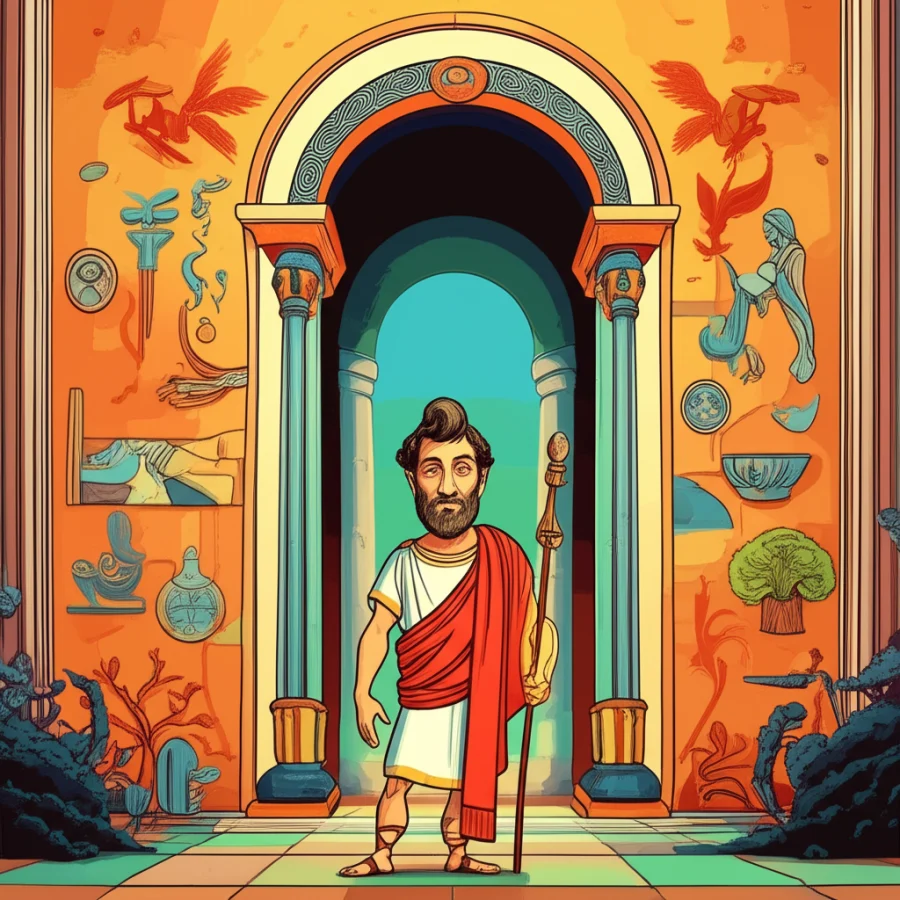
Standing against this terrifying entity was Theseus. He was a mortal hero, the son of Aegeus, the king of Athens, and Aethra, the daughter of King Pittheus of Troezen. Theseus was renowned for his strength, his bravery, and his keen intellect. He was not a demigod in the same vein as some other Greek heroes, but a human who achieved greatness through his own deeds and determination. His symbolic attributes included the sword, a tool of justice and valor, and later, the thread gifted by Ariadne, representing guidance and the clever unraveling of complex problems. Theseus was the embodiment of Athenian aspiration, a champion of justice and a protector of his people.
Main Story / Narrative Retelling: The Dread Tribute and the Hero’s Resolve
The city of Athens, once proud and prosperous, found itself under a dark shadow cast by the island of Crete. For years, a dreadful tribute had been imposed upon them by King Minos of Crete, a punishment for the death of his son, Androgeus, who had been killed in Athens. Every nine years, Athens was forced to send seven young men and seven young women, the fairest and noblest of their youth, to Crete. These unfortunate souls were then cast into the Labyrinth, a colossal, intricate maze designed by the master craftsman Daedalus, a prison from which there was no escape. There, they were left to the mercy of the Minotaur, a gruesome end that filled Athenian hearts with dread and shame.
When the time came for the third tribute, the citizens of Athens were consumed by despair. The appointed youths, chosen by lot, wept as they prepared for their grim voyage. It was then that Theseus, who had recently come into his own as the son of King Aegeus, stepped forward. He declared, with a voice that carried the weight of his conviction, that he would be one of the chosen youths. He would sail to Crete, not as a victim, but as a slayer. His father, Aegeus, pleaded with him, his heart heavy with foreboding, but Theseus’s resolve was unyielding. He was determined to end this horrific cycle and restore honor to Athens.
The Athenian ship, its sails stained black to signify their sorrowful mission, set sail for Crete. Theseus, however, had a secret plan. He instructed the helmsman to hoist white sails on their return, a signal that would inform his anxious father of his success, should he achieve it. The voyage itself was fraught with the anxieties of facing an unknown fate, the vastness of the Aegean Sea a mirror to their own vulnerability.
Upon arrival in Crete, the Athenian youths were brought before King Minos. Among them was Ariadne, the king’s own daughter. Unlike the cruel king, Ariadne was captivated by the brave Athenian prince. She saw in Theseus not just a victim, but a potential liberator. She met with him in secret, her heart torn between loyalty to her father and a burgeoning admiration for the hero.
Ariadne, knowing the terrifying nature of the Labyrinth and the beast within, devised a plan to aid Theseus. She presented him with a simple, yet brilliant, tool: a ball of thread, spun from her own stores. "Tie one end to the entrance of the Labyrinth," she whispered, "and unwind it as you go. It will be your guide back to safety." She also gave him a sharp sword, its steel glinting with the promise of victory.
The appointed hour arrived. The Athenian youths, their faces pale but their spirits bolstered by Theseus’s presence, were led to the imposing entrance of the Labyrinth. With a deep breath, Theseus tied the end of Ariadne’s thread to a sturdy stone at the entrance. He then stepped into the echoing darkness, the thread unspooling behind him, a fragile lifeline in the suffocating gloom.
The Labyrinth was a masterpiece of architectural terror, a bewildering labyrinth of winding corridors, dead ends, and echoing chambers. The air was thick with the stench of despair and something far more primal and terrifying. Theseus moved with caution, his senses heightened, his grip firm on the sword. He could hear the guttural roars of the Minotaur echoing from the depths of the maze, a sound that would have sent lesser men fleeing.
Finally, in the heart of the Labyrinth, amidst a chamber filled with the macabre remnants of past victims, Theseus confronted the Minotaur. The creature was a monstrous spectacle, its bull’s head lowered, its eyes burning with savage fury. The ensuing battle was a brutal clash of mortal strength against primal beast. Theseus, fueled by the desperation of his city and the courage of his heart, fought with all his might. He dodged the Minotaur’s powerful charges, using the confines of the maze to his advantage, and with a swift, decisive thrust, he vanquished the beast, ending its reign of terror.
Exhausted but triumphant, Theseus followed the thread back through the maze, emerging into the blinding sunlight, the cheers of the surviving Athenian youths ringing in his ears. He had fulfilled his promise, not only to Athens but to himself. He had faced the ultimate terror and emerged victorious. He and the surviving youths, with Ariadne by his side, set sail for Athens, the white sails of their ship a beacon of hope against the blue Aegean.
Symbolism and Meaning: Echoes of Fear and the Triumph of Reason
The myth of Theseus and the Minotaur resonated deeply with the ancient Greeks for several reasons. The Minotaur itself symbolized the primal fears of humanity: the irrational, the monstrous, the unknown that lurked in the dark. Its unnatural birth also spoke to the consequences of defying natural order and the divine. The Labyrinth, a complex and disorienting structure, represented the challenges and uncertainties of life, the seemingly insurmountable obstacles that individuals and societies might face.
Theseus’s victory was a powerful allegory. His courage and determination represented the triumph of human will and intellect over brute force and fear. The thread of Ariadne symbolized wisdom, guidance, and the importance of having a plan, a strategy, to navigate complex situations. Theseus’s actions also embodied the ideal of leadership and civic responsibility, a hero willing to risk everything for the welfare of his community. The myth served as a powerful reminder that even the most terrifying challenges could be overcome with bravery, intelligence, and a commitment to justice.
Modern Perspective: The Hero’s Enduring Legacy
Today, the legend of Theseus and his voyage continues to capture the imagination. The myth has been reinterpreted and retold countless times in literature, art, and popular culture. From epic poems and scholarly analyses to graphic novels and video games, Theseus remains a compelling figure. The Labyrinth, in particular, has become a potent metaphor for complex problems and psychological journeys. Modern interpretations often explore themes of heroism, the nature of monstrosity, and the struggle between order and chaos. The story’s enduring appeal lies in its timeless themes of courage, sacrifice, and the triumph of good over evil, albeit within the context of ancient storytelling.
Conclusion: A Legacy of Stories
The tale of Theseus and the Voyage of Athens is a profound example of the rich cultural heritage of ancient Greece. It is a story passed down through generations, a testament to the power of human imagination and the enduring human need to grapple with the mysteries of existence, our fears, and our aspirations. As Muslims, we recognize that only Allah is the true Creator and Sustainer of all that exists. These ancient stories, while captivating in their narrative and symbolic depth, are understood as products of human culture and storytelling traditions, not as divine truths. They offer us a valuable window into the past, allowing us to appreciate the diverse ways in which humanity has sought to understand itself and the world around it, celebrating the enduring legacy of storytelling and the boundless reach of human creativity.