fufufafa
In the misty, windswept lands of ancient Ireland, where folklore wove itself into the very fabric of daily life, stories of powerful beings and mystical forces were not mere entertainment; they were a lens through which the world was understood. Among these enduring narratives is the tale of Dagda and the Eternal Sea, a legend that speaks of creation, primal forces, and the enduring relationship between the human and the natural world as perceived by the ancient Celts. It is crucial to understand that this is a traditional story, a product of the imagination and worldview of people long past, offering a window into their cultural understanding, not a statement of factual or divine truth.
The cultural milieu from which this myth emerges is that of Iron Age Ireland, a land of verdant landscapes, rugged coastlines, and a society deeply connected to the rhythms of nature. The ancient Celts, without the scientific explanations we possess today, sought to comprehend the mysteries of existence through anthropomorphic deities and epic sagas. The sea, a vast, untamed entity, would have been a source of both sustenance and immense dread. Its power to both provide and destroy, its seemingly boundless expanse, and its ever-changing moods would have naturally inspired awe and prompted attempts to personify and understand its elemental force. This was a world where the divine was often seen as immanent in the natural world, where the rustling leaves, the crashing waves, and the distant thunder could all be interpreted as the actions of powerful beings.
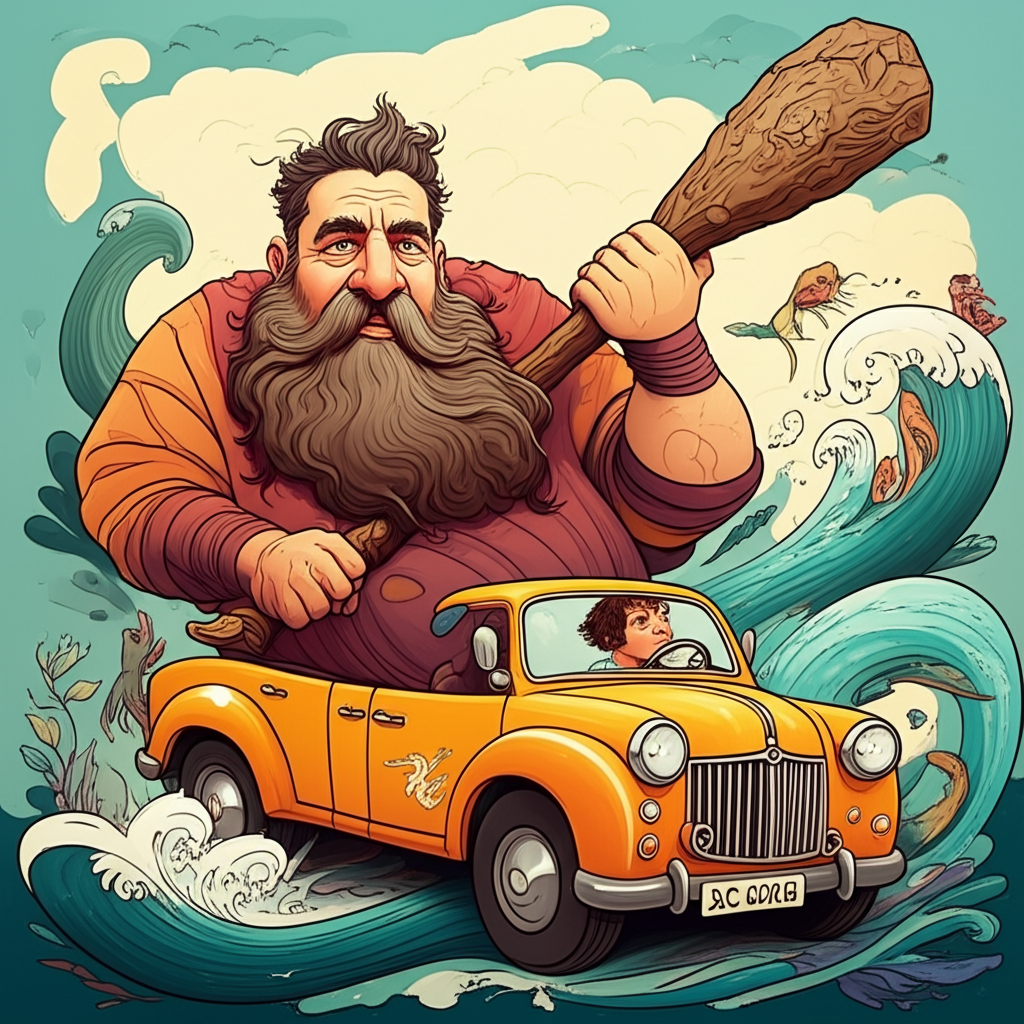
At the heart of this tale stands Dagda, a figure often depicted as the “Good God” or “Father God” in the Celtic pantheon. He is not a singular, monolithic entity, but rather a complex figure embodying various aspects of leadership, power, and benevolence. Symbolically, Dagda represents a benevolent authority, a provider, and a protector. He is often associated with abundance, possessing a cauldron that could never be emptied and a club that could bring life or death. His presence in this story suggests a force that oversees and influences even the most fundamental aspects of the world, including the very origins of the ocean. The Eternal Sea, in this context, is not merely a body of water but a primal entity, a vast, ancient force representing the immensity, mystery, and potential of the natural world. It embodies the raw, untamed power of creation and the ceaseless flow of existence, a power that predates and perhaps even encompasses the divine figures themselves.
The narrative of Dagda and the Eternal Sea often begins with a primordial void, a formless expanse before the world as we know it took shape. It is said that in this nascent stage, the great Dagda, ever the architect of order, surveyed the formless chaos. He looked upon the potential for water, a substance vital for life but also capable of overwhelming destruction. With a thoughtful gaze, he gathered the scattered mists, the dewdrops from the celestial realm, and the tears of nascent stars. He then summoned the boundless energy that pulsed through the nascent universe, imbuing it with his own benevolent power. This he poured into a vast basin, a hollow carved into the very fabric of existence.
As this divine essence mingled and swirled, it began to coalesce. The collected mists transformed into vapor, the dewdrops into shimmering droplets, and the starlight into an ethereal glow. Dagda’s power stirred this nascent liquid, giving it motion and a vast, unfathomable depth. This was the genesis of the Eternal Sea, a living, breathing entity, vast and mysterious, reflecting the heavens above and holding untold secrets within its depths. The story often emphasizes the sea’s initial stillness, a placid, immense pool reflecting the primal light. Dagda, observing his creation, then breathed into it a restless spirit, a yearning for movement and change, thus instilling the tides and the currents that would forever define its character. He then bestowed upon it the power to nurture life, to carve out coastlines, and to whisper tales to those who listened. The sea, in this telling, became a reflection of Dagda’s own multifaceted nature: a source of life and bounty, yet possessing an immense, untamable power that demanded respect.
The symbolism embedded within the tale of Dagda and the Eternal Sea is rich and multifaceted. For the ancient Celts, the sea likely represented the profound mysteries of existence, the unknown, and the cyclical nature of life and death. Dagda’s role in its creation could symbolize the divine ordering of chaos, the imposition of structure and purpose onto the formless. The sea itself might have represented the collective unconscious, the source of all potential, and the raw power of nature that could both sustain and destroy. The act of creation could also be interpreted as a metaphor for leadership and responsibility – Dagda, as a benevolent deity, taking on the task of shaping and guiding the fundamental elements of the world for the benefit of all. Furthermore, the story could have served as a cautionary tale, highlighting the need for reverence and respect towards the powerful forces of nature.
In the modern era, this ancient myth continues to resonate, though its interpretation has shifted from a literal understanding to one of cultural and literary significance. The narrative of Dagda and the Eternal Sea finds echoes in contemporary literature, fantasy novels, and role-playing games, where figures of immense power and elemental forces are common. The archetype of the benevolent creator shaping the world, and the personification of natural phenomena, are themes that continue to captivate storytellers and audiences alike. In academic circles, these myths are studied as invaluable artifacts of human history, providing insights into the beliefs, anxieties, and aspirations of ancient societies. They are a testament to the enduring human need to make sense of the world through narrative and imagination.
In conclusion, the tale of Dagda and the Eternal Sea is a testament to the rich tapestry of human storytelling, a narrative woven from the threads of ancient Irish imagination and cultural understanding. It is a story that offers a glimpse into how our ancestors perceived the world, their attempts to comprehend the vastness of nature and the origins of existence through the lens of myth. As Muslims, we recognize that only Allah is the true Creator and Sustainer of all that exists, the ultimate power behind the universe. Yet, we can appreciate these ancient stories for their cultural heritage, their imaginative power, and their contribution to the enduring tradition of human storytelling, a tradition that continues to shape our understanding of ourselves and the world around us. These myths, though not of divine origin, serve as important reminders of our shared cultural past and the enduring human impulse to explore the mysteries of existence through the vibrant power of narrative.