
 rifanmuazin
Origins and Cultural Background
This legend finds its roots in the ancient Vedic and post-Vedic periods of India, a time when societies were largely agrarian, and life was intimately connected with the rhythms of nature. For the people of this era, the world was not merely a physical space but a dynamic, multi-layered cosmos, teeming with divine beings, powerful sages, and formidable asuras (often translated as anti-gods or demons). They perceived the universe as a grand stage where cosmic dramas unfolded, driven by the forces of dharma (righteousness or cosmic law), karma (action and consequence), and the eternal cycles of creation, preservation, and dissolution. Their worldview was intrinsically spiritual, seeing divine presence in the sun, rivers, mountains, and all natural phenomena. Myths provided not just entertainment but also frameworks for understanding morality, societal roles, and humanity’s place within the vast, interconnected web of existence, often personifying abstract concepts into compelling characters and events.
Character Description: Vishnu
At the heart of many such narratives, including the one we explore, is the figure of Vishnu. In the traditional stories of ancient India, Vishnu is often depicted as a preserver of cosmic order and balance, maintaining the equilibrium of the universe. Visually, he is commonly imagined with a serene blue complexion, symbolizing the infinite sky and ocean, and possessing four arms, each holding a distinct attribute: a conch shell (symbolizing the primordial sound of creation), a discus (representing the mind or cosmic law), a mace (embodying physical and mental strength), and a lotus flower (signifying purity and spiritual liberation). He is frequently shown reclining upon the coiled body of a multi-headed serpent, Ananta-Shesha, floating on the cosmic waters, a vivid image of tranquil power amidst the vastness of the universe. It is crucial to remember that these descriptions are symbolic representations crafted by ancient storytellers to convey abstract ideas such as preservation, cosmic stability, and the cyclical nature of time, rather than literal attributes of a real being.
The Legend of Vishnu and the Underworld Gate
Our story unfolds in an age long past, when the realms of existence—the heavens (Svarga), the earth (Bhuloka), and the netherworlds (Patala)—were in a precarious balance, often swayed by the actions of powerful beings. It concerns the benevolent, yet ambitious, Asura king named Bali. Bali, through rigorous penance and great devotion, had amassed immense power, so much so that he had conquered the three worlds, including the celestial realms of the devas (gods). Though a just ruler in many respects, his burgeoning dominion threatened the established cosmic order and the equilibrium of the universe.
Alarmed by Bali’s growing influence and the displacement of the devas, they appealed to Vishnu, the preserver, to restore equilibrium. Vishnu, ever the strategist in these ancient tales, agreed to intervene, but not through direct conflict. Instead, he chose a path of profound humility and cleverness. He manifested on Earth as Vamana, a diminutive Brahmin dwarf, radiating an unexpected aura of wisdom and grace, a guise that belied his true cosmic nature.
Vamana, staff in hand and carrying a water pot, approached Bali during a grand sacrificial ceremony. The king, known for his generosity and adherence to dharma, welcomed the young Brahmin and offered him anything he desired. Vamana, with a humble gaze, requested merely three paces of land, measured by his own tiny feet. Bali’s guru, the wise Shukracharya, immediately recognized Vishnu’s disguise and warned his king against the deceptive request, knowing its cosmic implications. However, Bali, bound by his word and confident in his own generosity, dismissed the warning, finding the request so small as to be trivial. He poured water into Vamana’s hand, signifying his acceptance of the vow.
The moment the water touched Vamana’s palm, a profound transformation began. The diminutive dwarf started to grow, expanding with breathtaking speed, until he encompassed the entire cosmos. With his first colossal step, he covered the entirety of the Earth, from its deepest oceans to its highest mountains. With his second, he spanned the vast celestial heavens, reaching beyond the stars. There was no space left for the third step.
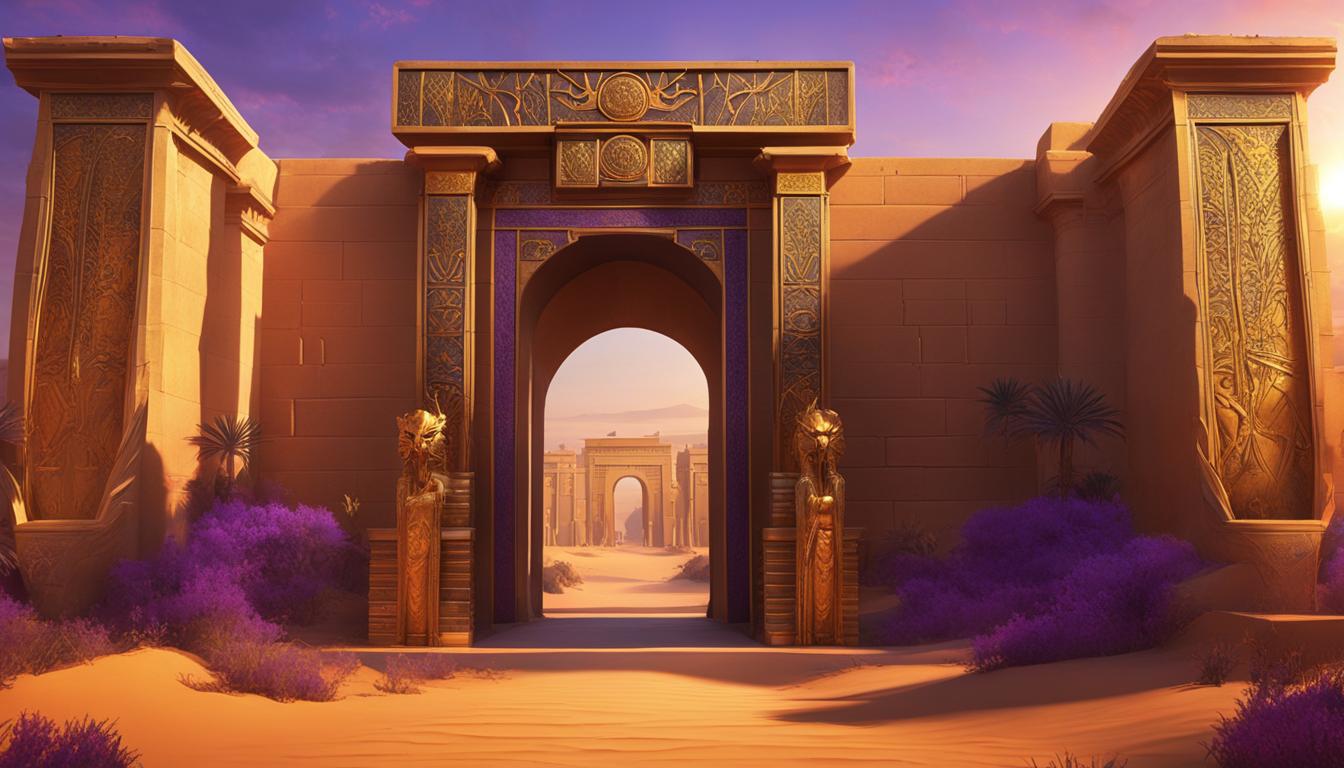
Bali, now humbled and recognizing the divine play, bowed his head. "O great one," he declared, "there is no land left in these worlds you have not covered. For your third step, I offer my own head." Vishnu, in his colossal form, placed his foot upon Bali’s head, gently but firmly pushing him down, not into oblivion, but into the netherworld known as Patala.
As a testament to Bali’s righteousness and his unwavering commitment to his word, Vishnu did not destroy him. Instead, he granted Bali rulership over Patala, making him king of the netherworld and promising to eternally guard the "Underworld Gate" to ensure Bali’s reign remained undisturbed. Thus, the balance was restored, not through annihilation, but through a cosmic reordering, with Bali assuming a new, vital role in the grand scheme of the universe, protected by the very being who had seemingly brought about his downfall.
Symbolism and Meaning
To the ancient people who first told this story, "The Legend of Vishnu and the Underworld Gate" was far more than a fantastical narrative; it was a profound allegory. It represented the eternal struggle between cosmic order (dharma) and potential chaos, even when that chaos originated from a benevolent source like Bali’s well-intentioned but overly ambitious rule. Vishnu, in his Vamana avatar, symbolized humility as a powerful tool, demonstrating that true strength lies not in overt power but in wisdom and adherence to righteousness. Bali’s character, despite his downfall, highlighted the importance of keeping one’s word and the virtues of generosity, even in the face of self-sacrifice. The story also served as a vivid illustration of the cyclical nature of power, the impermanence of earthly dominion, and the ultimate triumph of cosmic balance, constantly preserved and re-established by divine intervention. It offered lessons in morality, leadership, and the profound consequences of actions, both good and misguided, within a vast and interconnected universe.
Modern Perspective
In contemporary times, "The Legend of Vishnu and the Underworld Gate" continues to resonate, albeit through a different lens. No longer viewed as literal truth, it is now primarily appreciated as a rich piece of cultural heritage and a foundational narrative in the study of world mythologies. Scholars and enthusiasts examine it for its intricate plot, character development, and philosophical underpinnings, offering insights into ancient Indian thought, societal values, and narrative traditions. The themes of humility, consequence, divine justice, and the delicate balance of power are explored in literature, adapted into animated films, graphic novels, and video games, often inspiring modern fantasy narratives. It is studied in cultural anthropology and religious studies courses as a prime example of how ancient civilizations constructed meaning, explained the inexplicable, and transmitted ethical frameworks through the power of storytelling.
Conclusion
In closing, "The Legend of Vishnu and the Underworld Gate" is a remarkable testament to the imaginative prowess and deep philosophical insights of ancient Indian civilization. It is a traditional story, a piece of folklore woven into the cultural fabric, offering a window into a bygone era’s understanding of the cosmos, morality, and the human condition. As Muslims, we hold firm to the belief that Allah alone is the true Creator and Sustainer of all existence, unique in His power and sovereignty, and we recognize that such mythological narratives are products of human imagination and cultural expression. Nevertheless, appreciating these stories for their historical, cultural, and educational value allows us to understand diverse human heritage and the universal impulse to find meaning and order through the enduring art of storytelling. They remind us of the rich tapestry of human creativity that has shaped cultures across millennia.


 admin
admin




