fufufafa
In the vast tapestry of Chinese mythology, woven with threads of creation, heroism, and the enduring spirit of humanity, lies the legend of Nuwa and her potent artifact, the Ruyi. This is not a testament to divine intervention as understood today, but rather a story, a cultural narrative passed down through generations, reflecting the ancient worldview and the profound questions faced by early civilizations. To delve into the Ruyi is to step back in time, to understand how people once perceived their world, their place within it, and the forces they believed shaped their existence.
Echoes from a Primordial Landscape: Origins and Cultural Background
The myths surrounding Nuwa and the Ruyi emerge from the crucible of ancient China, a time when the very foundations of society were being laid. Imagine a landscape still largely untamed, where towering mountains held secrets, raging rivers carved their paths with untamed force, and the heavens above seemed to hold an awe-inspiring, often capricious, power. In this era, life was a precarious balance. Natural disasters like floods and droughts were not just inconveniences but existential threats. The world was a place of wonder and terror, where the forces of nature were often personified and imbued with intention.
The people of this time viewed the world as a complex interplay of cosmic energies and ancestral spirits. The distinction between the human and the supernatural was often blurred. They sought explanations for their existence, the formation of the earth, the stars, and the very essence of life. Myths served as their science, their philosophy, and their moral compass. They were narratives that helped to make sense of the unpredictable, to establish order, and to provide a framework for understanding the human condition. The creation myths, like those involving Nuwa, were particularly vital, offering a sense of origin and purpose in a world that could often feel chaotic and overwhelming.
The Weaver of Life and the Scepter of Will: Character Description
Within this rich mythological landscape, Nuwa emerges not as a deity in the Abrahamic sense, but as a primordial figure, a foundational creator, and a protector of humanity. She is often depicted as a benevolent being, sometimes with a serpentine lower body, symbolizing her connection to the earth and its life-giving energies. Her attributes are not those of a ruling god, but rather of a wise nurturer and a skilled artisan. She is the one who kneads the yellow earth to form the first humans, breathing life into them, and later, when humanity faces near extinction, she mends the broken heavens.
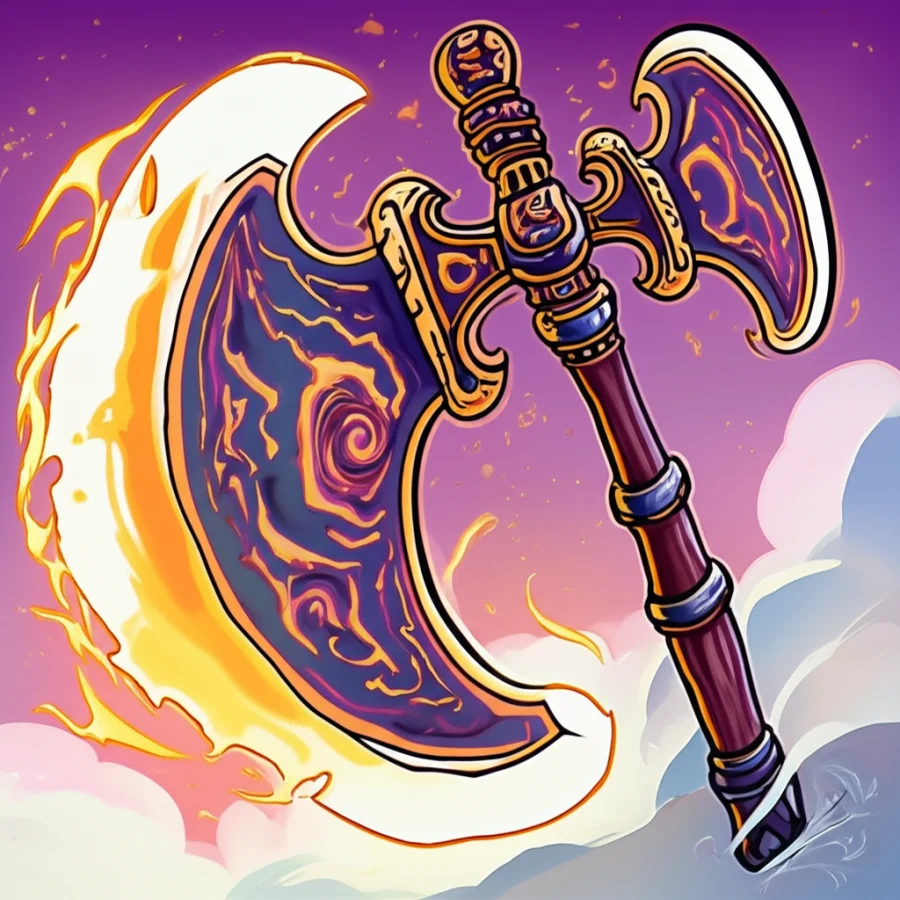
The Ruyi, in its various interpretations, is intrinsically linked to Nuwa’s power and her role as a shaper of reality. It is not merely an object; it is an extension of her will, a symbol of her ability to influence and rectify the world. It is often described as a scepter, a curved object that can take on various forms, symbolizing its adaptability and its power to bring about change. It is not a weapon of destruction, but rather an instrument of balance, of restoration, and of creation. Its symbolic attributes lie in its capacity to manifest desire, to mend what is broken, and to bring order to chaos. It represents the power of intention, the ability to shape circumstances through focused will, and the inherent potential for creation that resides within a benevolent force.
The Serpent’s Kiss and the Sky’s Scar: A Narrative Retelling
The story of Nuwa and the Ruyi often unfolds against a backdrop of cataclysm. In one prominent narrative, the world is plunged into chaos by a titanic battle between the water god Gonggong and the fire god Zhurong. Gonggong, in his rage, strikes Mount Buzhou, a pillar that holds up the sky, causing it to collapse. The heavens crack, the earth splits, and catastrophic floods and fires engulf the land. Humanity is on the brink of annihilation.
It is in this moment of profound despair that Nuwa, the compassionate creator, intervenes. With her immense wisdom and her connection to the very fabric of existence, she sets about to mend the shattered world. She gathers the five-colored stones, imbued with the essence of the earth and sky, and using her extraordinary power, she melts them into a celestial mortar. With this mortar, she meticulously repairs the breaches in the heavens, sealing the cracks and restoring the cosmic balance.
During this monumental task, it is believed that the Ruyi played a crucial role. As she worked, shaping and mending, the Ruyi may have been her guiding instrument, a tool that allowed her to channel her intent and solidify her creations. Perhaps it was used to smooth the celestial mortar, to ensure the perfect alignment of the repaired heavens, or to command the very elements to cooperate. The Ruyi, in this context, becomes the tangible manifestation of Nuwa’s unwavering resolve and her divine craftsmanship. It is the scepter that helped her to bring order out of pandemonium, to rebuild what had been destroyed, and to secure the survival of her creation – humanity.
Another facet of the Ruyi’s narrative involves its potential to grant wishes or to manifest desires. In some tales, it is said that Nuwa used the Ruyi to bring forth abundance, to heal the sick, or to bestow blessings upon her people. It was a symbol of her benevolent authority, a reminder that even in the face of overwhelming adversity, there existed a power capable of restoring harmony and fostering prosperity.
The Weaver’s Thread and the World’s Balance: Symbolism and Meaning
To the ancient Chinese, the myth of Nuwa and the Ruyi offered a profound exploration of several core themes. Primarily, it spoke to the power of creation and restoration. Nuwa’s act of mending the heavens represented the fundamental human desire to overcome destruction and to rebuild what has been lost. The Ruyi, as her instrument, symbolized the agency and the capability to enact such profound change.
The story also likely reflected their understanding of natural forces. The cataclysmic events were personifications of floods, earthquakes, and other destructive phenomena they experienced. Nuwa’s intervention offered a narrative of hope, suggesting that even the most powerful natural forces could be understood, managed, and ultimately balanced by a force of greater wisdom and benevolence.
Furthermore, the Ruyi itself embodied the concept of will and intention. In a world where so much was beyond human control, the idea of an artifact that could manifest one’s desires or rectify imbalances held immense symbolic weight. It represented the power of focused intent, the ability to shape one’s reality through determination and a clear purpose. For rulers and leaders, it might have served as an allegory for their own responsibilities – to govern with wisdom, to maintain balance, and to protect their people from chaos.
Whispers in the Digital Age: Modern Perspective
Today, the myths of Nuwa and the Ruyi continue to resonate, albeit in transformed ways. They are no longer taken as literal accounts of history but are cherished as integral parts of China’s rich cultural heritage. In literature, these figures are reimagined, their stories retold with new interpretations and artistic flair. Video games often draw inspiration from these ancient tales, with Nuwa appearing as a powerful sorceress or a celestial guardian, and the Ruyi as a potent magical item. Films and animated series explore these narratives, bringing them to life for contemporary audiences and fostering an appreciation for ancient storytelling traditions. In academic circles, these myths are studied in fields like cultural anthropology, comparative mythology, and religious studies, offering insights into the psychology and societal structures of ancient civilizations. The Ruyi, in this modern context, has become a symbol of imaginative power, of enduring cultural narratives, and of the universal human fascination with creation, destruction, and the quest for balance.
A Tapestry of Tales: Conclusion
In concluding, it is vital to reiterate that the tale of Nuwa and the Ruyi is a cultural narrative, a product of ancient human imagination and a testament to their efforts to understand the world. It is a story rich in symbolism and meaning, offering a glimpse into a worldview vastly different from our own. As Muslims, we recognize that the ultimate Creator and Sustainer of the universe is Allah, in whose hands alone lies all true power. These ancient stories, however, serve as valuable windows into the past, allowing us to appreciate the diversity of human thought, the enduring power of storytelling, and the fascinating ways in which cultures have grappled with the fundamental questions of existence. They are threads in the vast tapestry of human heritage, reminding us of our shared journey of inquiry and our collective capacity for imagination.