fufufafa
Introduction: Echoes from the Emerald Isle
Deep within the mists of ancient Ireland, where verdant landscapes met the wild Atlantic, a rich tapestry of stories was woven by the hands of its earliest inhabitants. These tales, passed down through generations, speak of gods, heroes, and magical artifacts that shaped the very fabric of their world. Among these revered narratives is the enigmatic legend of the Stone of Fál, often intertwined with the figure of the mighty Dagda. This is not a story meant to be believed as historical fact or divine truth, but rather a traditional myth, a vibrant fragment of cultural heritage that offers a profound glimpse into the worldview and values of the ancient Celtic people who first told it.
Origins and Cultural Background: A World of Spirits and Sovereignty
The myth of the Stone of Fál and the figures associated with it originate from pre-Christian Celtic Ireland, an era roughly spanning from the Iron Age into the early medieval period. This was a society deeply connected to the land, its cycles, and the unseen forces believed to inhabit it. Life was largely agrarian, clan-based, and governed by chieftains, kings, and the influential wisdom of druids, who served as priests, judges, and lore-keepers.
For these ancient people, the world was alive with spirit. Every grove, river, mountain, and even the stones themselves, could possess a vital essence. Their cosmology was not strictly divided into heaven and earth; instead, the physical and the supernatural often overlapped. The Otherworld, a realm of gods, fairies (known as the Aos Sí or Tuatha Dé Danann), and ancestral spirits, was believed to exist just beyond the veil of ordinary perception, sometimes manifesting in ancient burial mounds or sacred natural sites. Concepts like sovereignty, fertility, battle prowess, and wisdom were often personified by powerful deities, whose stories served as moral compasses, historical explanations, and sources of profound cultural identity. Leadership was not merely a political role but often carried a sacred dimension, where a king’s well-being was intrinsically linked to the prosperity of his land.
Character Description: Dagda, The Good God
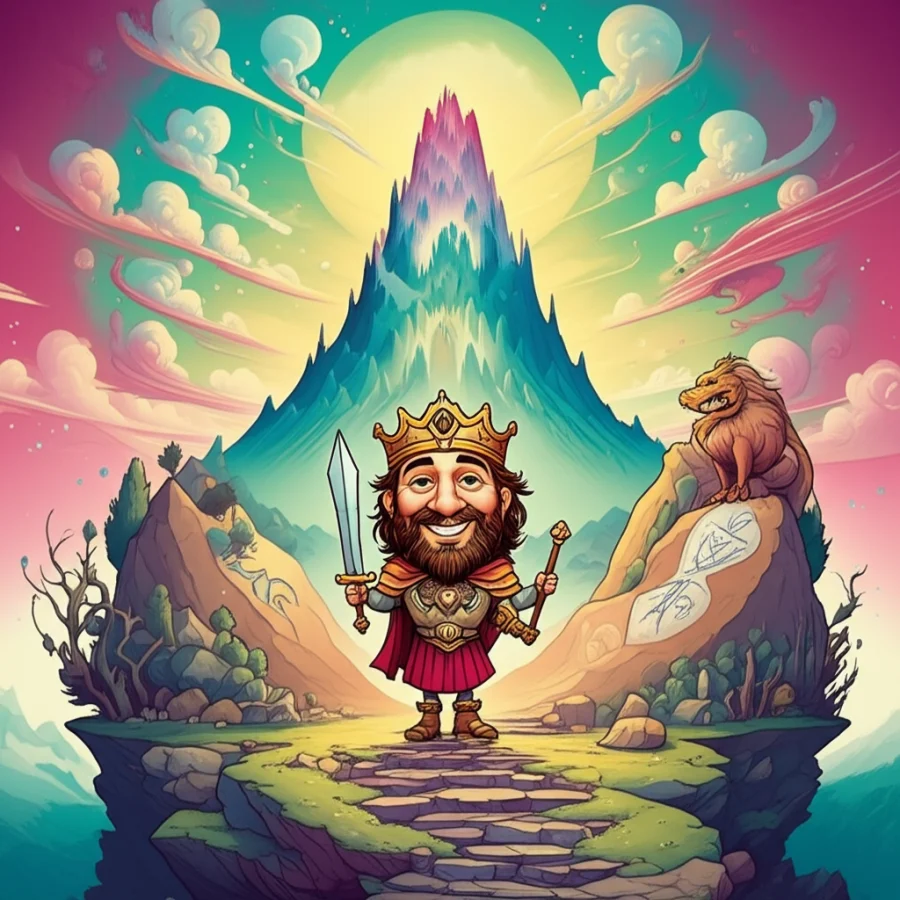
At the heart of many Irish myths, particularly those concerning the Tuatha Dé Danann – the divine race said to have ruled Ireland before the coming of humanity – stands the imposing figure of Dagda. His name, "The Good God," reflects his multifaceted role and benevolent nature, not in a monotheistic sense, but as a being embodying many beneficial attributes. He was revered as a father figure, a powerful chieftain, and a wise leader among his people.
Dagda is typically described as a large, often burly man, possessing immense strength and magical prowess. His most iconic possessions are symbols of his authority and gifts:
- A great club (or lorg mór): So massive that it had to be wheeled, one end could kill nine men, while the other could restore them to life. This symbolizes his power over life and death, destruction and healing, and his role as a formidable warrior and protector.
- The Undry (or Coire ánasa): His never-empty cauldron of abundance, from which no one left unsatisfied. This represents fertility, sustenance, generosity, and the bountifulness of the land under his good rule.
- Uaithne (The Daghda’s Harp): A magical harp that could play three kinds of music: music of sorrow, music of joy, and music of sleep. This symbolizes his wisdom, his mastery over emotion and fate, and his ability to bring order and harmony.
Symbolically, Dagda embodied the ideal king or leader: strong yet benevolent, wise, generous, and deeply connected to the well-being of his people and the land itself. He represented sovereignty, ensuring prosperity, justice, and protection, making him a central figure in myths that established the foundations of kingship in Ireland.
Main Story: The Roaring Stone and the Sovereign King
The tale of the Stone of Fál, or Lia Fáil (meaning "Stone of Destiny"), is intrinsically woven into the narrative of the Tuatha Dé Danann’s arrival in Ireland. These mythical beings, often depicted as god-like figures skilled in magic and the arts, were said to have come from four mythical cities – Falias, Gorias, Murias, and Findias – bringing with them four great treasures. From Falias, they brought the Stone of Fál.
This wasn’t just any stone. It was said to be a powerful, living artifact, imbued with a sacred purpose: to roar in exultation when the rightful High King of Ireland stood upon it. Imagine the scene: in an age before written records, where legitimacy was often contested and divine favor sought, the Stone of Fál served as an ultimate arbiter of kingship. When a new claimant to the High Kingship presented himself, he would approach this ancient monolith, often located on the Hill of Tara, the traditional seat of Ireland’s high kings. With bated breath, the assembled chieftains, warriors, and druids would watch as the aspirant placed his feet upon the hallowed stone. If he was truly the chosen one, the one destined to unite and rule the land, the Stone of Fál would emit a resounding roar, echoing across the plains and valleys, signaling divine approval and sealing his claim.
Dagda, as one of the most prominent leaders of the Tuatha Dé Danann and a figure deeply concerned with the welfare and rightful governance of Ireland, would have been instrumental in establishing the Stone’s significance. His wisdom and authority would have lent weight to its pronouncements, ensuring that the succession was seen as divinely ordained and beyond dispute. The roaring of the Stone was not just a sound; it was a cosmic affirmation, a declaration from the very essence of Ireland itself that the new king possessed fír flathemon, the "sovereignty of the ruler" or "ruler’s truth," a concept crucial to ensuring the prosperity of the land. A king who lacked fír flathemon would bring misfortune, famine, and war upon his people.
The Stone, therefore, was a tangible link between the mundane world of human rulers and the sacred realm of the gods and the land itself. It ensured a sacred contract: a king chosen by the Stone would rule justly, and in return, the land would flourish. The myth recounts that the Stone of Fál roared for every legitimate High King until the time of Conchobar Mac Nessa, or in some later traditions, until the coming of Christianity, after which it fell silent, its purpose fulfilled or perhaps superseded by a new spiritual order. Its eventual silence marked a transition, yet its legacy as a symbol of legitimate rule remained etched in the collective memory of the Irish people.
Symbolism and Meaning: Pillars of Ancient Society
To the ancient Celts, the Stone of Fál and the figure of Dagda were imbued with profound symbolic meaning, reflecting core values and anxieties of their society:
- Legitimate Kingship and Sovereignty: The most direct symbolism of the Stone of Fál is the validation of rightful rule. It represented the divine right of a king, a sacred bond between the land, its people, and its chosen leader. A roaring stone meant peace, prosperity, and order.
- Cosmic Order and Stability: The Stone’s pronouncements ensured stability in a world where power transitions could be fraught with conflict. It represented the maintenance of cosmic order through a divinely sanctioned succession.
- Dagda as the Ideal Ruler: Dagda himself symbolized the ideal chieftain – strong, wise, generous, and a protector of his people. His connection to abundance (the cauldron) and control over life and death (the club) underscored the qualities expected of a sovereign ruler.
- Interconnectedness of Nature and Leadership: The myth highlights the belief that the well-being of the land was intrinsically linked to the moral and legitimate rule of its king. A just king brought good harvests and peace; an unjust one brought famine and strife.
- Ancestral Wisdom and Power: The Tuatha Dé Danann, and their treasures like the Stone, represented the ancient, mystical wisdom and power that shaped Ireland. These stories served to root the present in a glorious, magical past.
Modern Perspective: Echoes in Contemporary Culture
Though no longer regarded as a literal truth, the myth of the Stone of Fál and the figure of Dagda continue to resonate powerfully in modern culture. They are recognized not as objects of worship, but as invaluable cultural artifacts that speak to a rich heritage:
- Literature and Fantasy: The Stone of Fál’s concept of a magical artifact validating leadership has influenced countless fantasy novels, films, and role-playing games, where heroes often seek or are chosen by ancient, powerful relics. Dagda’s archetype, the benevolent and powerful "Good God," appears in various forms in fantasy literature.
- National Identity and Heritage: The Lia Fáil remains a potent symbol of Irish national identity, particularly its connection to kingship and ancient history. A stone often identified as the Lia Fáil still stands on the Hill of Tara, serving as a focal point for tourists and those interested in Ireland’s past.
- Academic and Cultural Studies: Mythologists, folklorists, and historians study these tales to understand ancient Celtic societies, their belief systems, social structures, and linguistic heritage.
- Art and Media: References to Dagda, the Tuatha Dé Danann, and the Stone of Fál appear in various artistic expressions, from paintings and sculptures to video games and popular media, ensuring these ancient stories continue to captivate new audiences.
Conclusion: A Legacy of Imagination and Heritage
The Stone of Fál and the mystery of Dagda represent a profound legacy of human imagination and storytelling from ancient Ireland. They are cultural narratives, not tenets of belief, offering a window into the values, aspirations, and understanding of the world held by a people long past. These myths, rich in symbolism and narrative power, remind us of the universal human need to make sense of the world, to define leadership, and to imbue life with meaning through story.
As Muslims, we recognize that the true Creator and Sustainer of all existence is Allah, the One and Only God, who is unlike anything in His creation. We understand that such mythological tales are products of human ingenuity and cultural expression, originating from times when people sought to explain the inexplicable and articulate their place in the cosmos through varied lenses. The enduring power of these stories lies not in their literal truth, but in their ability to connect us to the vast tapestry of human cultural heritage, demonstrating the boundless capacity for imagination and the timeless tradition of passing down wisdom and wonder through the spoken word.