fufufafa
Introduction: Echoes from Ancient Isles
Deep within the mists of antiquity, where the veil between worlds felt thin and the forests held secrets whispered by the wind, arose a rich tapestry of myths and legends. Among these captivating narratives is a story that intertwines the enigmatic Stone of Fal with the mysterious figure known as Cernunnos. This particular myth, while drawing on widespread Celtic themes, is an imaginative exploration rooted in the ancient traditions of the British Isles and continental Europe. It is a traditional story, a narrative born from the collective imagination of ancient peoples, passed down through generations not as historical fact, but as a means to understand their world, their place within it, and the unseen forces they perceived around them.
Origins and Cultural Background: A World Alive with Spirit
To truly appreciate the tale of the Stone of Fal and its connection to Cernunnos, one must journey back to the Iron Age, to the heartlands of the Celtic peoples. This was a time spanning roughly from 800 BCE to 100 CE, an era long before the widespread arrival of Abrahamic faiths in these regions. The Celts were a diverse group of tribes spread across much of Western and Central Europe, known for their intricate artistry, warrior traditions, and a profound reverence for the natural world.
Their societies were often agrarian, deeply connected to the cycles of the seasons, the fertility of the land, and the rhythms of life and death. For them, the world was not a collection of inanimate objects but a vibrant, living entity, teeming with spirits, deities, and sacred places. Every grove, every river, every mountain held a unique essence. Trees, especially oaks, were revered as conduits to the divine, and bodies of water were often seen as gateways to other realms or as dwelling places for powerful entities. Druids, their learned class, served as priests, judges, teachers, and seers, mediating between the human and spiritual worlds. Their worldview was cyclical, understanding existence as an eternal process of birth, growth, decay, and rebirth, mirroring the perpetual renewal observed in nature. This profound connection to the wild, untamed aspects of their environment formed the bedrock of their mythology and the figures that populated it.
Character Description: Cernunnos, Lord of the Wild
At the heart of our exploration stands Cernunnos, a figure often depicted in ancient Celtic art, particularly from Gaul (modern-day France). He is instantly recognizable by his most striking attribute: majestic antlers, like those of a stag, growing from his head. He is frequently portrayed seated, in a cross-legged meditative pose, often flanked by animals—stags, boars, or wolves—emphasizing his role as the "Lord of Animals" or "Master of the Wild Hunt."
Cernunnos is also typically adorned with torcs, distinct neck rings symbolic of status, divinity, and wealth among the Celts, sometimes holding one in each hand or wearing them on his antlers. Another recurring motif is the ram-headed serpent, a creature that blends the earthiness of the serpent with the power of the ram, often associated with fertility, chthonic (underworld) power, and renewal.
Symbolically, Cernunnos represented a multifaceted array of concepts to the ancient Celts. His antlers, shed and regrown annually, powerfully symbolized renewal, cyclical time, and the regenerative forces of nature. As the Lord of Animals, he embodied the untamed wilderness, the raw vitality of nature, and the fecundity of the earth. His association with torcs linked him to material wealth and prosperity, while the serpent hinted at deeper mysteries—the underworld, the cycles of life and death, and primal wisdom. He was not merely a god of the hunt, but a guardian of the wild, a figure representing the balance and inherent power of the natural world, a connection to the deepest, most ancient aspects of existence. This was not a figure to be worshipped as a divine creator, but rather a symbolic representation of the forces that shaped their world and their understanding of nature’s profound mysteries.
The Main Story: The Stone, the Stag, and the Sovereign
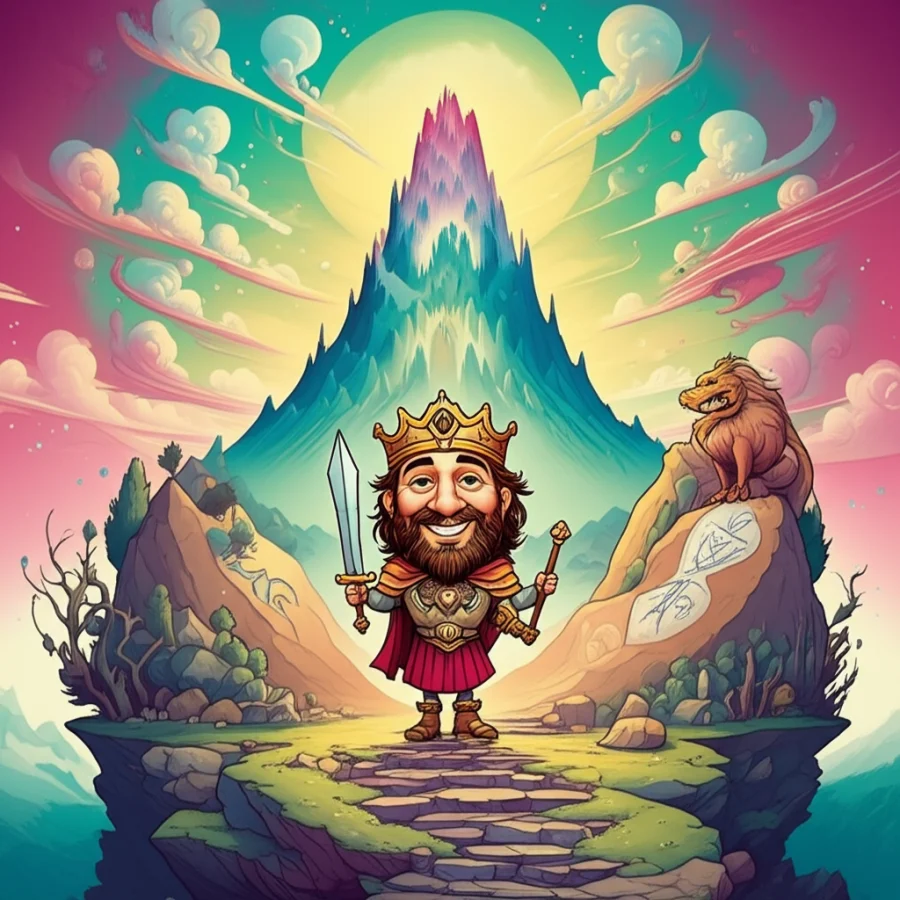
Legend whispers that the Lia Fáil, the Stone of Fal, was one of four sacred treasures brought to Ireland by the Tuatha Dé Danann, the mythical divine race of ancient Ireland. This formidable standing stone, now located on the Hill of Tara, the ancient seat of Irish kings, was said to possess an extraordinary power: it would let out a triumphant roar when the rightful High King of Ireland stepped upon it. For centuries, kings and aspirants alike sought its affirmation, believing its cry to be a divine mandate, a connection between the land, its people, and its chosen leader.
Yet, there came a time of silence. The land groaned under a succession of weak and fractured leadership. The Stone of Fal remained mute, its grey surface cold and unyielding, even to those who claimed the bloodline of ancient kings. The forests grew wilder, the rivers seemed to run less freely, and the people felt a disconnect from the ancient spirit of the land. The druids, in their wisdom, spoke of an imbalance, a forgotten truth that lay at the heart of sovereignty. They spoke of Cernunnos, not as a king, but as the spirit embodying the very essence of the land—its wildness, its cycles, its untamed, fertile power. The Stone, they divined, would only speak to one who truly understood the "mystery of Cernunnos."
This was not a mystery of ritual or sacrifice, but of deep intrinsic understanding. It was said that a true king must not merely rule the land, but be of the land, understanding its ancient rhythms, respecting its wild heart, and embodying its regenerative spirit. The Stone’s silence was a reflection of the land’s own discontent, a call for a leader who recognized that true power flowed not from conquest, but from harmony with the natural order.
Into this troubled age stepped a young chieftain named Bran. Unlike others, Bran did not arrive with armies or boastful claims. He spent his days in the ancient oak groves, learning the names of the trees and the calls of the birds. He observed the salmon leaping upstream, the stag shedding its antlers only to grow them anew, and the quiet decay that nourished new life. He sought out the most ancient druids, not to learn incantations, but to understand the meaning of the wild, the subtle language of the earth.
One moonless night, guided by the hoot of an owl and the scent of damp earth, Bran found himself in a clearing shrouded in mist. There, an ancient druid, with eyes like moss-covered stones, spoke to him not of gods, but of balance. "The Stone of Fal," the druid whispered, "is the heart of the land. And the heart of the land beats with the rhythm of Cernunnos. He is the cycle, the hunter and the hunted, the forest’s dark secret and its fertile promise. A king who does not honour this cycle, who does not feel the pulse of the wild within himself, cannot awaken the Stone. For the Stone seeks not a master, but a steward."
Bran understood. He returned to Tara, not with a newfound arrogance, but with a profound humility. When he approached the Lia Fáil, he did not demand its recognition. Instead, he stood before it, closed his eyes, and felt the earth beneath his bare feet. He thought of the deep roots of the ancient oaks, the quiet strength of the stag, the perpetual renewal of the forest floor. He felt the wildness within himself, the connection to the life and death, growth and decay that animated all things.
As Bran placed his hand upon the cold surface of the Stone of Fal, a tremor ran through the ground. A low hum began, growing in intensity, until the very air vibrated. Then, a mighty, resonant roar erupted from the Stone, echoing across the hills of Tara, a sound that was not merely a cry, but a primal affirmation, a voice from the ancient earth itself. The silence was broken, the land had spoken, and the mystery of Cernunnos had been understood.
Symbolism and Meaning: The King and the Wild
For the ancient Celts, this narrative would have been rich with profound meaning. The Stone of Fal, or Lia Fáil, represented the very sovereignty of the land, a tangible link between the spiritual realm and earthly rule. Its ability to "cry out" symbolized a divine mandate, legitimizing a king’s claim and ensuring the prosperity and stability of the realm. It was not merely a stone, but a living oracle of the land’s will.
Cernunnos, in this context, embodies the untamed, vital spirit of nature itself. He represents the cycle of life, death, and rebirth, the raw fertility of the earth, and the ancient wisdom held within the wilderness. The "mystery of Cernunnos" was not a riddle to be solved, but a truth to be embraced: that true leadership is inextricably linked to an understanding and respect for the natural world. A king who embodies the spirit of Cernunnos is one who understands balance, who values renewal over stagnation, and who acts as a steward of the land, rather than its absolute owner. This story would have served as a moral guide, emphasizing that a leader’s legitimacy stemmed from their alignment with the fundamental forces of existence, their connection to the wild, generative power of the earth, and their role in maintaining the sacred balance.
Modern Perspective: Echoes in Contemporary Culture
While the ancient world that birthed such myths has long since passed, the themes embedded within the Stone of Fal and the figure of Cernunnos continue to resonate in contemporary culture. In literature, particularly within the fantasy genre, the concept of a "Stone of Destiny" or a magical artifact that affirms true kingship is a recurring motif, often drawing inspiration from Celtic lore. Characters frequently undergo quests to prove their worthiness, not just through martial prowess, but through moral fortitude and a deep connection to their world, echoing Bran’s journey.
Cernunnos, with his striking visual identity, has found a place in modern visual media. He appears in video games as a powerful nature deity or guardian, in fantasy art as a symbol of wild magic or primal forces, and in certain films and television series that explore ancient mythologies or pagan themes. Academically, both the Lia Fáil and Cernunnos are subjects of study in archaeology, comparative mythology, and cultural history, offering insights into the belief systems, artistic expressions, and societal values of the Iron Age Celts. These modern interpretations, whether in fiction or academia, highlight the enduring power of these ancient symbols to inspire imagination and deepen our understanding of human cultural heritage.
Conclusion: A Legacy of Storytelling
The tale of the Stone of Fal and the mystery of Cernunnos stands as a testament to the profound imagination and intricate worldview of the ancient Celtic peoples. It is a cultural story, a narrative crafted to explain the world around them, to define leadership, and to connect humanity with the powerful, often enigmatic forces of nature. As a myth, it invites us to explore a rich cultural heritage, to understand the diverse ways in which different civilizations have sought meaning and order in their existence.
As Muslims, we recognize that the concept of creation and sustenance belongs solely to Allah (SWT), the One True Creator and Sustainer of all that exists. Our belief affirms that Allah is unique, without partner or peer, and that all power, wisdom, and majesty emanate from Him alone. This understanding allows us to appreciate mythological narratives for their cultural, historical, and educational value, without attributing any divine power or reality to the figures or events they describe. The legacy of such stories lies not in their literal truth, but in their capacity to reflect human dreams, fears, aspirations, and our enduring quest to comprehend the vastness of the world and our place within it. They remind us of the universal human impulse to tell stories, to weave narratives that bridge generations, and to pass down the intricate threads of imagination that form our collective cultural heritage.