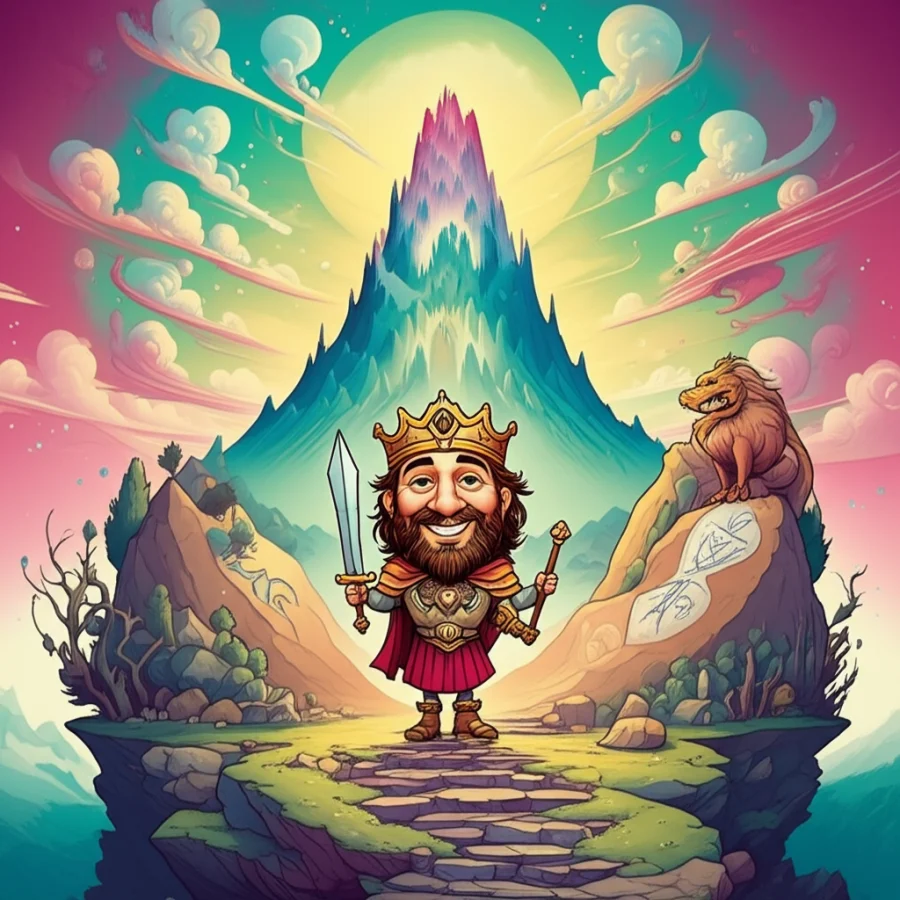
fufufafa
In the misty annals of ancient Ireland, where the veil between the seen and unseen often seemed thin, a rich tapestry of myths and legends was woven. These were the traditional stories told by ancient peoples, passed down through generations, shaping their understanding of the world around them. Among these captivating narratives stands the tale of the Stone of Fal, or Lia Fáil, and its subtle, yet profound, connection to the revered figure of Brigid, a connection that speaks to the very heart of Irish sovereignty and well-being. This is not a story meant for belief or worship, but rather a window into the cultural, historical, and educational understanding of a bygone era.
Origins and Cultural Background
The myth of the Lia Fáil and figures like Brigid emerged from the vibrant tapestry of pre-Christian Celtic Ireland, an era roughly spanning from the Iron Age into the early medieval period. This was a society deeply rooted in an agrarian lifestyle, where the rhythms of nature dictated existence, and the land itself was imbued with sacred significance. Life was often tribal, governed by chieftaincies and kingships, with strong oral traditions serving as the primary means of preserving history, law, and spiritual understanding.
For the people of this time, the world was alive with unseen forces and powerful entities. They viewed the natural environment—rivers, trees, hills, and the very soil beneath their feet—as manifestations of divine power or the dwelling places of spirits. Their worldview was animistic, recognizing a spiritual essence in all things, and cyclical, understanding life, death, and rebirth as an eternal process. Gods and goddesses were not distant, abstract beings but rather personifications of essential aspects of life: the sun’s warmth, the earth’s fertility, the craft of the artisan, the wisdom of the poet, and the courage of the warrior. These myths provided a framework for understanding their place in the cosmos, the duties of their leaders, and the moral fabric of their communities.
Brigid and the Lia Fáil: Pillars of Ancient Ireland
At the heart of many Irish myths are figures of immense symbolic power. Brigid, for instance, stands as one of the most prominent goddess figures in the Celtic pantheon, particularly revered in Ireland. She was not a single-faceted deity but a triple goddess, embodying distinct yet interconnected domains: poetry and inspiration, healing and medicine, and smithcraft and fire. These attributes were not to be interpreted as literal powers in the modern sense but as symbolic representations of crucial societal functions and values. Poetry represented wisdom, memory, and cultural continuity; healing symbolized well-being and life itself; and smithcraft, with its mastery over fire and metal, signified transformation, innovation, and protection. Brigid, therefore, symbolized the creative, nurturing, and transformative forces essential for a thriving community.
Complementing this, the Lia Fáil, or "Stone of Destiny," was one of the legendary Four Treasures of the Tuatha Dé Danann, the mythological race said to have settled Ireland. Unlike Brigid, the Lia Fáil was an artifact, a standing stone said to be located on the Hill of Tara, the ancient seat of the High Kings of Ireland. Its symbolic attribute was profound: it was believed to cry out with joy when the rightful High King of Ireland touched it. This act of validation was not just a political endorsement but a divine affirmation, signifying that the land itself had accepted its ruler. The Lia Fáil thus represented sovereignty, the sacred bond between the land, its people, and their chosen leader, and the divine mandate for kingship.
The Mystery Unveiled: A Narrative Retelling
The epic journey of the Tuatha Dé Danann to Ireland is a tale of magical arrival and powerful artifacts. When these skilled and mystical people descended upon the emerald isle, they brought with them four wondrous treasures, each imbued with unique properties. From the city of Falias came the Lia Fáil, the stone destined to announce Ireland’s true kings. From Gorias came the Sword of Nuada, from Findias the Spear of Lugh, and from Murias, the Cauldron of the Dagda. Each treasure served a vital function, ensuring the prosperity, justice, and protection of the land.
The Lia Fáil was placed atop the sacred Hill of Tara, a silent sentinel awaiting its moment of truth. For generations, chieftains and warriors would present themselves before it, seeking the elusive validation of kingship. When the chosen one, the rí or king whose destiny it was to rule, laid a hand upon its ancient surface, the stone would emit a resounding roar, echoing across the plains, proclaiming to all the land that a just and rightful sovereign had been found. This was not a mere custom; it was the land’s own voice, speaking through the stone, signifying its acceptance of the leader who would ensure its fertility and the well-being of its people.
The "Mystery of Brigid" within this narrative is not a direct, dramatic interaction with the stone, but rather a deeper, philosophical intertwining of her essence with the Lia Fáil’s purpose. Brigid, as the embodiment of poetry, healing, and smithcraft, represented the very flourishing of Irish society. A king validated by the Lia Fáil was expected to uphold the values and ensure the prosperity that Brigid herself personified. How could a king be truly "rightful" if he failed to foster creativity, ensure health, or protect the crafts that sustained his people? The stone’s cry, therefore, implicitly validated a ruler who would govern in harmony with the principles Brigid embodied – justice, sustenance, and the flourishing of the community.
Legend tells of a time when the stone’s cry grew silent, or its power diminished, perhaps in response to a king who was not truly aligned with the land’s needs, or perhaps due to the increasing influence of new belief systems. Some tales even speak of its eventual relocation, adding to its mystique. Yet, the ideal of a king whose rule brought forth the land’s bounty, whose reign fostered healing and inspired creativity – all aspects championed by Brigid – remained. The Lia Fáil was a test, not just of lineage, but of a ruler’s inherent connection to the welfare of Ireland, a welfare intrinsically linked to the spirit of Brigid. Her subtle presence in the lore of the Lia Fáil lies in the understanding that true sovereignty, affirmed by the stone, was inseparable from the harmonious and prosperous society she represented.
Symbolism and Meaning
For the ancient Irish, the Lia Fáil was far more than a rock; it was a potent symbol of sovereignty and divine right to kingship. Its roar signified the land’s acceptance of its ruler, a critical aspect in a culture where the health and prosperity of the land were directly linked to the moral integrity and leadership of its king. A king validated by the Lia Fáil was seen as having a sacred mandate, a blessing that ensured fertility, good harvests, and peace.
Brigid, in turn, symbolized the very essence of a thriving society: the intellectual prowess of poetry, the physical well-being brought by healing, and the material prosperity and protection offered by smithcraft. Her presence underscored the belief that a good ruler, one recognized by the Lia Fáil, would naturally foster these virtues. The combined symbolism suggests that true leadership was not merely about power, but about ensuring the holistic well-being of the community – its culture, its health, and its material advancement. The stone affirmed the king, and the king was expected to embody the principles Brigid represented, thus forging an unbreakable, mystical bond between the ruler, the land, and its people.
Modern Perspective
Today, the myth of the Lia Fáil and figures like Brigid continue to resonate, albeit in different forms. In contemporary literature, fantasy novels, and role-playing games, the Stone of Destiny is a classic trope, often adapted to represent ultimate power or the validation of a chosen hero. Brigid, too, appears in various media, her triple aspects making her a compelling character embodying strength, wisdom, and nurturing qualities. These ancient narratives are no longer seen as literal truths but as rich sources of inspiration for storytelling and character development.
Academically, these myths are invaluable for cultural studies, providing deep insights into the worldview, values, and social structures of ancient Celtic societies. Historians and folklorists study them to understand the origins of kingship, the role of women in mythology, and the spiritual landscape of pre-Christian Ireland. The Lia Fáil itself, a real stone still standing on the Hill of Tara, draws tourists and researchers, serving as a tangible link to a distant past and a testament to the enduring power of human imagination and storytelling.
Conclusion
The Stone of Fal and the mystery of Brigid stand as enduring testaments to the imaginative spirit of ancient Celtic peoples. These tales, woven from the fabric of their lives, offered explanations for the world around them, guided their societal structures, and inspired their leaders. It is crucial to remember that these are cultural stories, not beliefs to be adopted or practiced. As Muslims, we recognize that only Allah is the true Creator and Sustainer, and all power and guidance ultimately emanate from Him alone.
Yet, there is profound value in exploring such cultural heritage. These myths remind us of humanity’s universal quest for meaning, justice, and connection to the world. They highlight the enduring power of imagination, the artistry of oral tradition, and the diverse ways in which different cultures have sought to understand leadership, well-being, and their place in the grand tapestry of existence. By studying these narratives, we gain a deeper appreciation for the rich mosaic of human history and the timeless art of storytelling.