fufufafa
The Pacific Ocean, a vast canvas of sapphire and emerald, has cradled some of the most enduring and imaginative stories ever told. Among these, tales born from the rich tapestry of Polynesian mythology, particularly those originating from the ancestral lands of Hawaiki, offer a profound glimpse into the worldview of ancient peoples. The narratives of Tāne, the god of forests and birds, the enigmatic moʻo, serpentine guardians of water, and the fabled homeland of Hawaiki itself, are not mere folklore; they are echoes of a time when the natural world was imbued with spirit, and the cosmos was understood through the lens of profound connection and potent symbolism. These are traditional stories, passed down through generations by ancient peoples, offering insights into their understanding of creation, their relationship with the environment, and their deepest aspirations.
To understand these stories, we must journey back in time, to a period before written records, when Polynesian societies were deeply intertwined with the rhythms of the ocean and the land. Their world was one of vibrant, living forces. The sun, the moon, the stars, the relentless waves, the fertile soil, and the towering trees were not passive elements but active participants in a grand cosmic dance. This was a world where the boundaries between the physical and the spiritual were fluid, where the actions of gods and ancestral spirits could shape the destinies of humans, and where the natural world served as a constant source of wisdom and guidance. The environment was not just a backdrop for human life; it was the very fabric of existence, teeming with unseen energies and intelligences.
Central to these narratives is the figure of Tāne Mahuta, a prominent deity in Māori mythology, revered as the god of forests, birds, and procreation. In these tales, Tāne is often depicted as a colossal being, whose very form embodies the grandeur of the forest. He is the one who separated the sky father, Ranginui, from the earth mother, Papatūānuku, allowing light and life to flourish in the space between them. His domain is the lush, verdant canopy, the rustling leaves, and the myriad creatures that inhabit the trees. He is the source of wood, the provider of sustenance, and the progenitor of much of the life on earth. His symbolic attributes lie in his role as a creator, a sustainer of life, and the embodiment of the natural world’s generative power. He represents the immense, often untamed, force of nature, and the intricate interconnectedness of all living things within the forest ecosystem.
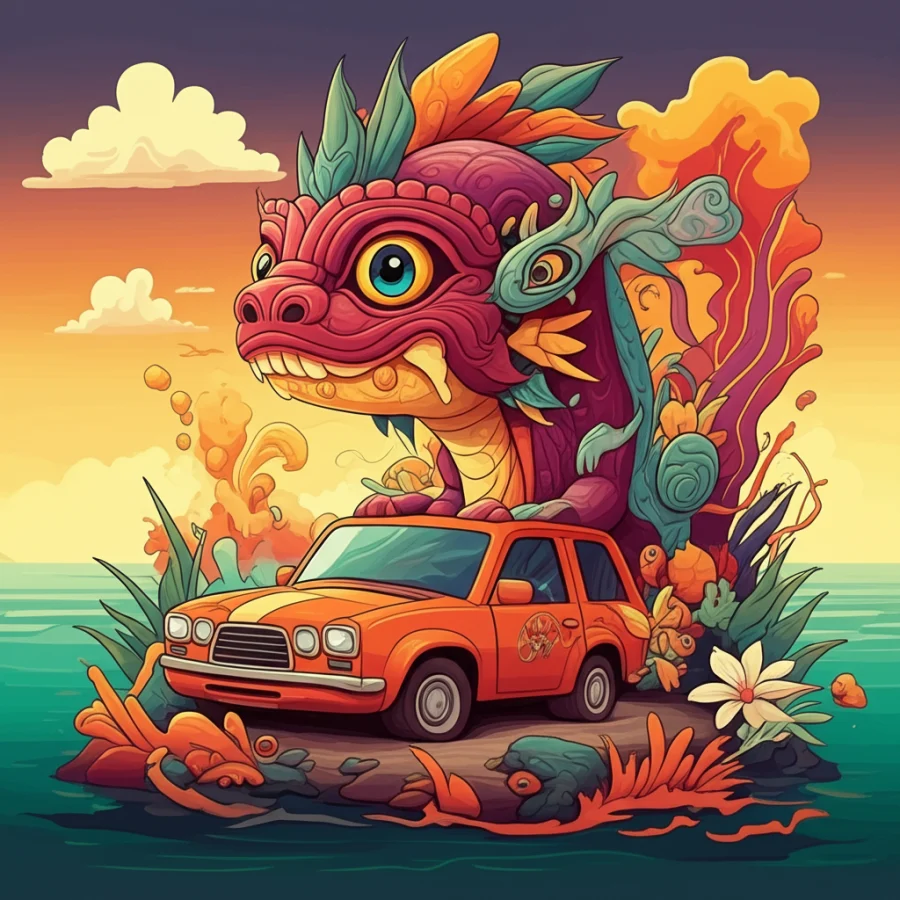
Then there are the moʻo. These are not just simple lizards; they are often portrayed as powerful, serpentine beings, deeply connected to water sources – rivers, streams, lakes, and even the sea. They are frequently depicted as guardians, protectors of their watery domains, possessing immense strength and an often fearsome presence. Their scales might shimmer with the iridescence of a rainbow, or be as dark and deep as the ocean depths. The moʻo embody the primal power of water, its life-giving properties, and its potential for destruction. They can be seen as symbols of the unseen forces that govern the natural world, the custodians of ancient knowledge, and sometimes, the embodiment of caution, reminding humans of the respect due to the powerful elements. Their symbolic attributes relate to guardianship, the elemental power of water, and the mysteries that lie beneath the surface of the visible world.
The concept of Hawaiki is perhaps the most foundational element, representing the mythical ancestral homeland of the Polynesian peoples. It is often envisioned as a paradise, a place of abundance and spiritual purity, from which the first ancestors journeyed across the vast ocean to settle new lands. Hawaiki is not merely a geographical location; it is a spiritual origin, a repository of ancestral knowledge, and a destination for the souls of the departed. The journey to Hawaiki, or the longing for it, represents a deep-seated human desire for belonging, for connection to one’s roots, and for the ultimate return to a place of peace and spiritual fulfillment. It is the cradle of civilization, the source of all life and knowledge in the Polynesian cosmological framework.
The narratives woven around Tāne, the moʻo, and Hawaiki are rich and varied, often interconnected. One can imagine a story where a young Polynesian explorer, setting out from a newly settled island, seeks guidance on his perilous voyage. He might pray to Tāne for strength and the wisdom to navigate the dense forests of a new land, or for the knowledge to build a sturdy canoe. As he journeys, he encounters a shimmering, ancient moʻo guarding a vital freshwater spring. The moʻo, through a series of trials or riddles, might impart crucial knowledge about the currents, the stars, or the hidden dangers of the sea, echoing the wisdom of Hawaiki itself. This moʻo, far from being an adversary, could be a conduit of ancestral knowledge, a manifestation of the very spirit of the land and water, guiding the voyager back towards the spiritual essence of his origin.
Alternatively, a tale might focus on the founding of a new village. The elders, seeking to establish a sacred space, might invoke Tāne to bless the land, ensuring its fertility and the abundance of its forests. They might then establish a sacred pool or stream, where a moʻo is believed to reside, as a place of reverence and a source of spiritual protection. The presence of the moʻo serves as a constant reminder of the delicate balance of nature and the need for respect towards the water, which sustains all life, drawing a parallel to the pristine waters of the mythical Hawaiki. The stories often served as moral compasses, teaching about the importance of respecting nature, honoring ancestors, and maintaining harmony within the community and with the spiritual world.
These stories may have represented a profound understanding of the natural world to ancient peoples. Tāne’s dominion over forests and birds spoke to the vital role of these elements in their survival, providing food, shelter, and materials. The moʻo, as guardians of water, highlighted the indispensable nature of this resource and the respect it demanded. Hawaiki, as the ancestral homeland, offered a sense of identity, continuity, and a shared heritage that bound communities together across the vast expanse of the Pacific. These narratives were not simply entertainment; they were cosmological blueprints, explaining the origins of the world, the relationships between humans and the divine, and the fundamental principles that governed existence. They were a way to make sense of a complex and often unpredictable world, imbuing it with meaning and purpose.
In the modern era, these ancient echoes resonate in various forms. In literature, authors draw inspiration from these myths to craft fantastical worlds and complex characters. In film and television, the dramatic landscapes and powerful symbolism of Polynesian mythology are often reinterpreted, bringing these stories to new audiences. Video games frequently incorporate elements of these narratives, from mythical creatures to quests inspired by ancestral journeys. Beyond entertainment, these stories are invaluable in cultural studies, offering insights into the philosophical, spiritual, and social structures of ancient Polynesian societies. They are a testament to the enduring power of human imagination and the universal need to understand our place in the cosmos.
It is crucial to reiterate that these are cultural stories, born from the rich imagination and profound connection to the natural world of ancient peoples. As Muslims, we recognize that only Allah (God) is the true Creator and Sustainer of all that exists, and that divine power resides solely with Him. These narratives, while fascinating and culturally significant, are not to be interpreted as literal truth or divine revelation. They stand as powerful examples of human storytelling, reflecting a particular way of understanding the world and its mysteries. They remind us of the enduring legacy of human heritage, the boundless capacity for imagination, and the timeless tradition of sharing stories that connect us to our past and to the deeper currents of human experience. They are echoes, whispers from a distant shore, reminding us of the power of myth to shape our understanding and to ignite our sense of wonder.