fufufafa
This article delves into a captivating narrative from ancient Greek mythology, a rich tapestry of stories woven by people long ago to explain the world around them. It is crucial to understand from the outset that this account is a traditional story, a myth passed down through generations, and is presented purely for its cultural, historical, and educational value. It is NOT real, nor is it meant to be believed, worshipped, or practiced in any form. Our exploration is an academic and appreciative look at a powerful piece of human imagination.
Origins and Cultural Background
The myth of Hermes and the lyre emerged from the vibrant intellectual and artistic landscape of ancient Greece, primarily during the Archaic and Classical periods (roughly 800 BCE to 323 BCE). This was a time when Greek civilization flourished, giving birth to democracy, philosophy, theatre, and some of the world’s most enduring literature. The society was polytheistic, meaning people worshipped a pantheon of gods and goddesses, each embodying different aspects of nature, human experience, and moral principles.
In this era, the world was viewed through a lens of divine intervention. Natural phenomena, human emotions, success, and misfortune were often attributed to the will or whims of the gods. These deities were not distant, abstract forces; they were anthropomorphic, possessing human-like qualities, emotions, and even flaws, albeit on a grander, immortal scale. Myths served as more than mere entertainment; they were explanations for the inexplicable, moral lessons, and reflections of societal values. Music, poetry, and storytelling held immense importance, believed to be divinely inspired arts that could move hearts, inspire courage, and even influence the gods themselves. The Homeric Hymns, epic poems attributed to Homer or his followers, are among the earliest and most vivid sources for tales such as the birth of Hermes and the creation of the lyre, providing a window into the ancient Greek psyche and their perception of their divine patrons.
Character Description: The Mischievous Messenger
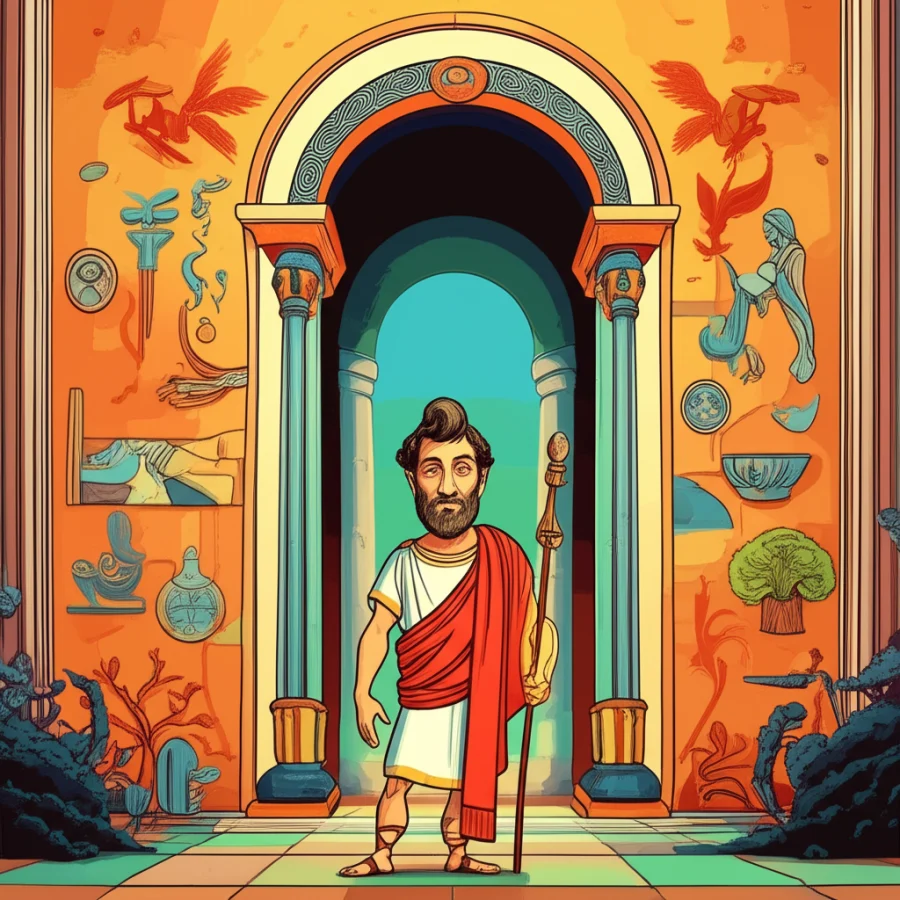
At the heart of this tale is Hermes, one of the most dynamic and complex figures in the Greek pantheon. He is typically depicted as a youthful, agile god, often wearing winged sandals (talaria), a winged traveler’s hat (petasos), and carrying a herald’s staff (kerykeion or caduceus), entwined with snakes.
Symbolically, Hermes embodies a fascinating array of attributes. He is the god of boundaries, transitions, and communication – the messenger of the gods, bridging the divide between Olympus, the earth, and the Underworld. He is also revered as the patron of travelers, merchants, shepherds, and athletes. However, perhaps his most distinctive and enduring characteristic is his role as the divine trickster. From the moment of his birth, Hermes is associated with cunning, inventiveness, and a playful disregard for conventional rules. He is the god of thieves, not necessarily promoting malice, but rather celebrating ingenuity and the ability to outwit. His symbolic attributes, therefore, speak to the power of wit over brute force, the importance of negotiation, and the fluid, ever-changing nature of the world. He represents the unpredictable spark of creativity, the charm of persuasion, and the often-ambiguous morality inherent in cleverness.
The Main Story: Birth, Theft, and the Unforeseen Gift
The story of the lyre’s creation begins on a cool, starlit night in a cave on Mount Kyllene in Arcadia. Zeus, king of the gods, had secretly lain with Maia, a shy nymph and one of the Pleiades. From this clandestine union, a most extraordinary child was born: Hermes. But this was no ordinary infant. According to the Homeric Hymn to Hermes, no sooner had Maia given birth than the babe, barely swaddled, displayed a cunning far beyond his years. He was born at dawn, but by midday, he had already embarked on his first great adventure.
His mother, exhausted, had fallen asleep. Slipping from his cradle, the infant Hermes’ eyes gleamed with mischief and a precocious intellect. His first act was to find a tortoise, which he promptly killed, scooping out its shell. With remarkable dexterity, he stretched ox-hide over the opening, fashioned arms from reeds, and strung seven gut strings across it. In a matter of hours, he had invented the lyre, an instrument of exquisite beauty and potential for divine melody. He plucked its strings, and the cave resonated with a harmony that delighted even his own infant ears.
But Hermes’ inventiveness was matched only by his audacious spirit. That very night, under the cover of darkness, he crept out and made his way to Pieria, where his half-brother, the majestic Apollo, god of music, light, and prophecy, grazed his magnificent herd of fifty sacred cattle. With an unparalleled display of cunning, Hermes drove the cattle away, leading them backward to obscure their tracks, and even fashioned sandals for himself to further confuse any pursuers. He eventually hid the herd in a secluded cave in Pylos, sacrificing two of them to the twelve Olympian gods (including himself, a delightful touch of self-importance for a newborn).
When Apollo awoke the next morning to find his prize cattle missing, his fury was immense. Guided by omens and clues, he eventually tracked the culprit to Maia’s cave, confronting the seemingly innocent infant in his cradle. Hermes, feigning ignorance and innocence, denied everything with a charming, persuasive tongue. The argument escalated, and Apollo, outraged by the babe’s insolence, dragged Hermes before their father, Zeus, on Mount Olympus, demanding justice.
Zeus, amused by his newborn son’s audacity but also recognizing the gravity of the theft, listened to both sides. He saw through Hermes’ clever lies but also admired his ingenuity. He commanded Hermes to return Apollo’s cattle. With a mischievous twinkle in his eye, Hermes led Apollo back to the hidden herd.
It was then that the true "curse" of Hermes, or perhaps more accurately, the profound consequence of his actions and the enduring legacy of his cunning, came into play. As Apollo stood fuming over his recovered cattle, Hermes pulled out the lyre he had crafted. He began to play, and the notes that emanated from the tortoise-shell instrument were unlike anything Apollo had ever heard. The melody was so enchanting, so sublime, that Apollo’s anger melted away, replaced by awe and a profound longing. The music spoke of joy, sorrow, and the very essence of existence, captivating the god of music himself.
Apollo, utterly spellbound, offered to exchange the cattle for the wondrous instrument. Hermes, ever the negotiator, agreed. Not only did Apollo receive the lyre, which became his primary attribute and a symbol of his dominion over music, but in further negotiations, Hermes received Apollo’s golden staff, the caduceus, which granted him dominion over flocks and herds, and later became his iconic symbol as a herald. Thus, through an act of theft and subsequent artistic brilliance, a complex reconciliation was forged, forever intertwining the fates of these two powerful gods. The lyre, born of trickery, became an instrument of divine harmony, a testament to Hermes’ dual nature and the profound power of art to transform conflict into beauty.
Symbolism and Meaning
To the ancient Greeks, the myth of Hermes and the lyre was rich with layers of meaning. Firstly, it illustrated the multifaceted nature of the gods themselves. Hermes embodies the concept that even divine beings possess both admirable and problematic traits – he is both a brilliant inventor and a cunning thief. This duality reflected the complexities of human nature, suggesting that ingenuity often coexists with mischievousness.
The story also profoundly emphasizes the power of music and art. The lyre, born from an act of deceit and violence (the killing of the tortoise), transformed into an instrument of unparalleled beauty and persuasion. It showed that art could transcend its origins, soothe anger, and forge connections, even between adversaries. For a culture that valued music and poetry so highly, this myth served as a divine origin story for one of their most cherished instruments, attributing its creation to a god known for his quick wit and creative spark.
Furthermore, the tale speaks to the themes of reconciliation and negotiation. The conflict between Hermes and Apollo, representing the tension between trickery and order, is not resolved through force but through a clever exchange and the overwhelming beauty of art. It highlights the Greek value of diplomacy and finding common ground, even after a transgression. The story suggests that even the most audacious acts can lead to unexpected positive outcomes, and that balance can be achieved between opposing forces. It also marks a coming-of-age for Hermes, establishing his place within the Olympian hierarchy not just as a thief, but as a god of invention, communication, and charming persuasion.
Modern Perspective
Today, the myth of Hermes and the lyre continues to resonate in various cultural forms. In literature, the Homeric Hymn to Hermes remains a foundational text, studied for its poetic beauty, its insights into ancient Greek society, and its portrayal of the trickster archetype. Authors and poets often draw inspiration from Hermes’ cunning and the transformative power of the lyre.
In the realm of art, Hermes is frequently depicted with his winged sandals and the caduceus, but also prominently with the lyre, symbolizing his connection to music and artistic creation. Visual media, from classical paintings to modern illustrations, often capture the playful confrontation between the infant Hermes and the furious Apollo, or the moment of the lyre’s enchanting performance.
Video games and fantasy literature frequently feature trickster characters or magical musical instruments, often drawing indirectly from archetypes established by myths like this one. The concept of a divine instrument with immense power, capable of influencing emotions or events, is a recurring trope. Academically, cultural studies and mythology courses continue to analyze Hermes as a quintessential trickster figure, exploring his psychological significance and his role in comparative mythology across different cultures. The story serves as a valuable case study for understanding the origins of art, the dynamics of sibling rivalry among gods, and the complex interplay of morality and creativity.
Conclusion
The tale of Hermes and the lyre stands as a testament to the enduring power of human imagination and storytelling. It is a vibrant narrative from ancient Greek mythology, a cultural artifact that offers insights into the worldview, values, and artistic sensibilities of a civilization long past. It is presented here as a fascinating piece of our shared global heritage, inviting contemplation and understanding, but never belief.
As Muslims, we recognize that only Allah is the true Creator and Sustainer, the One without peer or partner, who brought all existence into being. Our faith teaches us to reflect on the wonders of His creation and the guidance He has provided through His prophets. Within this understanding, we can still appreciate the richness of human cultural heritage, including the imaginative stories and myths that people have crafted throughout history. These tales, like the "Curse of Hermes" through the lyre, serve as a reminder of humanity’s innate drive to explain, to create, and to pass on wisdom and wonder through the timeless art of storytelling.