fufufafa
Introduction
Across the windswept shores and verdant valleys of Aotearoa, the land known today as New Zealand, ancient voices once wove tales of beings both wondrous and fearsome. Among the most enduring of these narratives are the legends of the Taniwha, powerful mythological creatures deeply embedded in the cultural fabric of the Māori people. These stories, passed down through generations, are traditional accounts told by the ancient inhabitants of this unique land, offering insights into their worldview and connection to the natural environment. The phrase "Echoes of Rongo" in this context refers to the subtle, pervasive influence of Rongo-mā-tāne, the Māori atua (deity) associated with cultivated foods, peace, and agriculture, suggesting a narrative where the untamed power of the Taniwha might interact with, or be understood through, the lens of balance and sustenance championed by Rongo.
Origins and Cultural Background
The myths and legends of the Taniwha emerged from a pre-colonial Māori society, a culture intrinsically linked to its environment. For these ancient people, the world was not merely a collection of physical elements but a living, breathing entity imbued with spiritual significance. Every mountain, river, forest, and sea held mana (prestige, spiritual power) and was often associated with specific atua or ancestral spirits (tipuna). Māori society was structured around iwi (tribes) and hapū (sub-tribes), with an intricate system of tapu (sacredness, prohibitions) and noa (common, unrestricted) governing daily life.
In this era, knowledge was primarily transmitted orally through epic poems, chants, and stories, and these narratives served as educational tools, moral guides, and historical records. The natural world was a profound teacher, its unpredictable forces—floods, storms, bountiful harvests—interpreted through a spiritual lens. People of that time viewed themselves as integral parts of a larger cosmos, descendants of the sky father Ranginui and the earth mother Papatūānuku, with a deep sense of kaitiakitanga (guardianship) over their lands and waters. It was within this rich tapestry of interconnectedness that the Taniwha found their place, manifestations of the land’s spirit and the potent forces of nature.
Character and Creature Description
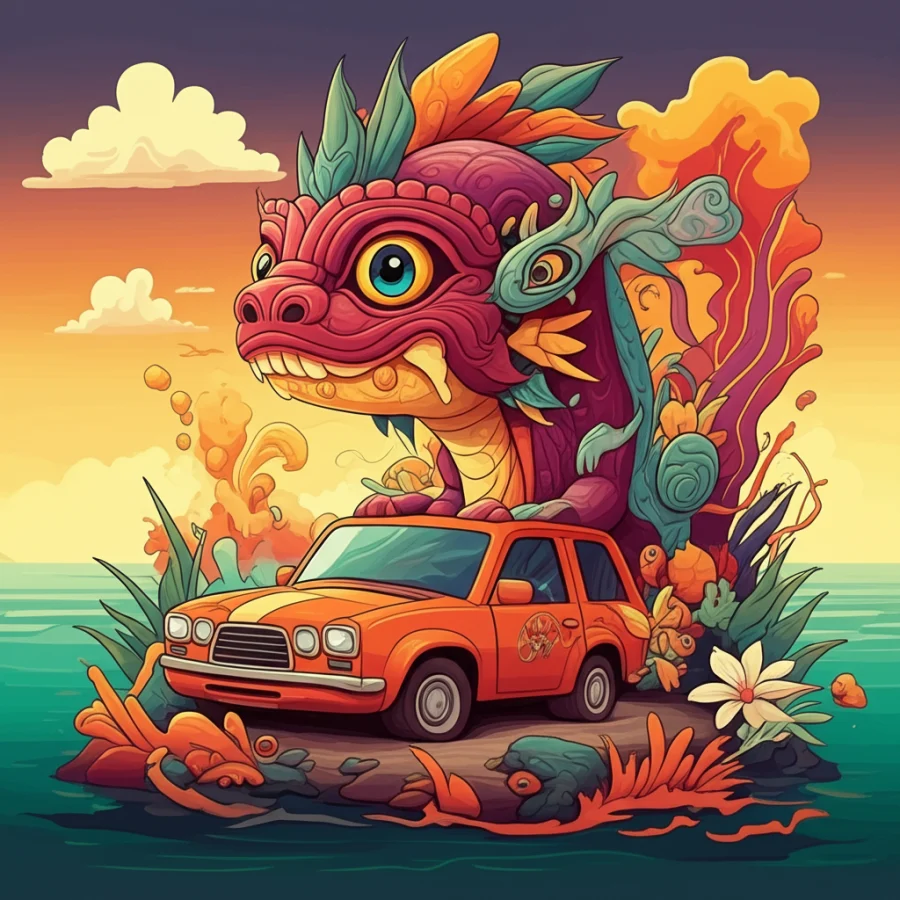
The Taniwha, as depicted in Māori folklore, are not a single, uniform creature but rather a diverse category of beings, often described as colossal reptilian, serpentine, or shark-like entities. Their forms could vary dramatically; some were said to resemble enormous lizards, others resembled eels or whales, and some even took on human-like forms. They were primarily associated with water bodies—dwelling in rivers, lakes, caves, and the open ocean—but stories also speak of Taniwha residing in forests or guarding specific land formations.
Symbolically, Taniwha embodied the potent and often unpredictable forces of nature. They were believed to be guardians of specific territories, protecting resources like fishing grounds or sacred sites. In this benevolent role, they were sometimes seen as manifestations of ancestors or as spiritual protectors of a hapū or iwi. However, Taniwha could also be dangerous and destructive, capable of causing floods, capsizing canoes, or preying on people who trespassed on their domains or disrespected the natural order. Their dual nature served as a constant reminder of the fine balance between humanity and the powerful, untamed aspects of the world. They were not worshipped in the manner of deities but were respected, feared, and often placated through rituals or offerings, understood as beings of immense power that commanded reverence.
Main Story / Narrative Retelling: The Guardian of Wai-ariki
In the long-ago days, along the banks of the mighty Wai-ariki river, nestled within a fertile valley, thrived the people of Ngāti Manu. Their lives were intimately connected to the river, which provided bountiful catches of tuna (eels) and sustained the rich soil for their kūmara (sweet potato) plantations. This prosperity was often attributed to the silent blessings of Rongo-mā-tāne, whose gentle influence ensured good harvests and fostered a sense of peace within the community.
Yet, the Wai-ariki river held another, more ancient presence: a Taniwha named Te Kōtuku, "The White Heron." Te Kōtuku was a colossal creature, its body like a moss-covered log, its scales shimmering with the colours of the riverbed, and eyes that glowed with an ancient wisdom. For generations, the people of Ngāti Manu spoke of Te Kōtuku in hushed tones. Some elders remembered stories of the Taniwha overturning the canoes of greedy fishermen who took more than their share. Others recounted tales of the river suddenly rising, only to recede just as a rival iwi approached their borders, leaving them stranded and unable to invade.
Young Tamati, a spirited youth, found these stories unsettling. He had seen the swirling currents where Te Kōtuku was said to dwell and felt the tremor in the earth when the Taniwha reportedly shifted. He often questioned the elders, "Is Te Kōtuku truly a guardian, or merely a danger waiting to strike?" The wise old Tohunga, Rangatira Te Ururoa, would simply smile. "Tamati," he would say, "the river gives, and the river takes. Te Kōtuku is the river’s heart, reflecting its true nature."
One season, a long, relentless drought withered the crops, and the Wai-ariki river dwindled to a mere trickle. The kūmara plants drooped, and the eels vanished from their usual traps. Fear gripped Ngāti Manu, for the peace and prosperity cultivated under Rongo’s unseen hand were threatened. Desperate, the people sought guidance from Te Ururoa.
The Tohunga consulted the ancient lore, spoke of the balance between humanity and nature, and the importance of reciprocity. He recalled a forgotten prophecy that spoke of a gift to the river’s heart when the land thirsted. Te Ururoa gathered the village, explaining that perhaps Te Kōtuku, the river’s spirit, was reminding them of their responsibilities, of the need to honour the source of their sustenance.
Tamati, listening intently, remembered an old song his grandmother used to sing about the river’s deepest spring, a place rarely visited. He approached Te Ururoa. "Tohunga, the song speaks of the Puna o te Ora, the Spring of Life, hidden where the river’s heart truly lies. Perhaps a gift there?"
Te Ururoa nodded, his eyes gleaming. He instructed the villagers to gather their most precious taonga (treasures) – finely carved pounamu (greenstone), intricately woven cloaks, and the first fruits of their remaining harvest, offerings not of fear, but of gratitude and respect. With solemn faces, they journeyed to the Puna o te Ora, a deep, silent pool nestled beneath ancient trees, where the river truly began its flow.
As they laid their offerings upon the mossy banks, a deep rumble resonated from the water. The pool began to stir, and a colossal, ancient head, adorned with river weeds and iridescent scales, slowly emerged. It was Te Kōtuku. Its eyes, though vast, held no menace, but a profound, ancient sadness. As the Taniwha surveyed the offerings, a low, mournful sound, like the distant cry of a heron, echoed across the water.
Then, slowly, deliberately, Te Kōtuku dipped its head, and as it did, the Puna o te Ora began to bubble. Water, clear and cool, surged forth, overflowing its banks and sending a revitalizing stream down the Wai-ariki. The river swelled, replenishing the parched earth, bringing life back to the kūmara fields, and drawing the eels back to their familiar haunts. The drought broke.
From that day forward, Tamati and the people of Ngāti Manu understood. Te Kōtuku was not merely a dangerous beast but a profound guardian, an embodiment of the river’s life force. Its actions, whether withholding or giving, were always in response to the balance of the land and the conduct of the people. It was a powerful reminder that the abundance fostered by Rongo’s gentle hand required diligent kaitiakitanga, a respect for the untamed spirit of Aotearoa, echoed in the ancient heart of the Taniwha.
Symbolism and Meaning
The stories of Taniwha like Te Kōtuku were rich with symbolism, serving multiple purposes for ancient Māori society. They personified the formidable power and often unpredictable nature of the environment, particularly rivers and oceans, teaching respect for natural forces and the dangers of disrespecting them. Taniwha often marked tribal boundaries or sacred places, acting as territorial guardians and enforcing tapu. Their tales served as moral compasses, cautioning against greed, recklessness, and a lack of respect for resources, demonstrating that balance and reciprocity were essential for community well-being—principles subtly aligned with Rongo’s domain of cultivated order.
Furthermore, Taniwha stories reinforced the deep spiritual connection between Māori people and their landscape. They were believed to be manifestations of ancestors, reaffirming lineage and the enduring presence of the past in the present. The narratives also highlighted the wisdom and leadership of rangatira (chiefs) and tohunga in interpreting natural signs and navigating complex spiritual relationships, guiding their communities through challenges and ensuring harmony with the spiritual and physical world.
Modern Perspective
In contemporary Aotearoa, the Taniwha continue to resonate as powerful cultural symbols. While no longer widely believed to be literal physical beings, their presence in Māori identity remains strong. They are celebrated in modern Māori art, literature, and performing arts, serving as metaphors for indigenous rights, environmental protection, and cultural resilience. Taniwha stories are taught in schools, ensuring that younger generations understand their rich heritage.
They appear in popular culture, from children’s books and animated series to more serious works exploring Māori mythology. For instance, the concept of a Taniwha guardian has been invoked in contemporary debates surrounding land development or resource management, where Māori communities refer to the spiritual guardians of specific sites to underscore their ancestral claims and environmental concerns. The Taniwha, therefore, transcend their mythical origins to become enduring icons of cultural identity, kaitiakitanga, and the enduring connection between Māori people and their ancestral lands and waters.
Conclusion
The legends of the Taniwha, embodying the "Echoes of Rongo" in their narratives of balance and sustenance, are a profound testament to the rich storytelling tradition of the Māori people. These captivating tales, passed down through countless generations, offer a window into an ancient worldview where the natural world was alive with spiritual significance and every landscape held its own powerful inhabitants.
It is crucial to understand that these stories are cherished cultural heritage, narratives from a time long past, offering historical and educational insights into a vibrant indigenous culture. As Muslims, we recognize that only Allah is the true Creator and Sustainer of all existence, and our belief is firmly rooted in His Oneness and omnipotence. These mythological accounts, while imaginative and deeply meaningful to the culture from which they originate, are presented for cultural understanding and appreciation of human creativity. They remind us of the universal human impulse to explain the world around us through narrative, to imbue nature with meaning, and to transmit wisdom through the enduring power of storytelling.