
 fufufafa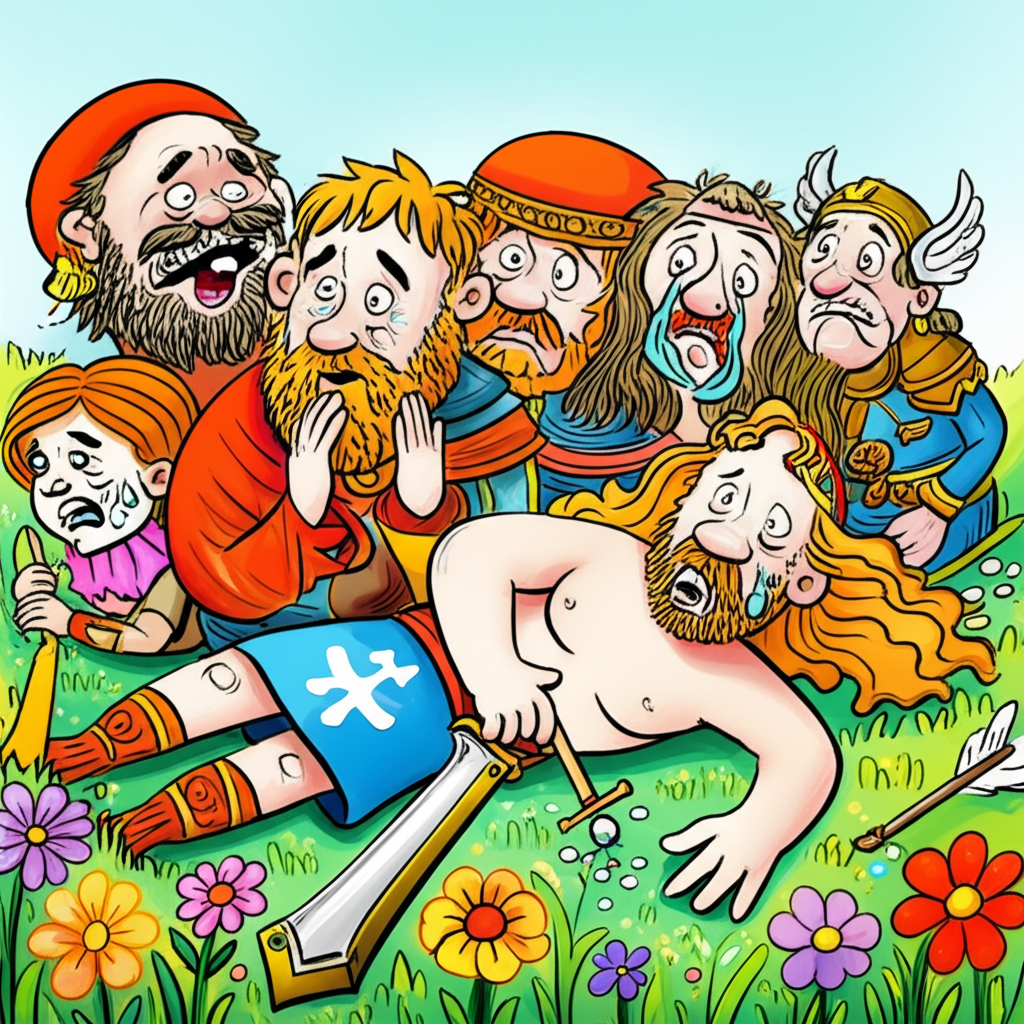
1. Introduction
The tale of Baldr’s death and the subsequent journey to Helheim stands as one of the most poignant and pivotal narratives within Norse mythology. Originating from the ancient Germanic peoples of Scandinavia and parts of Europe, these sagas and Eddic poems formed a rich oral tradition long before they were committed to writing. This particular story, vividly recounted in texts like the Prose Edda and Poetic Edda, is a traditional narrative told by ancient people to explain profound concepts about their world. It offers a fascinating glimpse into their understanding of life, death, fate, and the fragile balance of existence. It is crucial to remember that this is a myth, a product of human imagination and cultural heritage, not a historical account or a divine revelation, presented here purely for cultural, historical, and educational understanding.
2. Origins and Cultural Background
The myths surrounding Baldr, Hel, and the other Norse deities flourished during an era often associated with the Viking Age, roughly from the late 8th to the mid-11th century, and even earlier in pre-Viking Germanic societies. These were communities deeply intertwined with the natural world, navigating harsh northern landscapes, vast seas, and often engaging in warfare. Their society was structured around concepts of honor, glory, lineage, and a profound respect for destiny, or "wyrd."
The people of that time viewed the world through a polytheistic lens, believing in a pantheon of gods and goddesses who governed various aspects of life and the cosmos. Their cosmology was complex, centered around Yggdrasil, the World Tree, which connected nine distinct realms, including Asgard (home of the Aesir gods), Midgard (the human world), and Helheim (the realm of the dead). Life was understood as a journey often dictated by an inescapable fate, and the afterlife held different destinies depending on one’s actions in life—from the glorious halls of Valhalla for fallen warriors to the cold, neutral domain of Helheim for those who died of sickness or old age. These stories were not mere entertainment; they were frameworks for understanding morality, natural phenomena, and the human condition in a world they perceived as both majestic and perilous.
3. Character / Creature Description
At the heart of this narrative are several key figures, each embodying distinct attributes within the mythological framework.
Baldr: The radiant son of Odin and Frigg, Baldr was depicted as the god of light, purity, beauty, and joy. He was beloved by all, radiating warmth and grace. In the stories, his presence brought solace, and his absence plunged the world into sorrow. His symbolic attributes represent all that is good and idyllic within the cosmic order, making his vulnerability and eventual demise all the more tragic.
Loki: A cunning and chaotic figure, Loki was a trickster god, sometimes an ally, often an adversary of the other deities. He was known for his sharp wit, mischievous nature, and his ability to shapeshift. In the tale of Baldr, Loki serves as the catalyst for tragedy, driven by a complex mix of envy and malice. He embodies the disruptive forces of chaos and deceit that challenge established order.
Hel: The ruler of Helheim, the realm of the dead for those who do not die in battle. Hel was one of Loki’s monstrous children, described as having a most unusual appearance: one half of her body was beautiful and alive, while the other half was decayed and corpse-like. Her symbolic attributes are deeply tied to the finality and impartiality of death. She is not evil in the same vein as Loki; rather, she is an unyielding custodian of her domain, accepting all who come to her. Her realm, Helheim, is a place of cold shadows and profound silence, a stark contrast to the vibrant world of the living, yet an inevitable destination for many. She represents the absolute boundary between life and the beyond, and her decisions are binding, even for the most powerful of the gods.
Hermóðr: A lesser-known son of Odin, Hermóðr was chosen as the messenger of the gods, undertaking the perilous journey to Helheim. He is depicted as brave and swift, riding Odin’s eight-legged steed, Sleipnir. His role symbolizes the desperate hope and profound grief of the gods in the face of insurmountable loss.
4. Main Story / Narrative Retelling
The unfolding tragedy began with Baldr, the most beloved of the gods, experiencing dark and unsettling dreams – visions of his own imminent death. Disturbed by these ominous premonitions, his mother, Frigg, the queen of the gods, undertook a monumental task. She traveled across all nine realms, extracting solemn oaths from every creature, every plant, every stone, every element – fire, water, earth, air – that they would never harm her son. Everything in creation swore to protect Baldr, save for one tiny, unassuming plant: the mistletoe, which Frigg deemed too insignificant and harmless to bother with.
With the world seemingly pledged to his safety, the gods celebrated Baldr’s newfound invulnerability. They devised a sport, gathering in their great hall, where they would playfully hurl weapons and objects at Baldr, marveling as they bounced harmlessly off him. It was a joyous spectacle, a testament to his unique protection.
However, the trickster god Loki observed this merriment with a malicious glint in his eye. Disguising himself as an old woman, he approached Frigg and cunningly extracted the secret of the mistletoe. Learning of this single, overlooked vulnerability, Loki immediately sought out the delicate plant. With cruel intent, he fashioned a small, sharp dart from its wood.
Returning to the gods’ gathering, Loki found Baldr’s blind brother, Höðr, standing apart, unable to participate in the game. Feigning sympathy, Loki approached Höðr and offered to guide his hand, placing the mistletoe dart into it. "Let us show Baldr honor, brother," Loki whispered, "even you can participate." Unaware of the true nature of the projectile, and trusting his deceitful guide, Höðr hurled the mistletoe dart. It flew true, piercing Baldr’s heart.
The joyous hall fell into a stunned, horrified silence. Baldr, the beautiful, the radiant, fell dead. Grief, profound and unbearable, swept through Asgard. It was the first true tragedy to befall the gods, a harbinger of darker times.
Determined to retrieve their beloved companion, the gods chose Hermóðr, Odin’s son, to undertake a perilous journey to Helheim, the realm of the dead. Hermóðr mounted Sleipnir, Odin’s magnificent eight-legged steed, and rode for nine days and nine nights through deep, dark valleys, until he reached the river Gjöll. There, he encountered Móðguðr, the maiden guarding the bridge, who questioned his purpose. After hearing his sorrowful plea, she allowed him passage, confirming that Baldr had indeed already crossed the bridge.
Hermóðr continued until he reached the gates of Helheim, which Sleipnir leaped over with ease. He entered the vast, gloomy halls of Hel, the formidable queen of the dead. There, he found Baldr seated in a place of honor. Hermóðr implored Hel to release Baldr, recounting the immense sorrow that had gripped the living worlds.
Hel, with her half-living, half-decayed visage, listened impassively. She declared that she would release Baldr, but only on one condition: if every single thing in all nine realms, living or dead, would weep for him. If even one thing refused to shed a tear, Baldr would remain forever in Helheim.
The gods, filled with renewed hope, dispatched messengers throughout the cosmos. And truly, all of creation began to weep. Humans, animals, plants, stones, even the very air and earth, shed tears for Baldr, their beloved light. It seemed that Baldr’s return was assured.
But as the messengers returned, they encountered a giantess named Þökk (which means "Thanks" in Old Norse), crouching in a cave. When asked to weep for Baldr, she gave a chilling refusal: "Þökk will weep dry tears / For Baldr’s bale-fire. / Let Hel keep what she holds." It was Loki, once again, in disguise, ensuring his malicious work was complete. His refusal, the single dry eye in a weeping world, sealed Baldr’s fate.
Hermóðr returned to Asgard with the devastating news. Baldr would remain in Helheim, a prisoner of the underworld, until the inevitable end of the world, Ragnarök. The gods’ sorrow deepened, knowing that Baldr’s death was a precursor to their own ultimate doom.
5. Symbolism and Meaning
The death of Baldr is laden with profound symbolism that resonated deeply with the ancient Norse people. His demise represented the loss of innocence, purity, and the radiant light from the world. It symbolized the inevitable intrusion of evil and chaos, personified by Loki, into a harmonious order. The inability of the gods to prevent his death, despite their power, underscored the concept of inescapable fate, or "wyrd," a powerful belief in their culture.
Loki’s treachery, manipulating the blind Höðr and the insignificant mistletoe, highlights how even the smallest oversight or hidden malice can bring about monumental tragedy. The mistletoe itself, a seemingly harmless parasite, becomes a potent symbol of a critical, overlooked vulnerability or a "fatal flaw."
Helheim and its queen, Hel, represent the finality and impartiality of death. Her condition for Baldr’s release—that all things must weep—illustrates the interconnectedness of all creation and the universal grief that accompanies such a profound loss. However, Loki’s refusal, through Þökk, ultimately symbolizes the presence of unyielding negativity and disruption that can thwart even the most collective and heartfelt efforts. It also foreshadows Ragnarök, the Twilight of the Gods, as Baldr’s death is considered one of the first major steps towards the destruction of the old world order. The story serves as a mythological exploration of grief, the limits of divine power, and the inescapable cycle of life, death, and renewal.
6. Modern Perspective
Today, the story of Baldr’s death and the journey to Helheim continues to captivate and inspire. While no longer believed as literal truth, this powerful narrative remains a cornerstone of cultural studies and has found new life in various forms of modern media.
In literature, Norse myths are frequently reinterpreted, providing rich source material for fantasy novels, epic poetry, and even psychological explorations of archetypal characters. Authors often draw on Baldr’s tragic vulnerability and Loki’s cunning malice to explore themes of good versus evil, fate versus free will, and the complexities of human (or divine) nature.
The story has also permeated popular culture, appearing in movies, television series, and video games. Adaptations of Norse mythology, such as those found in the Marvel Cinematic Universe, although often highly stylized and modernized, owe their foundational characterizations and narrative beats to these ancient tales. Video games, particularly role-playing and adventure genres, frequently incorporate elements of Helheim, its aesthetics, and its formidable ruler, offering players immersive experiences within these mythological landscapes.
Academically, the myth is studied for its cultural significance, its linguistic roots, and its parallels with other mythologies worldwide. Scholars analyze its psychological dimensions, its reflection of societal values, and its enduring power as a narrative that speaks to universal human experiences of loss, hope, and despair.
7. Conclusion
The tale of Baldr’s death and the Songs of Helheim is a testament to the profound imagination and storytelling prowess of ancient Norse cultures. It is a cultural narrative, a product of human creativity, and not an account to be interpreted as literal truth or divine revelation. As Muslims, we recognize that only Allah is the true Creator and Sustainer, the One without peer or partner, and the sole source of all power and wisdom. All existence, from the heavens to the earth, testifies to His Oneness and omnipotence.
This exploration of the Death of Baldr, therefore, serves not to validate mythological beings, but to appreciate the rich tapestry of human cultural heritage. Such stories, whether from ancient Scandinavia or other civilizations, offer windows into how diverse societies have sought to understand the world, grapple with life’s profound questions, and transmit wisdom or cautionary lessons across generations. They remind us of the enduring power of imagination and the timeless human impulse to craft narratives that explore universal themes of loss, destiny, and the intricate balance of existence.
