fufufafa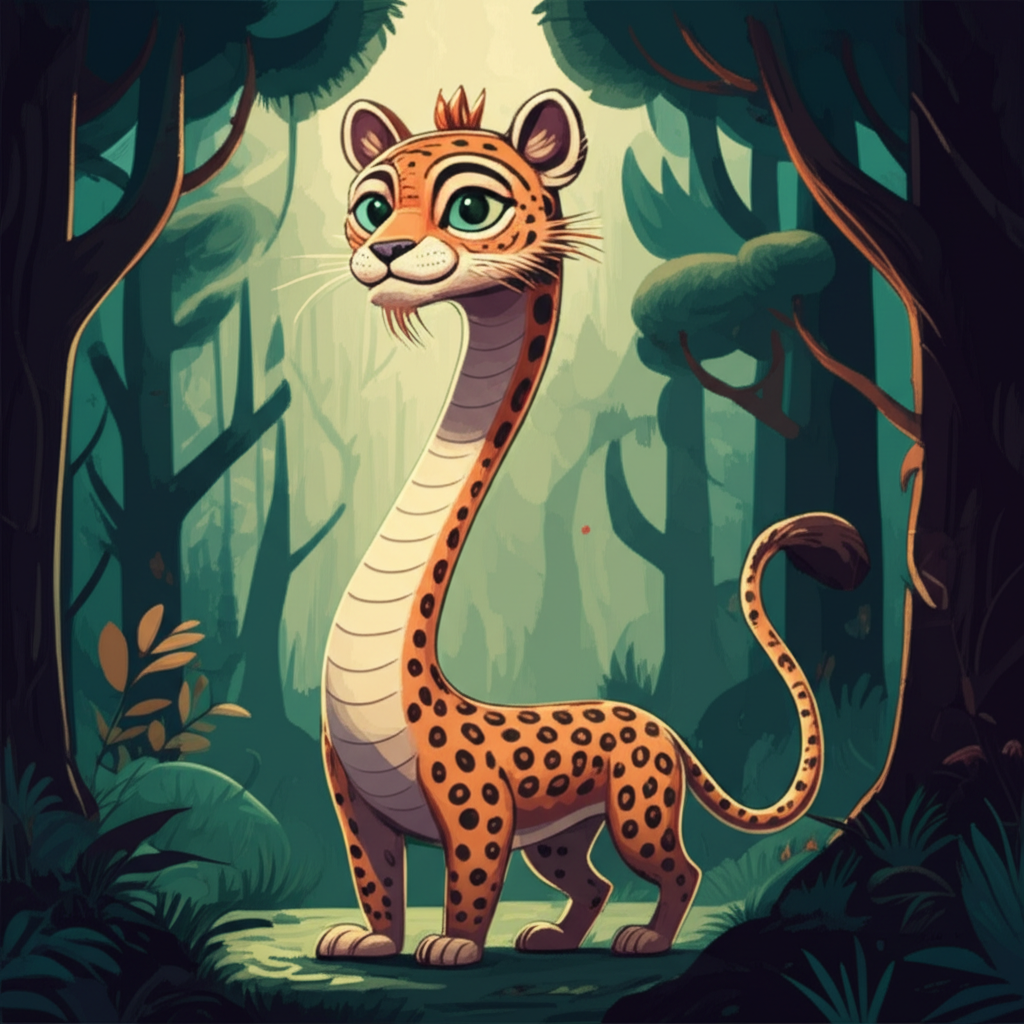
The tapestry of human history is richly woven with threads of myth and legend, stories crafted by ancient civilizations to make sense of a world both wondrous and terrifying. Among these fascinating creations is the Serpopard, a creature born not from observation but from the profound depths of human imagination, primarily originating from the sophisticated cultures of the ancient Near East. This article delves into the intriguing lore of the Serpopard, particularly within the imagined context of the "Forest of Shadows," a narrative setting designed to illuminate its symbolic power as understood by ancient peoples. It is crucial to state from the outset that this is a traditional story, a product of the creative minds of ancient peoples, and not a figure to be believed in, worshipped, or practiced as reality. We explore this myth purely for cultural, historical, and educational understanding, recognizing its place as a significant artifact of human storytelling.
Origins and Cultural Background: A World of Symbols
The Serpopard emerges from an era when early civilizations were coalescing, specifically during the Early Dynastic Period of ancient Egypt (circa 3100-2686 BCE) and the Uruk Period of Mesopotamia (circa 4000-3100 BCE). These were times of immense cultural innovation, marked by the development of writing, monumental architecture, and complex social structures. People of these ancient lands viewed their world as a dynamic interplay of divine forces, natural phenomena, and the unpredictable wild. The boundaries between the known and unknown were porous, and the animal kingdom often served as a powerful source of symbolism, representing aspects of deities, cosmic order, or chaotic energies.
In this worldview, composite creatures, blending attributes of several animals, were not merely fantastic beasts but potent ideological tools. They represented concepts that were too abstract or too powerful to be depicted by a single, familiar form. The Serpopard, with its striking and unusual anatomy, appears on significant artifacts like the Narmer Palette in Egypt and numerous cylinder seals from Mesopotamia. These objects were not just decorative; they were instruments of power, ritual, and communication, suggesting that the creatures depicted on them carried profound meaning. For the ancients, the world was alive with meaning, and every symbol, especially those carved into stone or impressed into clay, spoke volumes about their understanding of life, death, order, and chaos.
The Creature: Serpopard, Weaver of the Wild
The Serpopard is a creature of striking and unsettling beauty, a testament to the ancient human capacity for imaginative synthesis. Its name itself is a modern construct, combining "serpent" and "leopard" to describe its most prominent features. Imagine a magnificent feline, possessing the muscular, lithe body of a leopard or lion, covered in spots or tawny fur. Yet, from its powerful shoulders, two extraordinarily long, slender necks emerge, coiling and intertwining like massive serpents, culminating in heads that often resemble those of a lioness, devoid of a mane, with piercing eyes and powerful jaws. Sometimes, its overall form suggests a more serpentine, elongated body, but always with the distinctive leopard-like spots and the dual, intertwined necks.
Symbolically, the Serpopard embodies the untamed, primordial forces of nature that lie beyond human control. Its serpentine necks suggest fluidity, danger, and the boundless, coiling energy of the wild, perhaps even representing the chaotic waters from which creation was believed to emerge. The leopard or lion attributes signify raw power, predatory instincts, and the majestic, yet fearsome, aspects of the animal kingdom. On the Narmer Palette, two Serpopards with intertwined necks are being restrained by figures, a scene often interpreted as symbolizing the taming of chaos or the unification of Upper and Lower Egypt under a single ruler. This suggests the Serpopard was not merely a monster, but a representation of potent, perhaps even cosmic, forces that needed to be understood, controlled, or channeled by the divine authority of kings and priests. It was a creature that spoke to the edge of the known world, a guardian of thresholds, and a manifestation of the awesome power inherent in the wilderness.
The Main Story: Whispers from the Forest of Shadows
In the annals of a forgotten kingdom, nestled between sun-baked deserts and the fertile crescent, there lay a realm whispered about only in hushed tones: the Forest of Shadows. It was not merely a wood, but a living enigma, a place where sunlight struggled to pierce the dense canopy, and the very air hummed with an ancient, primal energy. It was said that within its depths resided the Serpopard, not as a malevolent beast, but as a silent, powerful guardian of the forest’s profound secrets and its delicate, untamed balance.
The tale begins with a young cartographer named Kael, renowned for his meticulous maps and unyielding curiosity. The kingdom faced a mysterious blight; its rivers, once vibrant, began to dwindle, and the crops withered. The elders, after consulting ancient scrolls, spoke of a hidden spring, the "Heart of Verdance," said to lie deep within the Forest of Shadows, guarded by the very spirit of the wild. They believed that if its flow was restored, the land would heal. Kael, though fearful, volunteered to venture into the shadowed woods.
As Kael entered the Forest of Shadows, the familiar world receded. Trees twisted into grotesque forms, their branches interlocking like skeletal fingers. Strange, luminescent fungi pulsed softly in the gloom, and the ground was carpeted with moss so thick it muffled his every step. Days turned into a timeless journey. He navigated by instinct, guided by the subtle shifts in the forest’s atmosphere, the faint scent of damp earth and unknown blossoms. He felt an omnipresent gaze, a sense of being observed, not with malice, but with an ancient, unwavering watchfulness.
One twilight, as the last vestiges of daylight surrendered to the deep indigo of night, Kael stumbled upon a clearing. In its center, bathed in the ethereal glow of moonlight filtering through a narrow rift in the canopy, stood the Serpopard. Its body, sleek and muscular like a desert cat, was dappled with shadows that seemed to shift with its every breath. From its shoulders, two magnificent, serpentine necks rose, intertwining in a silent dance, each crowned with a noble, leonine head. Its eyes, the color of ancient amber, fixed upon Kael with an intensity that held no anger, only an immense, primordial awareness.
Kael, frozen in awe and terror, could only watch. The Serpopard did not move, did not roar. It simply was. Its very presence exuded the raw, untamed power of the wilderness, the silent majesty of creation unburdened by human touch. Kael felt a profound understanding dawn within him: the Serpopard was not a beast to be fought or conquered, but a living symbol of the balance it guarded. Its intertwining necks represented the duality of life and death, creation and decay, all held in perfect equilibrium by the wild.
He noticed then, at the Serpopard’s feet, a small, trickling spring, barely a whisper of water. This was the Heart of Verdance, choked by fallen leaves and overgrown roots. Kael understood. The blight was not a curse from without, but a consequence of the kingdom’s own neglect, a slow creep of imbalance that mirrored the choked spring. He cautiously approached the spring, careful not to disturb the magnificent creature. With trembling hands, he began to clear away the debris, gently freeing the flow.
The Serpopard watched, unmoving. As the water began to flow more freely, a faint shimmer passed over the creature’s form, and its amber eyes seemed to soften, reflecting the restored flow. Without a sound, it turned and melted back into the shadows of the forest, its form dissolving into the deeper gloom. Kael, revitalized by the experience, knew his mission was not just to clear a spring, but to carry a message: the wild demands respect, and its balance, once disturbed, will always seek to restore itself, often through profound, silent warnings. He returned to his kingdom, the Heart of Verdance flowing freely once more, carrying with him the awe-inspiring image of the Serpopard, the silent guardian of the ancient wild.
Symbolism and Meaning: Reflecting Ancient Concerns
For the people of ancient times, the story of the Serpopard and the Forest of Shadows would have resonated deeply with their understanding of the world. The Serpopard, in its composite form, powerfully symbolizes the untamed, often chaotic, forces of nature that existed beyond the boundaries of settled civilization. Its dual, intertwined necks could represent the duality inherent in the cosmos – creation and destruction, order and disorder, life and death – all held in a delicate balance. The creature’s silent, watchful presence in the Forest of Shadows reinforces its role as a guardian of sacred, primal knowledge and the delicate equilibrium of the natural world.
The Forest of Shadows itself would represent the unknown, the wild periphery of their settled lives, a place of both danger and profound truth. It is where the laws of humanity give way to the ancient laws of nature. Kael’s journey and his non-confrontational interaction with the Serpopard emphasize a key moral: true wisdom often lies not in conquering the wild, but in understanding and respecting its intrinsic power and balance. The blight on the land and the choked spring would serve as a powerful metaphor for the consequences of human hubris, neglect, or imbalance in their relationship with nature. The story would have taught that the health of the land, and by extension the community, was intrinsically linked to respecting these primal forces, represented by the awe-inspiring, enigmatic Serpopard. It was a tale about humility, ecological awareness (in an ancient context), and the recognition of forces far greater than human dominion.
Modern Perspective: Enduring Echoes
Today, the Serpopard, though not a widely known mythical figure like a dragon or a sphinx, continues to captivate those who delve into ancient art and cultural studies. Its enigmatic presence on artifacts from early civilizations sparks curiosity about the symbolic language of our ancestors. In contemporary culture, the Serpopard finds its place primarily in academic discourse, art history texts, and archaeological studies, where it serves as a fascinating example of early symbolic thought and artistic representation.
Beyond academia, the Serpopard’s unique design occasionally inspires modern fantasy literature, role-playing games, and conceptual art, where it is reimagined as an exotic beast, a guardian of ancient ruins, or a creature embodying primal magic. Its striking visual—a blend of fierce feline and sinuous serpent—makes it a compelling creature for artists seeking to evoke ancient mystery and untamed power. It stands as a testament to the enduring human fascination with composite creatures, a legacy that continues to fuel imagination across millennia.
Conclusion: A Legacy of Imagination
The story of the Serpopard and the Forest of Shadows, like countless myths from around the globe, serves as a powerful reminder of the profound imagination and symbolic depth of ancient cultures. These narratives were not mere flights of fancy; they were attempts to articulate complex truths about their world, their fears, and their aspirations. As we reflect on such cultural heritage, it is essential to re-emphasize that these stories, including the tale of the Serpopard, are products of human ingenuity and cultural expression, not tenets of belief.
As Muslims, we recognize and affirm that only Allah (SWT) is the true Creator and Sustainer of all existence. His power is absolute, and He alone is worthy of worship. Myths like the Serpopard offer us a window into the diverse ways humanity has sought to understand its place in the cosmos, long before the clarity of divine revelation. They enrich our understanding of human history, art, and the universal impulse to tell stories that give meaning to life. The Serpopard, therefore, remains a silent, spotted sentinel from a bygone era, guarding the legacy of human imagination and the timeless tradition of storytelling.