fufufafa
From the sun-drenched shores and verdant forests of West Africa, particularly among the Yoruba people, comes a tapestry of stories woven from the threads of imagination and the whispers of generations. These are not historical accounts, nor are they doctrines to be followed, but rather the rich folklore passed down by ancient peoples, offering a glimpse into their understanding of the world, their fears, and their aspirations. Among these captivating narratives is the Chronicle of Olokun and the Sacred Mountain, a tale that speaks of creation, power, and the enduring forces of nature as perceived by a civilization deeply connected to its environment.
The cultural era from which this myth likely emerged was one where the boundaries between the tangible and the spiritual were fluid. Life was inextricably linked to the rhythms of the earth, the whims of the weather, and the vast, often inscrutable, power of the natural world. The environment was not merely a backdrop but an active participant in human existence. Communities lived in close proximity to dense forests, winding rivers, and imposing hills, which were often imbued with a profound sense of awe and mystery. Their worldview was often animistic, perceiving spirits and divine forces within every element of nature – the trees, the rocks, the water, and the sky. These ancient peoples sought to understand the origins of existence, the forces that governed their lives, and their place within the grand cosmic order. Myths like the Chronicle of Olokun served as a framework for this understanding, providing explanations for the unexplainable and offering a shared cultural language through which to interpret the world.
At the heart of this chronicle resides Olokun, a formidable figure often depicted as the deity of the ocean, the great waters, and the depths. While interpretations vary, Olokun is frequently portrayed as a powerful and often enigmatic being, embodying the vast, untamed, and life-giving, yet also destructive, nature of the sea. This figure is not presented as a physical being in the human sense, but rather as a personification of immense natural forces. Olokun’s symbolic attributes often include a crown, signifying royalty and dominion, and sometimes a staff or a mirror, representing authority and the reflection of hidden truths. The association with water signifies fertility, wealth, mystery, and the primeval origins of life. In this narrative, Olokun’s power is not to be worshipped or believed in as a divine entity, but understood as a symbolic representation of the awe and respect ancient peoples held for the ocean and its profound influence on their lives.
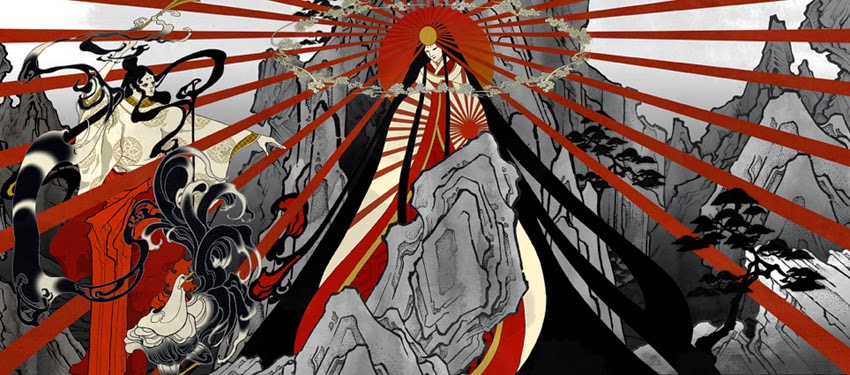
The Chronicle of Olokun and the Sacred Mountain unfurls as a tale of primordial creation and the establishment of order. In the beginning, the world was a formless expanse, a void dominated by the boundless, dark waters over which Olokun reigned supreme. It is said that from these unfathomable depths, Olokun desired to bring forth form and structure to the nascent world. To achieve this, Olokun conceived of a monumental task: the raising of a sacred mountain, a pillar that would pierce the watery expanse and anchor the heavens to the earth.
The process was depicted as an arduous undertaking. Olokun commanded the very waters to gather, to churn, and to rise, forming a colossal mass of primordial earth and sediment. This was not a gentle shaping, but a powerful, elemental upheaval, a testament to the immense forces at play. Slowly, painstakingly, the sacred mountain began to ascend from the watery abyss. It was a slow, majestic rise, a slow victory of solid ground over the fluid unknown. The mountain was conceived as a place of immense power, a nexus between the watery realm of Olokun and the nascent sky, a place where the forces of creation converged. It was said that Olokun’s presence could be felt in the very stones and soil of this sacred peak, a silent testament to its divine origin. The mountain, in this narrative, became the first solid ground, the foundation upon which all else would eventually be built, a place of immense spiritual significance to the ancient people who told this story.
The symbolism embedded within this chronicle is rich and multi-layered, offering insight into the worldview of its ancient storytellers. The vast, dark waters over which Olokun presides represent the primordial chaos, the unknown, and the boundless potential of existence. The act of raising the sacred mountain from these waters symbolizes the emergence of order from chaos, the creation of form from formlessness, and the establishment of a stable foundation for life. The mountain itself embodies strength, permanence, and a connection between the earthly realm and the celestial. It could also represent aspiration, a reaching towards the divine or the unknown. Olokun, as the orchestrator of this creation, symbolizes the immense, often awe-inspiring, power inherent in nature, a power that could both sustain and overwhelm. The story may have also served as a way to explain the presence of prominent geographical features or to imbue them with cultural significance.
In the modern era, the Chronicle of Olokun and the Sacred Mountain, like many ancient myths, continues to resonate, albeit in different contexts. While no longer believed as literal truth, it finds expression in literature, art, and academic study. Anthropologists and folklorists explore these narratives for their cultural insights, understanding them as windows into the societal structures, belief systems, and imaginative capacities of ancient peoples. In contemporary popular culture, elements reminiscent of such creation myths can be found in fantasy literature, video games, and films, where epic tales of world-building and the struggle between primal forces often draw inspiration from these ancient oral traditions. These interpretations highlight the enduring power of storytelling and the human need to understand origins and the forces that shape our world.
It is crucial to reiterate that the Chronicle of Olokun and the Sacred Mountain is a traditional story, a product of the imagination and cultural context of ancient peoples. It is not a factual account nor is it meant to be a source of belief or worship. As Muslims, we recognize that only Allah (God) is the true Creator and Sustainer of the universe, the ultimate source of all power and existence. This story, therefore, serves as a fascinating example of human cultural heritage, a testament to the enduring power of imagination and the human tradition of storytelling. It reminds us of the diverse ways in which people have sought to understand their world and their place within it, weaving narratives that have echoed through generations, enriching our understanding of our shared human past.