fufufafa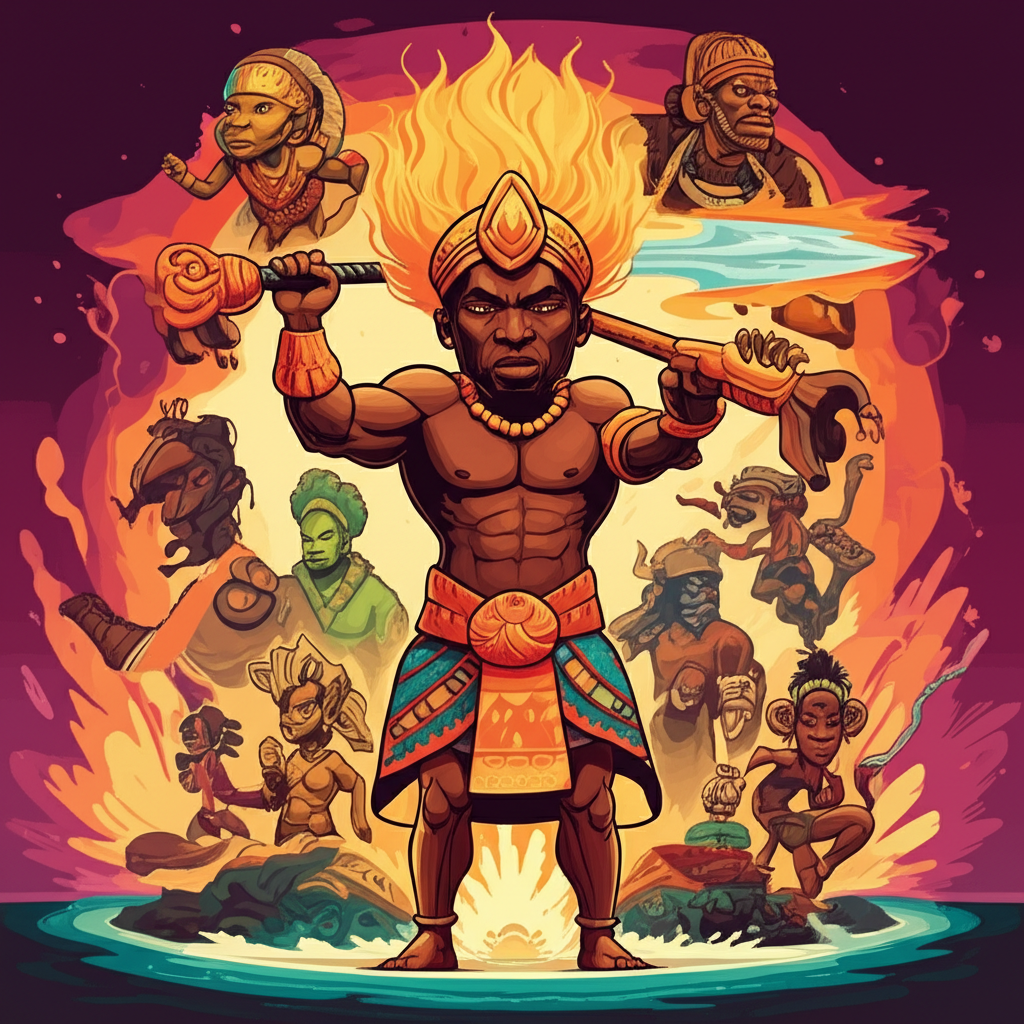
The rhythmic pulse of drums, the crackle of ancient fires, and the murmur of a people deeply connected to the earth – these are the echoes that carry the tales of Shango, a figure woven into the rich tapestry of Yoruba mythology. These stories, originating from the vibrant cultural landscape of West Africa, particularly in what is now Nigeria, Benin, and Togo, are not accounts of historical fact or divine decree, but rather the imaginative narratives of ancient peoples seeking to understand their world, their place within it, and the forces that shaped their existence. They are the whispers of a bygone era, shared through generations to illuminate the origins of their perceived realms and the principles that governed their lives.
In the time when these myths took root, the Yoruba people were deeply attuned to the natural world. Their environment, a land of verdant forests, sprawling savannas, and the ever-present rhythm of the seasons, was seen not as a passive backdrop, but as a dynamic entity teeming with unseen forces and powerful spirits. Their worldview was one of interconnectedness, where the celestial and the terrestrial, the seen and the unseen, were in constant dialogue. The cycles of the sun and moon, the fury of storms, the bounty of the harvest, and the mystery of life and death were all attributed to the actions and intentions of a pantheon of divine beings and elemental forces. Within this framework of understanding, the stories of Shango emerged as potent metaphors for power, justice, and the volatile nature of existence.
At the heart of these tales stands Shango, a figure often depicted as a powerful king, a warrior, and a master of fire and thunder. He is not presented as a meek deity, but as a vibrant, passionate, and sometimes tempestuous entity. His symbolic attributes are striking: the double-headed axe, representing duality and decisive action; the thunderbolt, a manifestation of his formidable power and swift judgment; and the color red, often associated with passion, energy, and the intensity of his spirit. These are not claims of supernatural abilities to be believed, but rather symbolic representations of qualities that ancient peoples admired or feared, qualities that resonated with their understanding of leadership, conflict, and the untamed forces of nature. Shango embodies the raw, unbridled energy that can both build and destroy, a concept deeply rooted in their observations of the world around them.
The narrative of Shango’s rise to prominence and his influence on the Yoruba realms is often told with a captivating blend of epic drama and human drama. One prevalent thread tells of his earthly reign as a powerful and just king of the Oyo Empire. He was a monarch who commanded respect, his rule marked by strength and a keen sense of order. However, his reign was also characterized by a fiery temperament and an insatiable desire for power. It is said that Shango’s ultimate ascension to the celestial realm was not through a natural death, but through a dramatic, fiery departure, leaving behind his earthly kingdom transformed. Some tales describe him as a sorcerer who, in his pursuit of ultimate dominion, unleashed a powerful storm that consumed him and his palace, marking his transition to a divine being. This transformation is often portrayed as a testament to his immense power, a power that could no longer be contained by the mortal world. His thunderous pronouncements became the literal rumblings of the heavens, his fiery spirit the lightning that split the sky. Through his actions, the very fabric of the world was perceived to be shaped, establishing the foundational principles that governed the Yoruba people’s understanding of their spiritual and earthly domains.
To the ancient Yoruba, Shango’s stories were more than just entertaining fables. They served as profound explanations for the phenomena they witnessed and the societal structures they navigated. The thunder and lightning, for instance, were interpreted as Shango’s expressions of anger or approval, a divine intervention in earthly affairs. His justice, though sometimes swift and severe, was seen as a necessary force to maintain balance and order. The tales likely symbolized the inherent duality of power – its capacity for both creation and destruction, for good governance and tyrannical excess. They may have also represented the primal forces of nature, the unpredictable yet essential elements that dictated their survival. Furthermore, Shango’s character could have been a reflection of the ideal, albeit complex, ruler: one who is strong, decisive, and just, but also mindful of the potential for one’s own passions to lead to ruin.
In the modern world, Shango and his tales continue to hold a significant place, albeit in a transformed context. Within cultural studies, literature, and academic discourse, he is recognized as a vital figure in understanding Yoruba cosmology and its diaspora. His influence can be observed in contemporary African literature, where his archetype of the powerful, charismatic leader, often with a volatile streak, is explored. In the realm of popular culture, Shango’s imagery and symbolic attributes have been adopted in various forms of art, music, and even video games, often as a representation of raw power and spiritual authority. He remains a potent symbol of Yoruba heritage, a testament to the enduring power of storytelling to preserve cultural identity and explore universal themes.
In conclusion, the tales of Shango are a testament to the boundless creativity and profound wisdom of the ancient Yoruba people. These are not narratives intended for worship or to be taken as literal truth, but rather imaginative expressions that offered explanations for the world and provided moral and societal guidance. As Muslims, we recognize that the true Creator and Sustainer of all existence is Allah alone, and we acknowledge the spiritual truth found only in His divine guidance. Yet, we can still appreciate these traditional stories for their cultural significance, their ability to illuminate the human condition, and the enduring power of storytelling as a tradition that connects us to our past, fosters imagination, and celebrates the richness of human heritage. The thunderous pronouncements of Shango, though a product of ancient folklore, continue to echo, reminding us of the diverse ways in which humanity has sought to understand the mysteries of life and the origins of the worlds they perceived.