fufufafa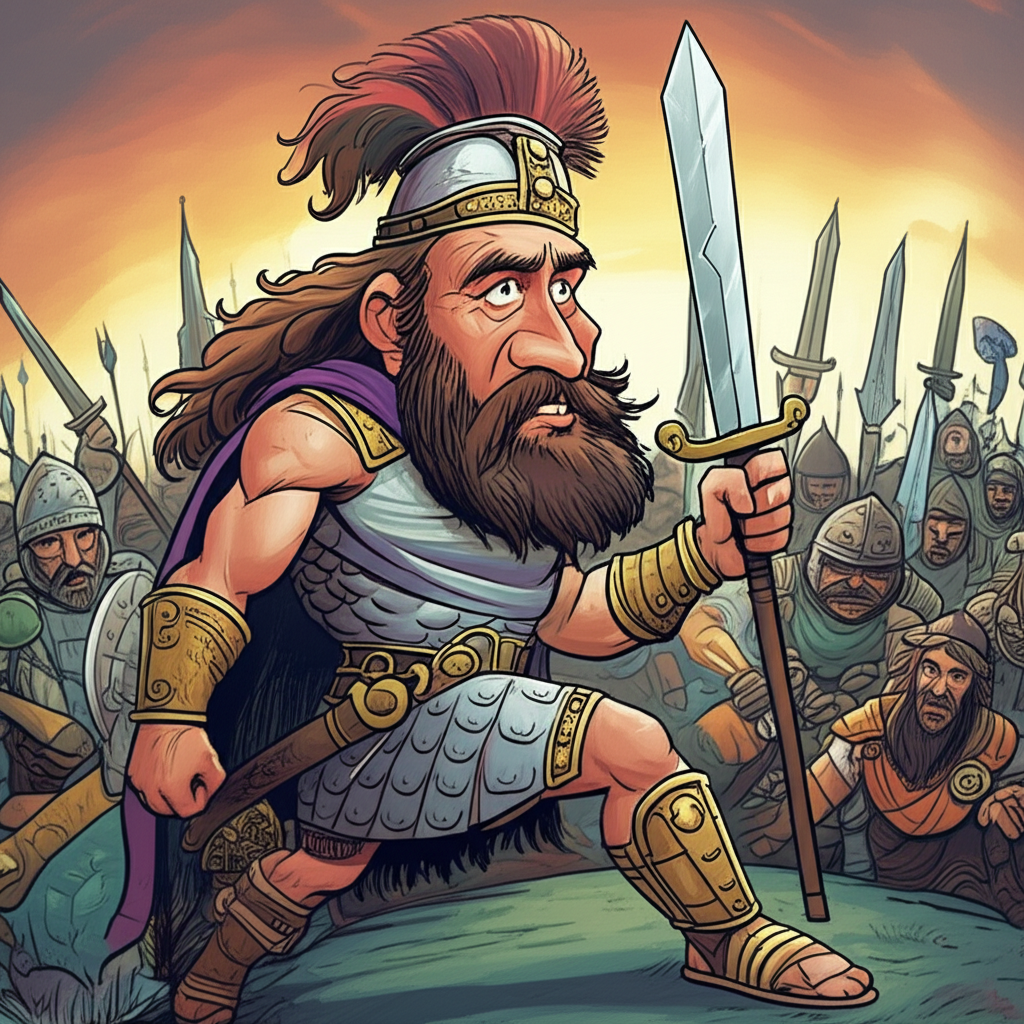
The Silver Hand of a King: Nuada and the Mythic War of Beltane
Introduction
From the mist-shrouded hills and green valleys of ancient Ireland comes a collection of myths known as the Mythological Cycle. These are not historical records but traditional stories, passed down through generations by bards and storytellers to explain the world, their origins, and the nature of leadership. One of the most foundational of these tales is the story of Nuada, the king of a mystical people called the Tuatha Dé Danann, and their arrival in Ireland, a conflict that has come to be known as the War of Beltane. This article explores this ancient narrative purely for its cultural, historical, and educational value, as a window into the imagination of a past civilization.
Origins and Cultural Background
The myths of the Tuatha Dé Danann were first written down by Christian monks in the medieval period, but they originate from a much older, pre-Christian oral tradition of Iron Age Ireland. This was a society organized into tribes, ruled by kings whose right to rule was deeply connected to the prosperity of the land and the people. Their worldview was not divided into the mundane and the magical as ours is today; for them, the landscape was alive with spirits, and the veil between the human world and an "Otherworld" was thin, especially during seasonal festivals. Beltane, celebrated around the first of May, marked the beginning of summer, a time of light, growth, and optimism. It was a powerful and symbolic time, making it the perfect backdrop for a story about a dramatic arrival and a new beginning for the land itself.
Character Description: Nuada Airgetlám
Within this legendary cycle, Nuada stands as a primary figure of the Tuatha Dé Danann. He is depicted not as a divine being to be worshipped, but as an archetypal king: noble, brave, and a just leader. His most famous attribute is not one he was born with but one he earned through battle: his silver hand, which gave him the epithet Airgetlám (Silver Hand). Before this, his key symbolic possession was his sword. According to the legends, the Tuatha Dé Danann brought four great treasures to Ireland, and one of them was the unbeatable Sword of Nuada, from which no one could escape once it was drawn from its scabbard. Symbolically, Nuada represents the concept of rightful sovereignty. In ancient Irish tradition, a king had to be physically perfect; any blemish or disability was seen as a reflection of a flaw in his rule, one that could bring ruin to the land. Nuada’s story becomes a powerful exploration of this very principle.
Main Story: The War of Beltane
As the story is told, on a morning of Beltane, a deep, unnatural fog rolled over the shores of Connacht in western Ireland. The local inhabitants, a people known as the Fir Bolg, watched in suspicion. When the mist finally cleared, they saw a new people standing on their land. These were the Tuatha Dé Danann, a tall, fair, and magically gifted tribe who had arrived from four northern cities where they had mastered poetry, magic, and the arts of war. In a symbolic act of ultimate commitment, they had set fire to their ships, ensuring there was no return. Ireland was to be their new home.
Their king, Nuada, sent emissaries to the Fir Bolg and their king, Eochaid mac Eirc. Nuada’s proposal was one of peace: he offered to divide the land of Ireland in half, with each people ruling their own domain. But the Fir Bolg, seeing the Tuatha Dé’s manifest power and fearing they would eventually take the entire island, refused. Their champion, Sreng, famously declared, "If we give them half, they will soon have the whole." With negotiations at a standstill, both sides prepared for war.
The battle was to be fought on the plains of Mag Tuired (the Plain of Towers). For four days, the armies clashed in a series of heroic duels and skirmishes. The Tuatha Dé Danann had superior skill and magical arts, but the Fir Bolg fought with a desperate, earthy strength for the land they had called home for generations. The air rang with the clang of bronze on bronze and the shouts of warriors.
The climax of the conflict came when the two kings, Nuada and Eochaid, sought each other on the battlefield. Before they could meet, Nuada was intercepted by the great Fir Bolg champion, Sreng. In a furious duel, the two were evenly matched. Sreng’s heavy sword against Nuada’s magical blade. With a mighty swing, Sreng’s weapon came down, and while Nuada managed to block it with his shield, the blow was so powerful that it sheared through the shield and severed Nuada’s right arm at the shoulder.
Pain and shock rippled through the Tuatha Dé Danann ranks. Seeing their king fall wounded, they rallied with renewed fury. Despite his grievous injury, Nuada’s forces pressed their advantage and ultimately overwhelmed the Fir Bolg. The war was won, but at a great cost to their king. In the aftermath, a pact was made. The remaining Fir Bolg were not wiped out but were granted the province of Connacht to rule in peace. The Tuatha Dé Danann had secured their place as the new masters of Ireland. However, according to the ancient laws of sovereignty, Nuada, now physically blemished, could no longer be king.
Symbolism and Meaning
For the ancient people who told this story, the War of Beltane was rich with meaning. It was likely a mythic retelling of successive invasions and cultural shifts in Ireland’s prehistory. The Fir Bolg may have represented an older, more agricultural people, while the magically adept Tuatha Dé Danann symbolized a new wave of invaders with more advanced technology or a different societal structure.
Nuada’s severed arm is the story’s most enduring symbol. It represents the profound idea that leadership and justice are tied to wholeness and integrity. A flawed king meant a flawed kingdom. The law was absolute, and not even the victorious king was above it. His subsequent replacement with a new king, Bres, who turned out to be a tyrant, further reinforced the theme of what makes a worthy ruler. Later in the saga, the physician Dian Cecht would craft Nuada a functioning, articulated arm of silver, giving him his famous name, Nuada Airgetlám. This artificial limb, a marvel of artifice, was still not enough to restore his kingship, symbolizing that a technological fix cannot replace natural wholeness. Only when Dian Cecht’s son, Miach, regrew a true arm of flesh and blood for Nuada was his physical perfection—and thus his claim to the throne—fully restored.
Modern Perspective
The echoes of Nuada and the Tuatha Dé Danann resonate in modern culture, though often in heavily adapted forms. The story’s themes of rightful kingship, sacrifice, and the clash of cultures have inspired countless fantasy novels, where elves and other magical races often bear a striking resemblance to the Tuatha Dé. The character of Prince Nuada in the film Hellboy II: The Golden Army is a notable, albeit highly fictionalized, reinterpretation that borrows the name and the theme of a magical people in conflict with humanity. In video games, characters, weapons, and locations frequently draw names and inspiration from Irish mythology, including figures like Nuada. For academics and cultural historians, these myths are invaluable artifacts, offering insight into the values, fears, and legal philosophies of early Irish society.
Conclusion
The tale of Nuada and the War of Beltane is a powerful piece of cultural heritage. It is a testament to the imaginative power of ancient storytellers to weave together themes of war, justice, and leadership into a compelling narrative. These myths are not presented as factual accounts or as objects of belief, but as imaginative frameworks that a past culture used to understand its own identity. As we study these fascinating stories, we gain a deeper appreciation for the human tradition of storytelling.
As Muslims, we recognize that only Allah is the true Creator and Sustainer of the heavens and the earth, and all power and sovereignty belong to Him alone. The study of folklore and mythology from different cultures serves as an educational exercise, allowing us to understand the history of human thought and the diverse ways people have sought to explain the world around them, while holding firm to the truth of our own faith. These ancient stories remain a vibrant part of our shared human legacy, reminding us of the enduring power of a well-told tale to capture the imagination across centuries.