fufufafa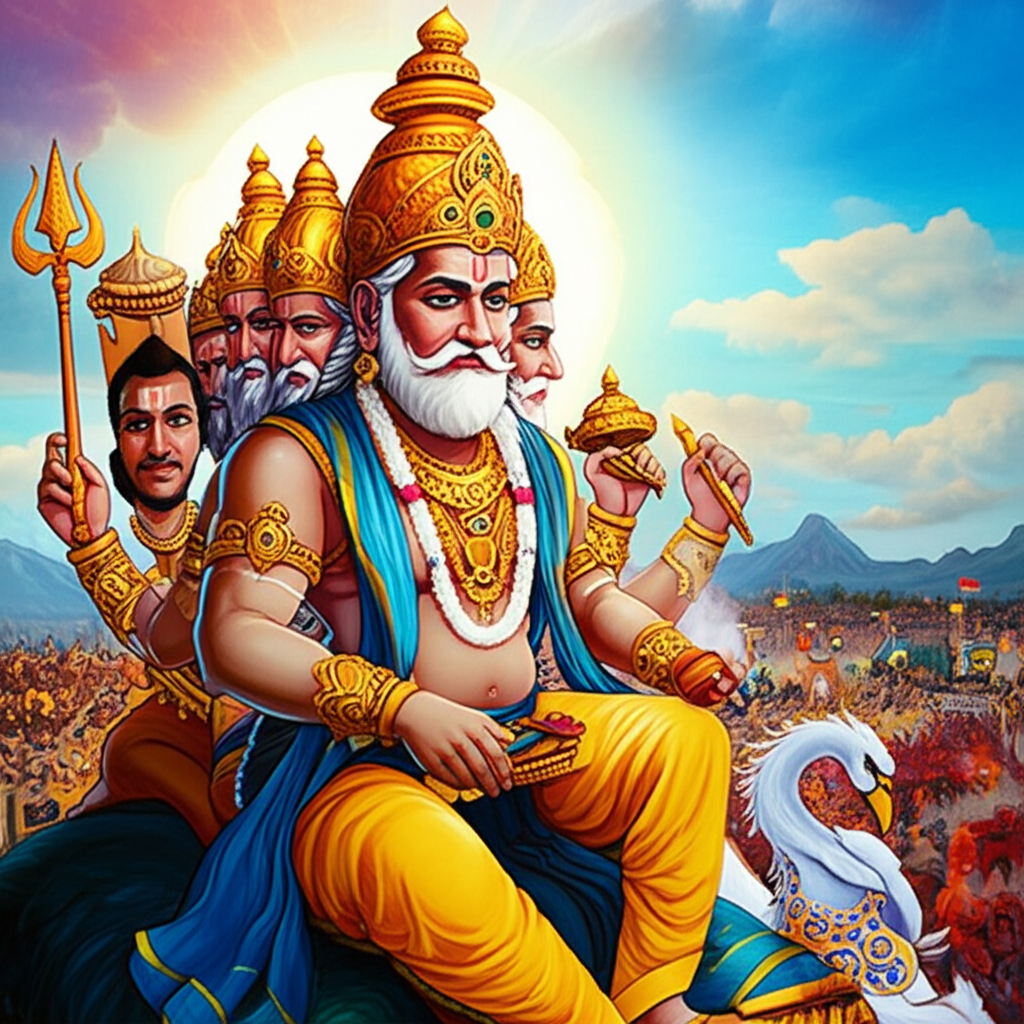
Introduction:
The story of Brahma and the War of Kurukshetra originates from ancient Indian mythology, specifically within the epic narrative of the Mahabharata. This tale, passed down through generations via oral tradition and later written Sanskrit texts, offers a glimpse into the worldview and moral framework of the people who crafted and cherished it. It is crucial to understand that this is a traditional story, a product of human imagination, and not a historical account or a reflection of divine truth.
Origins and Cultural Background:
The Mahabharata, the source of this particular narrative, is believed to have taken shape over centuries, with its core likely emerging sometime between 400 BCE and 400 CE. The society that fostered this epic was characterized by a complex social hierarchy, a strong emphasis on dharma (righteous conduct), and a rich tradition of philosophical and religious thought. Their understanding of the world was deeply intertwined with the natural environment and the cyclical nature of time. They envisioned a cosmos populated by gods, demigods, demons, and humans, all interacting within a cosmic order maintained by adherence to dharma. Events, both natural and human-caused, were often attributed to the actions and interventions of these divine or semi-divine beings. The concept of karma, the principle of cause and effect, played a significant role in shaping their understanding of human destiny and the consequences of one’s actions.
Character Description: Brahma
Brahma, within this mythological framework, is considered the creator god, the first member of the Hindu trinity (along with Vishnu, the preserver, and Shiva, the destroyer). He is often depicted with four heads, each reciting one of the four Vedas (ancient Hindu scriptures). He is typically seated on a lotus flower, which symbolizes purity and creation. He is also associated with knowledge and wisdom. Symbolically, Brahma represents the creative force of the universe, the potential for new beginnings, and the cyclical nature of creation and destruction. The four heads can be interpreted as representing the four directions, the four Vedas, or the four aspects of human personality. It is important to remember that these are symbolic attributes within the context of the myth, not literal representations of a divine being.
Main Story / Narrative Retelling:
The stage was set for the Kurukshetra War, a devastating conflict between two branches of the same family: the Pandavas and the Kauravas. The dispute centered on the rightful inheritance of the throne of Hastinapura. As tensions escalated and war became inevitable, both sides sought allies and blessings from powerful beings, including the gods.
Before the war erupted, sage Vyasa, the narrator of the Mahabharata, pleaded with King Dhritarashtra, the blind father of the Kauravas, to avoid the impending destruction. Vyasa possessed divine vision and could foresee the carnage to come. But Dhritarashtra, blinded by his affection for his sons, refused to heed the sage’s warnings.
Witnessing the impending doom, even the gods in their heavenly abodes were deeply concerned. The sheer scale of the impending bloodshed threatened to destabilize the cosmic order. Fearing the catastrophic consequences of the war, the deities, led by Indra, the king of the gods, approached Brahma in his celestial realm.
"O Brahma," Indra implored, "the earth groans under the weight of impending war. The Kurukshetra battlefield will soon be soaked in the blood of countless warriors. The balance of dharma is at risk. What must we do?"
Brahma, seated on his lotus throne, listened intently. He closed his eyes in deep contemplation, his four heads turning slowly as he considered the gravity of the situation. When he opened his eyes, his gaze was filled with a profound understanding.
"The war is inevitable," Brahma declared. "It is a consequence of the choices made by mortals, a working out of karma. I cannot prevent what is destined to be. However," he continued, "I can ensure that dharma prevails, even amidst the chaos. I shall guide the wise and protect the righteous. But I will not directly interfere in the conflict itself."
Brahma then summoned Saraswati, the goddess of knowledge and wisdom. He instructed her to guide Vyasa, the sage, to accurately record the events of the war. "Let the story of this conflict be a lesson for all future generations," Brahma commanded. "Let it serve as a reminder of the consequences of greed, envy, and the importance of upholding dharma."
Brahma also ensured that Krishna, an avatar of Vishnu, would play a crucial role in the war. While he would not wield weapons himself, he would act as the charioteer of Arjuna, the Pandava warrior. Krishna’s divine wisdom and guidance would be instrumental in helping Arjuna navigate the moral dilemmas of the battlefield and ultimately prevail.
Throughout the eighteen days of the Kurukshetra War, Brahma remained a silent observer. He did not directly intervene to alter the course of events. He allowed the consequences of human actions to unfold, but ensured that the story was recorded for posterity and that Krishna, the embodiment of righteousness, would guide the Pandavas towards victory.
Symbolism and Meaning:
The story of Brahma and the War of Kurukshetra is rich in symbolism. Brahma’s non-interventionist role highlights the concept of free will and the consequences of human choices. While the gods may observe and even influence events from afar, they ultimately allow humans to shape their own destinies. The story also underscores the importance of dharma and the cyclical nature of time. The war represents a period of great upheaval and destruction, but also an opportunity for renewal and the restoration of balance. The presence of Krishna as Arjuna’s charioteer symbolizes the divine guidance available to those who seek it and the ultimate triumph of good over evil. To the people of that time, the story likely served as a cautionary tale about the dangers of unchecked ambition and the importance of adhering to moral principles.
Modern Perspective:
The Mahabharata, including the role of Brahma, continues to be reinterpreted and adapted in modern literature, films, television shows, and video games. The epic themes of duty, sacrifice, and the struggle between good and evil resonate with contemporary audiences. Brahma’s role as the creator and silent observer is often explored in the context of existential questions about the nature of existence and the role of divine forces in human affairs. Scholars in cultural studies examine the myth as a reflection of ancient Indian society’s values, beliefs, and social structures.
Conclusion:
The story of Brahma and the War of Kurukshetra is a powerful example of the rich storytelling tradition of ancient India. It is a cultural artifact, a product of human imagination, and not a reflection of divine truth. As Muslims, we recognize that only Allah is the true Creator and Sustainer, and we attribute all power and glory to Him alone. The stories of other cultures offer us valuable insights into the human experience, the evolution of ideas, and the enduring power of storytelling. These narratives, while not aligned with our faith, provide a glimpse into the cultural heritage of others and can enrich our understanding of the world. It is through such cultural understanding and the appreciation of diverse narratives that we can foster respect and build bridges between different communities. We should always approach these stories with a critical and discerning mind, recognizing their symbolic value while remaining firm in our belief in the Oneness of Allah.